
Foreword
In the first installment of this series, “Power Politics Reborn: Realism as the Guiding Lens in a Tech-Driven Multipolar Era,” I laid out a broad framework illustrating how great-power competition, viewed through a realist lens, underpins today’s global realignments. Once a systemic shift in power disrupts the status quo, states adapt through measures such as decoupling, reshoring, and industrial planning. At the heart of that adaptation is each nation’s ability to transform innovation into profitable industries—an outcome grounded in robust techno-industrial ecosystems that reinforce geoeconomic clout. Far from introducing any new theory, I simply apply classic realism to emphasize how economic strength—built on tangible technologies and flourishing value chains—remains a decisive pillar of global influence.
Now, with this second article—“Back to Center Stage: China’s Resurgence under Realpolitik with Chinese Characteristics”—I shift attention to the actor perhaps most responsible for unsettling the U.S.-led unipolar order: China.
Why highlight China before turning to the United States? Because China’s rapid economic expansion, technological ambitions, and outward-focused strategies have presented the most formidable challenge to U.S. primacy. As China strives to reduce vulnerabilities in key value chains and elevate its industries across global supply networks, it has provoked strong American responses—ranging from tariffs and export controls to the buzzword of “derisking.” These moves by both Beijing and Washington reflect the reality that economic integration, once a cornerstone of globalization, now increasingly serves as a battlefield in great-power competition. In grappling with social and strategic fallout from deindustrialization, the United States is prioritizing industrial revitalization to remain competitive. China’s resurgence has therefore triggered a cycle of recalibration, prompting not just the U.S. but also other major players (including the EU) to negotiate new rules and power dynamics.
In this article, I examine China’s worldview—shaped by a sense of “national rejuvenation” following the so-called “Century of Humiliation,” and sustained by the conviction that economic might, technological mastery, and supply chain autonomy form the bedrock of national power. A realist perspective highlights how Beijing’s confidence in reshaping the global order coexists with pragmatic caution, mindful that a premature confrontation with the U.S. could jeopardize core objectives. At the same time, as Chinese industries climb the global value chain—particularly in AI, green tech, and advanced manufacturing—China’s competitors keep refining their own strategies, with real ramifications for trade flows, alliances, and industrial ecosystems.
Clarifying the Scope and Next Steps
This series aims to show how realism and power politics intersect with evolving technological and geoeconomic landscapes. Still, it does not claim to comprehensively address every nuance of China’s vast reality. My goal here is to identify pivotal drivers, offer informed interpretations, and explain why China’s ascent so profoundly influences ongoing geopolitical shifts.
I plan a follow-up article that will delve deeper into China’s dual circulation and the broader modernization puzzle—how Beijing aims to harmonize supply and demand, tap its vast domestic market, and further anchor itself at the core of global value chains. Because this present piece outlines China’s strategic direction from the founding of the PRC onward, it only briefly touches on the contradictions inherent in these next development phases. Internal social pressures, changing consumer patterns, and evolving partnerships all factor into the next stage. Recognizing China’s transformation as multifaceted—shaped by local interests, regional diversity, and leadership goals still in flux—this upcoming installment will examine the tension between China’s pursuit of world leadership and its need to reconfigure both internal and external growth models.
Linking Back to the Series
“Back to Center Stage” aligns seamlessly with the overarching themes introduced earlier. China’s rise has reshaped major-power interactions, driving states to reexamine value chains and rework security frameworks. Subsequent articles will focus on the United States and the European Union, each confronting its own historical path, strategic culture, and future ambitions. Through these region-specific lenses, I aim to illustrate how realism, in practice, spurs states to evaluate costs and benefits in a rapidly shifting environment of technological breakthroughs and geoeconomic rivalries.
Ultimately, these analyses are designed to spark reflection rather than prescribe sweeping policy. While each region’s outlook is informed by distinct cultures and constraints, the world remains inherently interdependent—decisions in one corner reverberate globally. By stressing these intricate interconnections, I hope to shed light on how states protect their near-term interests yet also shape collective stability and opportunity. I invite you to read on with an open mind about the multipolar transitions unfolding around us—and the pivotal role China plays in that evolving picture.
Introduction
China’s rise on the world stage is not an accident of economics but a deliberate, strategic project decades in the making. The Chinese Communist Party (CCP) leadership, steeped in lessons from history and guided by a realpolitik lens, has pursued national rejuvenation with patient determination. In Beijing’s view, power – economic, technological, and military – is the ultimate guarantor of sovereignty and security in a competitive international system. This analysis offers a deep dive into China’s grand strategy with a focus on its technological and industrial ascent. It examines how historical experience and cultural traditions shape the long-term vision of China’s leaders, how coordinated development policies advance the country’s comprehensive power, and how specific sectors like green technology, artificial intelligence (AI), and semiconductors are wielded as instruments of national strategy. Crucially, this review evaluates China’s choices through Beijing’s own strategic lens, treating its moves not as reactive responses to the West, but as proactive calculations aimed at restoring what China considers as its rightful place in a multipolar world. The throughline is a hard-edged realism: from Mao Zedong to Xi Jinping, Chinese leaders have shared core goals – strengthening the state, pursuing strategic autonomy and self-reliance, and amassing leverage – even as tactics evolved. Understanding China’s mindset on its own terms is vital to grasp the technological and geopolitical competition unfolding in the 21st century.
Historical and Cultural Foundations of Chinese Strategy
China’s strategic behavior today cannot be understood without reference to the weight of history and the depth of its civilizational philosophies. The Chinese worldview is informed by millennia of statecraft – a blend of Confucian ideals, Legalist power politics, and the bitter legacy of a “Century of Humiliation.” These factors shape the values and assumptions of China’s current leadership, molding a strategic culture that prizes patience, national unity, and the ruthless pursuit of strength.
Philosophical Legacies: Confucianism, Legalism, and Realpolitik
Two ancient philosophical currents – Confucianism and Legalism – have long guided Chinese governance and still echo in the CCP’s approach to power. Confucianism emphasizes social harmony, hierarchical order, and moral leadership. It envisions rulers as virtuous guardians of the people, legitimized by benevolence and cultural excellence. Legalism, by contrast, asserts that stability comes only from strong laws and state authority, rooted in a cynical view of human nature. Legalist thinkers like Han Fei Zi advised rulers to enforce strict discipline and wield power unsentimentally to secure the state.
Under President Xi Jinping, the CCP has consciously drawn on both traditions to buttress its rule. As one scholarly analysis notes, Xi’s regime explicitly invokes Confucian and Legalist ideas to legitimize highly centralized one-party control. Confucian rhetoric of “rule by virtue” is used to project an image of paternalistic responsibility, while Legalist themes of law and order justify harsh measures against any threats to stability. By tapping into these deep cultural veins, the Party claims a distinct “Chinese” model of governance, reinforcing “cultural self-confidence” in contrast to Western liberal ideals. In practice, this means that moralistic slogans and crackdowns on dissent go hand in hand. Xi frequently cites Confucius in speeches to stress unity and loyalty, even as his administration implements Legalist-style campaigns against corruption and dissent to tighten the Party’s grip. The fusion of these philosophies provides a time-tested playbook: ensure absolute authority at the top, maintain order through any means necessary, and present it as upholding societal harmony.
Notably, Chinese strategic thought has never shied from realpolitik. Even in dynastic times, emperors employed Confucian benevolence externally and Legalist statecraft internally – a duality often summarized as “Confucian on the outside, Legalist on the inside” (外儒内法). Contemporary China mirrors this. Outwardly, its leaders speak of peace and cooperation, but inwardly they calculate power balances with cold precision. Scholar Alastair Johnston’s research into Chinese strategic culture finds a consistent “parabellum” mindset – a propensity to prepare for and deter conflict – underlying the veneer of Confucian rhetoric. In short, the CCP’s heritage equips it with a deep toolkit of statecraft: ideological flexibility (pragmatism over purity), reverence for centralized authority, and a realist conviction that order comes from strength. These traits, rooted in Confucian and Legalist thought, continue to underwrite China’s grand strategy today.
The Century of Humiliation and National Rejuvenation
Layered atop ancient philosophy is the searing memory of China’s “Century of Humiliation” – roughly the period from the First Opium War in 1839 to the founding of the People’s Republic in 1949. During those hundred years, foreign imperial powers defeated China in war, forced unequal treaties, colonized parts of its territory, and reduced the once-mighty Qing empire to a fractured, semi-colonial state. This era of national trauma left an indelible mark on China’s collective psyche and on the CCP’s foundational narrative. It instilled a determination that such weakness and subjugation must never recur.
From Mao to Xi, Chinese leaders have portrayed the CCP as the historic agent that ended humiliation and began China’s revival. In a 2023 speech, Xi Jinping noted that since its founding, the Party “closely united and led the Chinese people… in working hard for a century to put an end to China’s national humiliation”. Under CCP leadership, he proclaimed, China transformed “from standing up and growing prosperous to becoming strong,” making the nation’s rejuvenation “historically inevitable.”. This narrative of redemption and resurgence is more than propaganda; it genuinely guides policy. The lesson learned is that only comprehensive national power can safeguard sovereignty. The humiliation discourse thus translates into a resolute emphasis on sovereignty, territorial integrity, and state dignity in Chinese strategy. In practical terms, it underpins Beijing’s hard line on issues like Taiwan, Xinjiang, Hong Kong, and the South China Sea – all seen as arenas where any concession could invite a return of foreign domination. “Never again” is the unspoken mantra.
The quest for “national rejuvenation” (民族复兴), a signature theme of Xi’s era, explicitly ties back to avenging the humiliations of the past. Xi’s hallmark Chinese Dream is essentially the dream of a strong China restored to its rightful status after a long historical eclipse. This entails not only wealth and military might, but also psychological security – being able to assert China’s interests without fear of foreign coercion. It is why, for example, Beijing is hypersensitive to foreign criticism of its human rights or political system: such criticism revives memories of past foreign “lecturing” and meddling. Sovereignty, in the Chinese formulation, means absolute non-interference by outsiders in China’s internal affairs. The national humiliation legacy also fuels a drive for self-reliance. The logic is straightforward – if foreign powers once exploited China’s weaknesses, then China must never be dependent on others for critical needs. This historical chip on the shoulder helps explain China’s immense investment in indigenous capabilities today, from defense industries to food security and advanced technology.
Crucially, China’s leadership does not frame its rise as an unprecedented “new” ascent but as a return to normalcy. As one analysis observes, the Chinese view their resurgence as a return to greatness from a century of decline, rather than a brand-new bid for dominance. This perspective breeds a strong sense of historical entitlement and patience. Unlike rising powers who lack past primacy, China sees itself as merely reclaiming a position it held for centuries in the pre-modern world – namely, the predominant power in Asia and a central actor globally. This restorative ambition carries deep emotional weight. It reinforces the CCP’s legitimacy at home (the Party delivered salvation) and shapes China’s posture abroad (it seeks respect commensurate with its heritage). The narrative of humiliation and rejuvenation drives home a strategic imperative: China must be powerful enough that no one can ever humiliate it again. In service of that goal, almost any sacrifice or effort is justified.
Box 1: Realism in Action—Contrasting 19th-Century Power Shifts Between East and West
Scope & Definitions
This case study explores how realism—the international relations theory that states prioritize survival and power—played out among Asian empires (Qing China, Tokugawa/Early Meiji Japan, and Mughal/Post-Mughal India) confronted with Western powers rising through industrialization. “Century of Humiliation” commonly references the period from the First Opium War (1839–1842) to the founding of the People’s Republic of China in 1949, during which Qing China faced a series of defeats and concessions to foreign interests. India, likewise one of the world’s leading economies by total GDP in the early 18th century, became a British colony. Japan, meanwhile, escaped a similar fate through rapid modernization following the Meiji Restoration (1868), enabling it to compete with Western powers.
Historical Overview & Key Milestones
- Pre-Industrial Balance (circa 1700–1800)
- Asia’s Leading Economies: According to estimates by economic historian Angus Maddison, China and India together comprised 40–50% of world GDP in the early 18th century. They were predominantly agrarian but had significant handicraft sectors (textiles, ceramics, etc.).
- Western Empires on the Eve of Change: European powers (especially Britain, France, and later Germany) were still in an emergent industrial phase, but about to undergo dramatic transformation due to technological advances.
- Industrial Revolutions & Western Surge (late 18th–19th century)
- Technological Leap: Steam power, mechanized textile production, steelmaking innovations, and modern transport (railways, steamships) propelled European (and later U.S.) economies to global dominance.
- Military Innovations: Rapidly advancing artillery, breech-loading rifles, and iron-hulled warships outclassed older Asian armies and navies, giving Western empires coercive leverage on distant shores.
- China & India Under Pressure
- Qing China: Entered the 19th century with a large share of global GDP but lacked modern industrial capacity. Repeated military defeats (Opium Wars, Sino-Japanese War) led to “unequal treaties” and territorial concessions.
- India: The Mughal Empire had been in decline since the early 18th century; the British East India Company progressively took control, culminating in the British Raj in 1858. By the end of the 19th century, India’s share in global GDP declined sharply, and it became a source of raw materials and a market for British manufactures.
- Japan’s Divergent Path
- Tokugawa Isolation: Japan maintained a near-sealed border policy (sakoku). Western “gunboat diplomacy,” notably by the U.S. Commodore Perry (1853), forced Japan to open select ports.
- Meiji Restoration (1868): Japan’s new leadership embraced rapid Westernization—adopting European-style militaries, bureaucracies, and industrial technologies. By the 1890s, Japan revised or ended many unequal treaty terms; by 1905, it had defeated Imperial Russia in war, signaling its arrival as a modernized power.
Key Metrics Illustrating East–West Power Divergence
- Global Manufacturing Shares
- China: Circa 1800: ~30% of world manufacturing; by 1900: <10% (varies by source).
- India: Circa 1750: ~24–25% of world manufacturing (especially textiles); by 1900: <3%.
- Britain: Rose from ~2% of global manufacturing output in 1750 to around 20–25% by 1870 (the “workshop of the world”).
- GDP Ratios & Population
- China & India: Held major shares of world GDP (40–50% combined in 1700), but by 1913, their combined share had fallen to ~10–15%, though they still accounted for a large proportion of global population.
- Britain & U.S.: By 1900, the U.S. and British economies outproduced entire continents, a direct product of industrial capacity and overseas colonial/market networks.
- Military/Technological Gaps
- Steam & Steel: By mid-19th century, Britain and France had steam-powered ironclads, rifled artillery, and advanced logistics; Qing China’s fleet was still largely wooden junks, and Indian principalities used outdated weaponry.
- Railways & Telegraph: Rapid deployment of these networks in Europe and North America exponentially improved troop movement and coordination. Japan adopted similar technologies post-1868, while China and India lagged under fragmented or colonial railroad systems.
- Paths to Modernization
- Japan: Between 1870 and 1910, industrial output soared, literacy improved, and new factories proliferated. By the early 20th century, Japan matched or exceeded some Western powers in steel tonnage and naval capabilities.
- Qing China & Colonial India: Internal strife (Taiping Rebellion, regional warlordism) and external subjugation (unequal treaties, colonial rule) hampered domestic efforts to build modern factories and armies on the same timeline.
Realist Interpretation
The comparison underscores a core realist premise: states that fail to keep pace in economic and military capabilities risk losing sovereignty or influence to more advanced rivals. Western powers, fueled by industrial revolutions, rapidly escalated their power, thus dominating under-industrialized states in Asia. Japan avoided the fate of China and India by pivoting to modernization in time to challenge Western empires—and, later, to pursue regional hegemony itself.
For China and India, the historical lesson is stark: having once held top positions in global GDP, they were dramatically outstripped by Western industrialization. China’s subsequent “century of humiliation” and India’s colonization exemplify the severe consequences of a relative power vacuum—outdated militaries and inadequate modernization left them vulnerable to imperialism. Japan’s divergence shows that states can alter their fate by rapidly adapting to new technological and industrial paradigms.
Uncertainties & Limits of the Data
- Historical Accounting: GDP estimates before the 20th century rely on incomplete records and varying methodologies (e.g., Angus Maddison’s reconstructions). Discrepancies arise from differences in data sources and definitions (e.g., what counts as “manufacturing” vs. “agricultural processing”).
- Underestimation of Informal Sectors: Traditional economies in China, India, and Japan featured substantial cottage industries that do not map cleanly onto modern manufacturing measures.
- External vs. Internal Decline: While Western encroachment was a major factor, internal fragmentation, social upheaval, and leadership choices also strongly influenced how quickly China and India lost ground—and how swiftly Japan rose.
- Counterfactuals: Even robust data on trade volumes or steel tonnage cannot predict how different policies—earlier rail development, deeper foreign alliances—might have changed outcomes in Asia. These metrics are proxies, illustrating the broader shift in power, but cannot fully capture qualitative aspects of governance, culture, and strategic decision-making.
Conclusion
Contrasting the trajectories of China, India, and Japan with contemporary Western powers in the 19th century highlights the realist imperative for states to remain technologically and militarily competitive—or risk subjugation. Despite large populations and significant wealth, both Qing China and Mughal/Post-Mughal India were overwhelmed by Western powers’ industrial might. By contrast, Japan’s Meiji-era modernization enabled it to stand as a near-peer competitor by the close of the century. For China today, these historical echoes of vulnerability motivate a relentless drive for technological and economic self-sufficiency—a rational, risk-aware response rooted in the painful lessons of the past.
The Communist Ideology and Leadership Values
While history and tradition influence China’s worldview, the Marxist-Leninist ideology of the CCP provides the organizational framework for its strategic action. The CCP is an avowedly Leninist party – centralized, disciplined, and convinced of its vanguard role. This translates into a leadership culture that values control, unity of purpose, and ideological loyalty. Over time, the CCP has blended its Marxism with Chinese nationalism and selective traditional ideas, forging a unique state ideology under leaders like Mao, Deng, and now Xi.
Xi Jinping Thought, the guiding doctrine of the current era, is often described as an eclectic synthesis. It “merges party-centric nationalism, Leninism, Maoism, Legalism, and Confucianism” into a Sinicized socialism that serves CCP rule. In practice, this means that Xi’s worldview is intensely Party-centric and power-centric. One of Xi’s oft-repeated principles is that “government, military, society and schools – east, west, south, north, and center – the Party leads them all.” The primacy of the CCP is non-negotiable; everything else, from economic reforms to foreign ventures, must reinforce the Party’s leadership. This reflects Leninist DNA – the state is an instrument of the Party, and maintaining internal cohesion is paramount. Dissent or pluralism are seen as existential threats (echoing lessons from the Soviet collapse, which Chinese leaders attribute to ideological laxity). Thus, CCP ideology molds strategic behavior by prioritizing regime security above all. Policies are crafted not only for external effect but also to shore up domestic stability and Party legitimacy.
A key aspect of CCP ideology is its long-term orientation. Communist ideology traditionally involves long-range historical thinking – the eventual triumph of socialism, etc. In China’s case, this merges with indigenous long-termism. From Mao’s era onward, Chinese leaders have issued expansive multi-decade visions (e.g. Mao’s vision of catching up to the West, Deng’s “three-step” development plan by mid-21st century, etc.). Under Xi, the CCP has set explicit centennial goals: by 2021 (100 years since the CCP’s founding) China should become a “moderately prosperous” society, and by 2049 (100 years of the PRC) China should be a “great modern socialist country” – essentially, a rich, powerful nation that is a global leader. Achieving these goals is framed as the Party’s historic mission. In Xi’s words, from now until mid-century, the central task is “to build China into a great modern socialist country in all respects and achieve national rejuvenation.”. This long-term mission-focus instills in Chinese policymakers a mindset of strategic patience and discipline. They are willing to work methodically over decades, avoiding rash moves that could derail their trajectory.
The values cherished by the leadership – discipline, patience, and holistic thinking – also derive from this ideological brew. Confucian influences reinforce respect for hierarchy and order; Leninist practice demands strict obedience and unity; nationalism provides the motivational zeal to overcome hardships for the motherland. The result is a leadership ethos that is calculating yet resolute. Chinese officials are trained to think in terms of comprehensive national power – a composite index of economic, military, technological, and institutional strength. Every major policy is evaluated for how it contributes to enhancing this comprehensive power and moving China closer to its rejuvenation. Chinese policymakers emphasize a long-term strategy, focusing on gradual, future-oriented progress rather than short-term political cycles. In sum, CCP ideology imbues the leadership with a strategic big-picture perspective, where short-term setbacks are tolerable if the long-term trend is upward. It also places a premium on self-reliance and resolve: as true Marxist believers in dialectical struggle, the CCP elite expects challenges and opposition, and values the ability to “struggle” through difficulties by relying on the Party’s own strength.
One cannot overlook Mao Zedong’s enduring influence on leadership values as well. Mao’s ideological legacy taught the Party to be revolutionary, independent, and unafraid of isolation. His dictum of “regaining initiative by daring to struggle” remains part of Party lore. Xi has in fact revived some Mao-era ideological campaigns (like urging Party members to remember the spirit of the Yan’an years, or launching rectification drives to enforce loyalty). The through-line is a belief that political willpower and correct line can overcome material disadvantages. This thinking reinforces China’s confidence in facing off against a materially superior U.S. in areas like defense or tech: the CCP mindset is that through mobilization, unity, and creativity, China can catch up and surpass competitors. Ideology thus serves as a force multiplier – rallying the nation around grand projects and stiffening resolve when encountering external pressure.
In summary, historical memory and ideological doctrines deeply shape China’s strategic calculus. Confucian and Legalist thought provide a native logic for authoritarian stability and pragmatic statecraft; the trauma of past weakness instills a drive for power and respect; and CCP Leninist ideology supplies the long-term, centrally coordinated approach to achieving those ends. Together, they forge a leadership perspective that sees the world through the lens of power politics and national destiny. Chinese leaders perceive global affairs as a Darwinian arena where only the strong prevail and where China must methodically gather the levers of strength. Patience, of course, is a virtue in this scheme – because time is on China’s side if it plays its cards well.
Strategic Patience and the Long View
A striking feature of China’s rise has been its strategic patience. For much of the past four decades, China increased its power cautiously, often quietly, avoiding direct confrontation even as it built formidable capabilities. This patience is not incidental; it reflects conscious strategic guidance from the top. Deng Xiaoping’s famous maxim – “hide our capabilities and bide our time, never seek to take the lead” – became the credo of Chinese foreign policy in the post-Mao era. Deng uttered these words as the Cold War waned, advising that China should remain modest abroad while focusing on internal development. The idea was that China needed a peaceful external environment to grow stronger, and it should not provoke a balancing coalition prematurely by flaunting its ambitions. Subsequent leaders Jiang Zemin and Hu Jintao largely heeded this “low-profile” strategy, emphasizing economic integration and “peaceful development” as China’s mantra.
The effectiveness of this approach is evident: for years, China benefited from globalization, attracted foreign investment and technology, and did not trigger severe counter-reactions, all while rising from a poor country into the world’s second-largest economy. Patience is ingrained in Chinese strategic culture partly via Confucian teachings (which value deliberation and restraint) and partly via realpolitik calculations. As long as the balance of power was unfavorable, it made sense for China to avoid risky assertiveness. Instead, it leveraged interdependence and the allure of its market to accumulate influence almost by stealth.
However, strategic patience does not mean passivity. Even during the “bide our time” years, China was steadily expanding its influence—joining and shaping international institutions, courting developing countries, and methodically modernizing its military. The patience was about timing and tactics, not abandoning ultimate objectives. Today, under Xi, China has become far more confident and assertive, indicating that its leadership believes the era of hiding is over. Xi Jinping has declared that China is now “moving closer to center stage” in world affairs. Still, the long-term orientation persists. Beijing thinks in decades, not months, when it lays plans for technological self-reliance or naval expansion. There is a prevailing sense that China can and will outlast Western democracies in strategic endurance. A frequently cited notion in Chinese discourse is that the West, especially the United States, suffers from short-term thinking and political cycle whims, whereas China’s one-party system allows it to plan to 2035, 2049 and beyond with continuity.
Chinese leaders also believe they are witnessing an irreversible power transition in the international system – one that they can navigate to their advantage if they remain steady. Xi Jinping and his strategists often speak of the current era as one of “great changes unseen in a century,” implying that the unipolar US-led order is breaking down and multipolarity is emerging. From Beijing’s perspective, this is an opportunity requiring strategic patience: if China avoids catastrophic conflict and continues strengthening itself, time and historical trends will weaken the U.S. position and elevate China. Strategic policy frameworks project China’s ascent to global prominence as part of its developmental trajectory, amid broader assessments of evolving international power structures. This confidence, noted by outside observers, reinforces patience – why take reckless action if one is on course to win by endurance? It also fosters a willingness to absorb short-term pain (like tariffs or sanctions) as temporary hurdles in a long game.
At the same time, patience has its limits, especially on core sovereignty issues. On Taiwan, for instance, Chinese leaders exhibit strategic patience (preferring eventual peaceful reunification) but also communicate that unification cannot be delayed indefinitely. They calibrate their actions (military drills, diplomatic isolation of Taiwan) to incrementally shift the status quo in their favor without triggering war – a patient salami-slicing approach. Yet Xi has tied resolving the Taiwan question to the rejuvenation goal, implying a determination to see progress on it by the 2049 timeline. Thus, even patience is bounded by the larger historical mission the CCP has set.
In sum, China’s long view manifests as gradualism in execution but boldness in vision. The state may spend years perfecting a technology or establishing footholds in global markets before unveiling its strength. It is a strategic tradition that values sequential advancement – achieve one level of development, then proceed to the next, each step building on the last. This is reminiscent of ancient Chinese wei qi (Go) strategy: encircle and accumulate advantages patiently until the balance tips decisively. By internalizing this approach, Chinese policymakers attempt to avoid impulsive adventures and instead shape the environment over time. The result is a foreign policy that can appear inscrutable or enigmatic to outsiders, because its moves are often subtle or indirect, aimed at long-term effects rather than immediate wins.
As we shall explore, this strategic patience underlies China’s methodical pursuit of technological supremacy and economic security. While the West sometimes sees Chinese initiatives like the Belt and Road or industrial plans as sudden aggressive plays, they are in fact the product of long incubation and forward planning. Beijing’s grand strategy is akin to a marathon, not a sprint – and it is determined to set the pace.
From Mao to Xi: Evolution of Grand Strategy
China’s current grand strategy did not emerge overnight with one leader – it is the product of an evolution across successive eras of the People’s Republic, each building on the achievements and lessons of the previous. Since 1949, the PRC has had five paramount leaders (Mao Zedong, Deng Xiaoping, Jiang Zemin, Hu Jintao, and now Xi Jinping), and each has faced different internal and external environments. Yet running through their tenures is a continuity of core strategic objectives: preserving CCP rule, safeguarding sovereignty, and restoring China’s great power status. What has changed are the strategies and policies to pursue those objectives, adapting to circumstances and China’s growing capabilities. Tracing the arc from Mao to Xi reveals how China’s grand strategy has been refined and why today’s approach looks more assertive – it rests on the cumulative gains of prior generations.
Mao Era: Sovereignty, Survival, and Revolutionary Strength
Mao Zedong (1949–1976) laid the foundational security and sovereignty framework for the PRC. Emerging from a century of foreign domination and civil war, Mao’s primary strategic concern was to cement China’s independence and regain control over its territory. He succeeded in unifying most of historical China (integrating Tibet and Xinjiang, for example) and asserted sovereignty by intervening in the Korean War (1950–53) to repel U.S. forces from China’s doorstep. The Korean War victory – costly as it was – sent a clear message: the new China would fight to defend its core interests even against a superpower. This bravado shaped China’s strategic ethos of standing up to stronger foes when necessary. Mao famously declared that China would “not fear nuclear war” at a time when it lacked any atomic weapons; such rhetoric underscored a resolve to never bow again.
Under Mao, China’s strategy was also driven by revolutionary ideology. Aligning with the Soviet Union initially, Mao aimed to build socialist strength but soon split with Moscow, determined that China pursue an independent path (the Sino-Soviet split of the 1960s). Isolated with two superpower rivals (U.S. and USSR), Mao adopted a strategy of “leaning to one side” then switching: he balanced against the greater threat (Soviet Union) by rapprochement with the U.S. in the early 1970s. This geopolitical flexibility – shocking the world by the Nixon-Mao détente – showed that Chinese leaders would make pragmatic shifts to secure the nation’s position, ideology notwithstanding.
Internally, Mao focused on self-reliance (自力更生). Sanctions and embargoes in the 1950s taught China to develop its own industrial and defense base. Mao launched major projects to ensure China could produce strategic goods like steel, machinery, and eventually nuclear weapons (successfully tested in 1964) without outside dependence. The concept of “self-reliance” in strategic industries dates to this period. Mao’s era was tumultuous (the Great Leap Forward, Cultural Revolution) and economically damaging, but it forged the foundations of a sovereign state with basic industrial and military capabilities. Mao also ingrained a mindset of continuous struggle – politically and against foreign threats – which still influences China’s assertiveness under pressure.
In summary, Mao contributed the essentials of hard sovereignty: territorial integrity (except Taiwan, which remained unresolved), a nuclear deterrent, and a defiant national spirit. He demonstrated that China would sacrifice and endure hardship rather than submit – an attitude that bolsters China’s bargaining posture even today. However, Mao’s China was still relatively weak and poor; he achieved security but not prosperity.
Deng Era: “Reform and Opening” and Hiding Strength
Deng Xiaoping (1978–1989 as paramount leader, though he influenced into the 1990s) revolutionized China’s strategy by pivoting from class struggle to economic development as the national priority. Deng famously said “development is the hard truth” – recognizing that without economic and technological strength, China could never truly be powerful. Thus began the era of Reform and Opening Up. Deng’s strategic genius was in marrying a pragmatic internal strategy (market reforms to build wealth) with an external strategy of integration into the global order to access capital, technology, and markets.
Deng assessed that the global environment after the Cold War would be favorable for Chinese development – and that China should seize the opportunity. His guidance to “keep a low profile and never claim leadership” encapsulated his foreign policy: avoid ideological crusades, join international institutions, trade with all sides, and reassure the world of China’s benign intent. This approach was codified in the so-called “24-character strategy” attributed to Deng: “observe calmly; secure our position; cope with affairs calmly; hide our capacities and bide our time; be good at maintaining a low profile; and never claim leadership.” It was a prescription to not alarm the status quo powers while China rebuilt its strength. During Deng’s time and well into the 1990s, China indeed focused inward on economic growth, largely avoiding foreign adventurism.
Nonetheless, Deng was not shy about protecting core interests. He authorized China’s 1979 war against Vietnam (a brief but bloody punitive expedition) to check Soviet-aligned Vietnam’s influence in Southeast Asia – demonstrating a readiness to use force regionally. But he quickly refocused on development after, essentially compartmentalizing security actions so they didn’t derail the main mission of growth. Deng’s governance saw the beginning of China’s defense modernization (with a downsized but more professional military) and the pursuit of science and education as keys to power. In the early 1980s, forward-looking officials like Jiang Zemin (then a minister) stressed that information technology would be the “strategic high ground” of international competition and that China must catch up. Deng’s administration launched programs to boost science and technical training, sent students abroad, and courted foreign investors. This was the start of China leveraging globalization to enhance its national power.
A notable strategic decision by Deng was the handling of Hong Kong and Macau – negotiating their return from Britain and Portugal through the “one country, two systems” formula. Deng prioritized sovereignty recovery through diplomacy when possible (peaceful reunification), reserving force mainly for when negotiation failed (as with Vietnam or in facing down provocations like 1980s skirmishes in the South China Sea). Taiwan remained unresolved, but Deng opened indirect talks and proposed the one country, two systems model for a future peaceful unification – again taking a long view.
In sum, Deng’s era contributed economic power to China’s grand strategy and set the template of strategic patience. He shifted China from a mainly military-industrial concept of power to a broader, comprehensive national power concept that emphasized GDP growth, technological advancement, and stable foreign relations. Deng firmly subordinated military expansion to economic priorities (famously cutting military budget shares). This was not pacifism but prioritization: he understood that wealth is the foundation of strength. The legacy is that by the early 2000s, China’s economy was booming and interlinked with the world, providing the material base for the more assertive policies of later years.
Jiang Era: Integration into the Global Economy and Technological Catch-up
Jiang Zemin (1989–2002 as CCP General Secretary) inherited a China on the rise but facing post-Tiananmen sanctions and suspicion. Jiang’s task was to normalize China’s global relations and continue economic expansion, while firmly keeping the CCP in control domestically. He largely succeeded: the 1990s saw China join the global economy at unprecedented scale, culminating in accession to the World Trade Organization (WTO) in 2001. This integration was a strategic choice – by locking itself into global trade rules, China gained access to vast export markets. The wager was that the benefits to national power would outweigh the risks. Indeed, WTO entry turbocharged China’s export industries and manufacturing ascent, fueling double-digit GDP growth that financed other elements of national power.
Jiang’s era was also marked by major strides in science and technology development. China’s industrial modernization accelerated through strategic research initiatives: the 863 Program (launched 1986 for high-tech development) and the 973 Program (established 1997 for basic scientific research), which complemented the industrial priorities outlined in the 1995 Ninth Five-Year Plan. The government poured resources into expanding higher education and research institutes. Jiang himself, having a technocratic background, stressed the need to “catch up with advanced levels” especially in information technology. Under his watch, China built its first modern internet infrastructure and invited tech multinationals to set up shop, learning from them. By early 2000s, Chinese firms were emerging in telecom (Huawei, ZTE) and consumer electronics. Jiang thus presided over the incubation of indigenous tech capabilities that form the backbone of today’s innovation drive.
On the strategic front, Jiang continued the low-profile foreign policy but began to test China’s newfound clout in regional affairs. In 1997, during the Asian Financial Crisis, China notably did not devalue its currency (a responsible stakeholder move) and provided some support to neighbors, which earned goodwill. Jiang also pursued better relations with Russia (signing a partnership in 1996) and with ASEAN, laying groundwork for later regional influence. Militarily, the 1995–96 Taiwan Strait Crisis – where China conducted missile tests and the U.S. sent carriers – was a wake-up call. Jiang’s government accelerated military modernization after seeing the gap in power projection relative to the U.S. Still, the overall thrust was to avoid direct confrontation and focus on “comprehensive national power” accumulation quietly.
Importantly, Jiang’s era saw Hong Kong’s handover in 1997 and Macau’s in 1999, peacefully achieved, which boosted national pride and CCP legitimacy. It reinforced the narrative that China was shedding the last vestiges of humiliation (colonial enclaves) through patient negotiation, not war – a vindication of Deng’s approach. Taiwan remained tense (especially with pro-independence sentiment rising there), but China issued a white paper in 2000 reiterating a preference for peaceful unification while not renouncing force.
By the early 2000s as Jiang yielded to Hu Jintao, China had transformed into a major trade power with growing financial resources, a more modern military, and expanding diplomatic influence – all without fundamentally upsetting the global order. This was strategic success: China was stronger but not yet seen as a systemic threat by the West, which was preoccupied with the War on Terror. Jiang thus passed to his successor a country far more capable than a decade prior, and integrated enough to have stakes in the existing system.
Economic Might – From Backwater to Powerhouse
China’s GDP soared from virtually negligible levels under Mao to $17.8 trillion in 2022, second only to the U.S. Deng Xiaoping’s Reform and Opening (1978) ignited explosive growth – by 2001 (WTO entry) China was the “workshop of the world.” As the chart shows, China’s share of global manufacturing output surged from under 5% in 1990 to roughly 30% by 2020, eclipsing all rivals. Likewise, its share of world merchandise exports climbed from ~2% in 1990 to 14–15% today. These gains reflect deliberate policy shifts: Deng prioritized economic development over ideology, spurring double-digit growth in the 1980s–90s. WTO accession in 2001 then supercharged China’s export machine (note the sharp post-2001 rise). By Hu Jintao’s era, China surpassed Germany, Japan, and finally the U.S. to become the #1 manufacturing nation and trading power. Today under Xi Jinping, China produces one-third of global manufactures and 15% of world exports, up from almost nil decades ago – a dramatic elevation of economic clout.
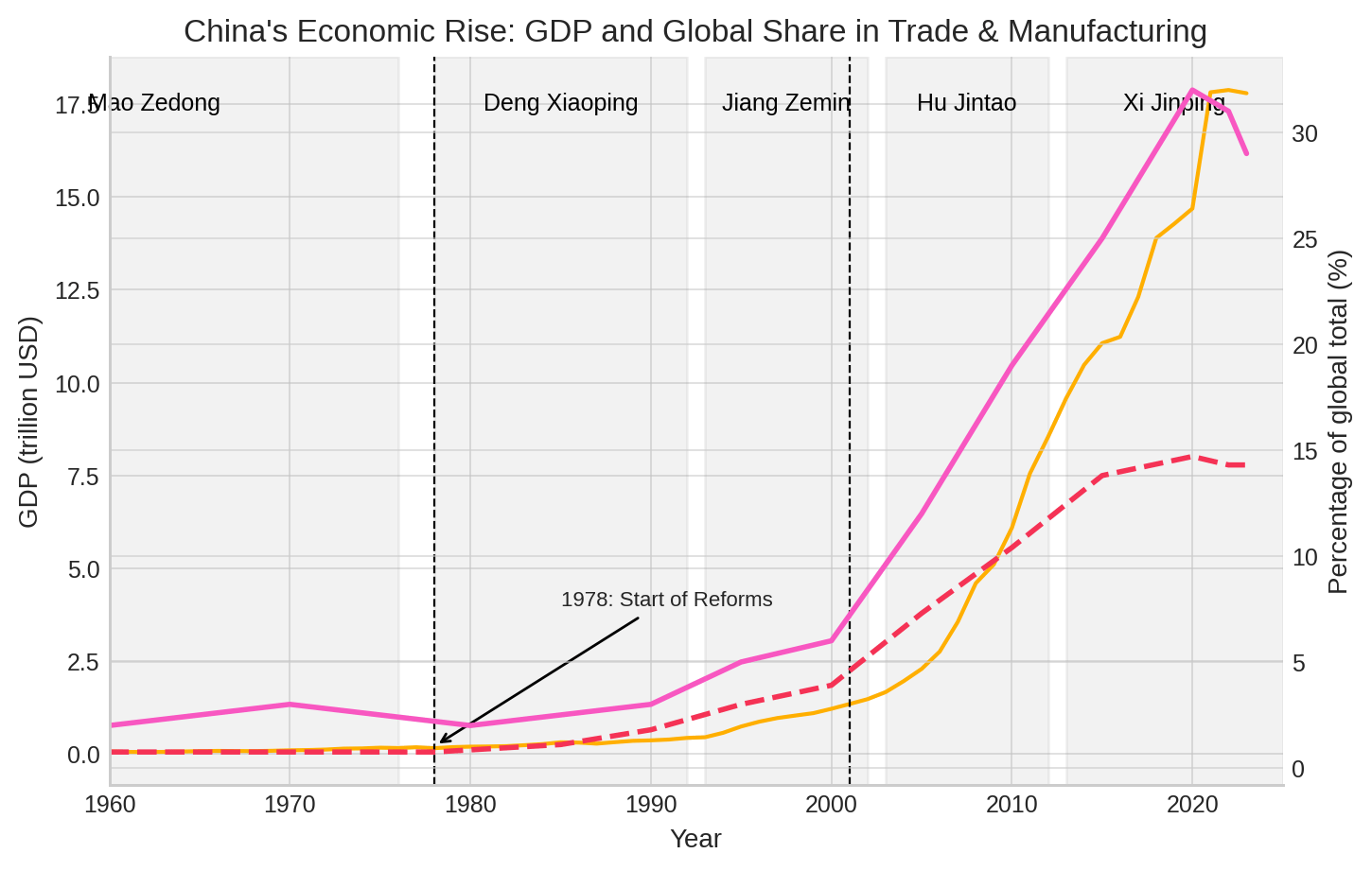
China’s Economic Rise across eras – GDP (yellow, left axis) vs. China’s share of world manufacturing output (pink, % right axis) and exports (red, % right axis). Major inflection points like 1978 (reforms) and 2001 (WTO entry) are annotated. Sources: ChinaPower Project – CSIS, World Bank.
Hu Era: “Peaceful Development” and Steady Assertiveness
Hu Jintao (2002–2012) presided over what was arguably the golden decade of China’s rise – a period of high growth, successful 2008 Beijing Olympics (signaling China’s arrival), and relatively calm external relations early on. Hu’s official line was that China’s rise would be a “peaceful development”, emphasizing that China sought a “harmonious world” with win-win cooperation. This slogan was aimed at assuaging fears of a “China threat.” Underneath the rhetoric, however, China under Hu became more proactive internationally as its power expanded.
Economically, China surpassed Japan in 2010 to become the world’s second-largest economy. It began investing abroad heavily (the “Going Out” strategy where state firms secured energy, minerals, and built infrastructure overseas). Hu’s government initiated the concept of the “Belt and Road” in embryonic form through infrastructure investments in Central Asia and Pakistan’s Gwadar Port, even though the BRI as a term came later under Xi. The idea that China could export capital and construction know-how abroad to gain influence took root in Hu’s time.
Technologically, Hu’s era saw massive expansion in innovation capacity. In 2006, China launched the National Medium- and Long-Term Program for Science and Technology Development (2006–2020), which set goals for becoming an “innovation-oriented society” and reducing reliance on foreign technology. This plan introduced targets for “indigenous innovation” and listed “strategic emerging industries” such as biotech, new energy, IT, etc., foreshadowing later initiatives. The 11th and 12th Five-Year Plans (covering 2006–2015) included these tech priorities. In effect, Hu’s administration institutionalized the drive to boost R&D, leading to China dramatically increasing its patent filings, academic research output, and the domestic tech industry’s capabilities. By 2012, companies like Huawei and Lenovo were globally competitive, and China had manned space missions and a burgeoning aerospace sector.
In foreign policy, while continuing a low-key posture generally, China under Hu did become more assertive after the 2008 Global Financial Crisis. Chinese leaders saw the crisis as a sign of Western weakness and a shifting balance. Hu’s second term (2008–2012) coincided with a more hardline stance on maritime disputes (e.g., more naval patrols in the South China Sea, incidents with Japan over the Senkaku/Diaoyu Islands). Some attribute this assertiveness to rising nationalism and the PLA’s growing clout, others to a calculated test of how far China could push as U.S. attention was divided. Still, Hu largely avoided direct military conflict and participated in global governance (such as G20 summits, climate talks) as a responsible major power. Hu also launched or joined multilateral forums like BRICS, projecting a vision of multipolarity and the Global South’s rise.
One conceptual contribution of the Hu era was the idea of a “Harmonious World” – calling for mutual respect and reform of the international system to be more equitable. This was in line with earlier multipolarity ideas championed by Chinese diplomats since the 1990s. Essentially, China was articulating a counter-hegemonic narrative softly: that the world should not be dominated by one superpower (the U.S.), but rather powers big and small should have a say (a thinly veiled reference to elevating China’s role). This set the stage for Xi to more bluntly assert a Chinese vision for world order.
To sum up, Hu Jintao’s era consolidated the fruits of Deng and Jiang’s strategies. China became wealthier, technologically stronger, and diplomatically more influential – to the point where it could begin setting the agenda in some areas. Continuity was evident in the emphasis on economic growth and stability, but change was seen as China started to flex its muscles in its near-abroad and to speak with a more confident voice on the global stage. By 2012, China had arrived at a level of power where the long-held goal of national rejuvenation seemed within reach. It was at this juncture that Xi Jinping took the helm and ushered in a new chapter.
Box 2: The 2008 Financial Crisis—A Strategic Inflection Point Emboldening China’s Global Posture
(How the West’s Financial Meltdown Accelerated Shifts in Power Politics)
Core Message
When the 2008 U.S.-centered financial crisis hit Western economies, China emerged comparatively unscathed and even maintained around 9% growth in 2009, aided by a ¥4 trillion (≈$585 billion) stimulus. This stark divergence prompted a fundamental shift in Beijing’s worldview: the once-lauded Western model of free-market finance showed deep vulnerability, emboldening China’s confidence in its own “state-capitalist” approach. From that point onward, Chinese leaders pursued greater assertiveness in global affairs—accelerating the timeline they had envisioned for China’s gradual rise and powering new initiatives (BRI, AIIB) that challenge U.S.-led frameworks.
Key Observations
- Systemic Western Weakness Unmasked
- Major banks collapsed under subprime and derivatives crises, shattering the myth of highly efficient Western financial regulation.
- Chinese elites saw “Western preachings” (fiscal discipline, liberalization) upended by bailouts and quantitative easing.
- China’s Divergent Crisis Response
- China’s ¥4 trillion stimulus stabilized its economy quickly, confirming to CCP officials the efficacy of strong state intervention.
- 2009–2010: While Western GDP shrank or stagnated, China recorded robust growth—fueling internal claims that “our system works.”
- Altered Timeline for Multipolarity
- Pre-2008, Chinese doctrine expected a slow, multi-decade shift in power balance. Post-crisis, Beijing accelerated external ambitions—perceiving a window to expand influence as the West struggled.
- Chinese officials openly questioned U.S. financial leadership, shifting from cautious integration toward selective revisionism (e.g. pushing yuan internationalization, forming parallel institutions).
- Assertive Policy Shifts
- Maritime claims hardened (South China Sea expansions in 2009–10), reflecting confidence that the West was too preoccupied to respond decisively.
- Economic governance: China began spearheading alternatives to Bretton Woods institutions—like the New Development Bank (BRICS), AIIB—offering non-Western nations new financing options.
Lasting Impact
- Deepened Skepticism Toward Western Models
- The meltdown’s self-inflicted nature reinforced China’s belief that Western-led rules are neither stable nor inevitable—justifying China’s own governance and “mixed-market” approach.
- Structural Reassessment of Global Finance
- The G20’s elevation to the ‘premier forum for international economic cooperation’ signaled a broader redistribution of global influence, though the G7 retained significant governing power in many domains. China strategically contributed to IMF bailouts while advocating for quota reforms that would better reflect its growing economic weight.
- Path to a More Confident Global Role
- Post-crisis, Beijing felt vindicated in demanding reformed or alternative orders, intensifying efforts to shape regional norms (Maritime Silk Road, RCEP) and reduce reliance on U.S. financial systems.
Conclusion
The 2008 crisis hammered the West and underscored China’s resilience, marking a strategic pivot from cautious integration to a bolder agenda. While the meltdown undeniably fast-tracked Beijing’s external ambitions, multiple factors (including decades of economic growth and existing dissatisfaction with Western frameworks) also shaped China’s evolving posture. Coupled with stable domestic support, Beijing leveraged the meltdown to expand its economic influence and adopt a more assertive global stance, convinced the Western financial model was far less unassailable than once believed.
Xi Era: National Rejuvenation and Global Ambition
Xi Jinping (2012–present) represents a culmination and a bold acceleration of China’s grand strategy. Xi’s leadership framework since 2012 progressively advanced national rejuvenation objectives, with the ‘Chinese Dream’ concept emerging early in his tenure and the formal ‘New Era’ doctrine institutionalized by 2017. Whereas previous leaders maintained a low profile, Xi has been far more forthright about China’s ambitions. He has concentrated power domestically, reasserted Party control over all sectors, and taken a more assertive stance abroad. This does not mean Deng’s patient approach is entirely discarded; rather, Xi appears to believe that China has accumulated enough strength to openly execute the later phases of its long-term strategy.
Under Xi, China launched a series of high-profile strategic initiatives. The Belt and Road Initiative (BRI), unveiled in 2013, is a flagship foreign policy project aiming to connect Eurasia (and beyond) through infrastructure and trade networks with China at the hub. Similarly, Made in China 2025, announced in 2015, established specific self-reliance targets for China in ten critical advanced manufacturing sectors by 2025. Xi also introduced the concept of “Dual Circulation” in 2020 to reshape the economy for greater self-reliance. These initiatives, which we will explore in detail, underscore Xi’s approach of proactively shaping China’s external environment and internal capacities to achieve major power status. Unlike the quiet achievements of past decades, Xi’s programs are explicitly branded and promoted, even if that invites pushback. Indeed, the Western backlash to “Made in China 2025” (viewing it as a threat to their industries) led Chinese officials to speak less about it publicly after 2018, though the policies continue.
Ideologically, Xi has tightened CCP discipline and revived strongman leadership not seen since Mao. He abolished term limits and enshrined “Xi Jinping Thought” in the constitution, elevating his personal authority. This centralization is intended to ensure unity as China navigates more contentious waters internationally. Xi emphasizes that the Party must control all levers – a return to Leninist firmness after a period of somewhat more collective leadership under Jiang and Hu. The effect has been a more coordinated and assertive pursuit of strategic goals, as bureaucracies and industries are pressed into serving national objectives (for instance, private tech firms are compelled to align with state tech ambitions).
One of Xi’s hallmark themes is self-reliance in key technologies. He has repeatedly exhorted China to become “self-reliant and strong in science and technology”, especially after seeing the U.S. impose tech sanctions. This drive for autonomy is consistent with the long arc from Mao’s self-reliance, but Xi is pursuing it in cutting-edge domains like AI, semiconductors, aerospace, and green tech through massive state-led efforts. Another focus is the military: Xi has undertaken the most sweeping military reform in decades, aiming to turn the People’s Liberation Army (PLA) into a “world-class force” by 2049. This includes reorganizing command structures, investing in power-projection capabilities (like aircraft carriers, cyber and space assets), and developing “assassin’s mace” technologies to counter U.S. strengths.
Xi’s foreign policy is far more assertive in defending what China sees as its core interests. This includes building militarized islands in the South China Sea despite an international tribunal ruling against China’s claims, applying economic coercion on countries that cross China’s political red lines (such as trade restrictions on South Korea, Australia, Lithuania in various disputes), and clashing with India along the Himalayan border. China’s diplomats under Xi even adopted a more confrontational tone, dubbed “Wolf Warrior” diplomacy, actively pushing back against Western criticism and promoting China’s narrative aggressively. All of these actions reflect a leadership that feels entitled and obligated to assert China’s interests commensurate with its increased power.
Yet Xi’s China still emphasizes that it does not seek outright hegemony or conflict. The official line is that China wants a “community of common destiny for mankind”, implying win-win cooperation and a multipolar world where no single country (implicitly, not the U.S.) dominates. In Xi’s talks with foreign leaders and multilateral forums, he often couches China’s rise as beneficial for global peace and development. This dual messaging – hard power moves on the ground, but benign rhetoric in speeches – is classic in great power strategy, keeping options open and trying not to galvanize a united opposition prematurely.
It is clear that Xi’s boldness builds on the platform established by predecessors. As one expert observed, despite surface differences, Xi’s rejuvenation strategy shows a “high degree of policy continuity” with earlier principles of centralized rule and state-directed development. The key institutions (Party control, state-owned economic pillars) are the same; what’s changed is that China now has the means to challenge U.S. primacy in ways unthinkable in Deng’s time. Xi’s task is managing this challenge. So far, he has shown a willingness to take higher risks – for example, Xi did not shy from a trade war with the U.S. when challenged, betting that China could weather the pressure better than expected.
As of the mid-2020s, Xi’s China is in a more openly adversarial stance with the West, especially the United States, which is imposing sweeping restrictions to contain China’s tech rise. We can interpret this as the inevitable strategic collision that China’s long ascent was preparing for. Xi appears to believe that this is the time to push through and not back down, lest China’s rejuvenation be stymied. The CCP under him conveys confidence that they can eventually prevail in a prolonged great-power competition. Indeed, Xi and Putin of Russia have together proclaimed that the world is witnessing “changes unseen in a century” and that they (China and Russia) are driving these changes. This hints at a perceived partnership to accelerate multipolar trends, splitting U.S. alliances and accessing resources, as strategic analysts observe that China’s Russia partnership serves both resource security and geopolitical competition objectives.
In conclusion, each era from Mao to Xi contributed building blocks to China’s grand strategy. Mao secured independence and instilled resolve; Deng brought economic might and patience; Jiang integrated China globally and pushed technology; Hu maintained momentum and cautiously expanded influence; Xi is capitalizing on all of it to make the final stride toward great power status. The continuity is seen in the unwavering pursuit of strength and sovereignty; the change is in China’s growing capacity and willingness to assert itself. Now with Xi at the helm, China’s strategy has entered a phase of active strategic competition – still calculating and long-term, but increasingly direct in challenging the U.S.-led order. China’s leaders see this not as a break with the past, but as the fruition of a 75-year quest to make China great again.
Strategic Coordination of National Development
Central to China’s rise has been the CCP’s ability to coordinate national development strategies in pursuit of power. Unlike many countries where economic policy, industrial policy, and foreign policy are compartmentalized, China tightly intertwines them under a holistic strategic framework. The engine of this coordination is a tradition of state planning and state-directed development, adapted to modern challenges. Through instruments like the Five-Year Plans, mega-initiatives such as Made in China 2025, and vehicles like state-owned enterprises and the Belt and Road Initiative, China orchestrates its economic growth, technological advancement, and overseas expansion in concert. The goal is straightforward: to systematically build the pillars of national power – industry, innovation, finance, infrastructure – and leverage them for geopolitical advantage. In this section, we unpack how these mechanisms function from China’s vantage point as rational means to compete in a realpolitik world.
The Role of Five-Year Plans: Guiding a Strategic Economy
Five-Year Plans (FYPs) are a legacy of China’s socialist command economy, but they remain vital today as blueprints aligning the nation’s development with strategic objectives. Each FYP (approved by the National People’s Congress) lays out priorities for economic and social growth, targets for key sectors, and major projects. In the reform era, the plans have shifted from rigid production quotas to indicative guidelines and strategic targets. Nonetheless, they signal the state’s direction and mobilize resources accordingly.
In the context of grand strategy, FYPs allow Chinese leaders to set long-term agendas and ensure policy continuity. For instance, starting from the 11th FYP (2006–2010) through the 13th (2016–2020), there was a clear through-line emphasizing “indigenous innovation” and nurturing high-tech industries. These plans recognized that to ascend the value chain, China had to reduce reliance on foreign technology and develop its own capabilities in areas like electronics, biotechnology, advanced materials, and aerospace. The 12th FYP (2011–2015) formally listed “strategic emerging industries” including new energy vehicles, next-generation IT, high-end equipment manufacturing, etc., which directly presaged initiatives like Made in China 2025. Thus, the seeds for China’s current tech drive were planted in successive FYPs years ago, illustrating the state’s habit of incremental but relentless planning.
A prominent example is the 14th Five-Year Plan (2021–2025), which reflects China’s response to a more hostile external environment. The 14th FYP elevates science and technology self-reliance as a “strategic pillar” of national development. It calls for breakthroughs in core technologies and specifically aims to achieve greater self-sufficiency in semiconductors, AI, biotech, and other frontier fields. The plan highlights a “growing urgency to protect China from external vulnerabilities” by reducing dependence on foreign tech and inputs. This was a direct reaction to events like the U.S. cutting off Huawei’s access to chips – the message: China must master these chokepoint technologies itself. The 14th FYP also formally incorporated the Dual Circulation strategy (more on that below), signaling a structural shift to bolster domestic economic loops to withstand decoupling or shocks.
We see, therefore, that FYPs act as vehicles for strategic adaptation. When global or domestic conditions change, new priorities are embedded in the plan, aligning the bureaucracy and industry with the leadership’s strategic intent. Because the plans cover five-year spans with outlooks often to 15 years (e.g., the 14th FYP document includes a vision for 2035), they bridge short-term actions with long-term goals. This disciplined planning culture – rare among large economies – gives China a way to marshal disparate efforts (provincial governments, SOEs, private sector) toward common targets like increasing R&D spending or achieving X% production of certain components at home.
From a realpolitik perspective, the FYP system is one of China’s advantages. It means the country can synchronize economic policy with strategic needs in a top-down fashion. For example, if leadership deems quantum computing critical for future security, they can incorporate that into the plan and suddenly funding, talent programs, and corporate incentives align to pursue it. Western commentators sometimes dub this the “whole-of-nation” approach, which can be formidable in rallying capabilities (albeit at the cost of some economic inefficiencies). Beijing sees this state-guided model as proven by China’s rapid ascent and as a necessity in competing with established powers. Chinese leaders invoking “concentrating forces” use an enduring socialist method that fuses central planning with market dynamics to unite government, industry, and research for strategic breakthroughs.
Made in China 2025: Climbing the Value Chain
No discussion of China’s coordinated strategy is complete without Made in China 2025 (MIC2025), the emblematic industrial policy initiative aimed at propelling China into the top ranks of advanced manufacturing. Launched in 2015, MIC2025 is essentially a roadmap for China to leap from being the world’s factory of low-tech goods to a technology powerhouse dominating high-value industries. It identified ten priority sectors, including advanced information technology, robotics, aerospace, marine engineering, new energy vehicles, power equipment, materials, biopharma, and more. The plan set specific benchmarks: by 2025, China intended to sharply increase domestic content in key components and materials (targeting 70% self-sufficiency in core components), and have Chinese firms achieve significant global market share in these industries.
From China’s perspective, MIC2025 is a rational strategy to avoid the “middle-income trap” and ensure national security. Relying on foreign suppliers for critical technologies (like semiconductors or aircraft engines) is seen as a strategic vulnerability – one that could be exploited by adversaries. Therefore, moving up the value chain and developing indigenous capabilities is about economic survival in the long run and strategic autonomy. Moreover, capturing high-tech industries is key to boosting productivity and incomes domestically; the leadership knows that China cannot prosper indefinitely on assembly-line labor and infrastructure spending alone. As such, MIC2025 was an offensive and defensive play simultaneously: build national champions in new industries to capture global markets (offense), and replace foreign tech in sensitive areas with homegrown versions (defense).
To Western countries, MIC2025 rang alarm bells because it openly signaled China’s intent to displace foreign competitors in cutting-edge fields. Beijing was somewhat caught off guard by the backlash. However, it’s important to frame MIC2025 in China’s own narrative. Chinese policymakers view industrial policy as a legitimate tool – after all, they point out, many of today’s rich countries used protection and subsidies in their own development phases. In the Chinese telling, the West enjoyed its decades of dominance in high-tech and now hypocritically wants to thwart China’s rise. Thus, pushing aggressively in advanced manufacturing is framed as restoring fairness and breaking Western monopoly, not malicious takeover. Internally, MIC2025 was promoted as the way to make “Chinese manufacturing” a mark of quality and innovation, not just low-cost mass production.
The implementation of MIC2025 involved massive state support. Government at central and local levels poured funds into research, provided subsidies and cheap loans to firms in target sectors, set up industrial parks and incubators, and facilitated acquisitions of foreign tech companies to gain know-how. A notable example is semiconductors: China invested tens of billions in domestic chip production since 2015, raising self-sufficiency from under 20% toward an initial 70% target by 2025, though current projections estimate ~30-35% amid technological hurdles and export controls. Similar pushes happened in electric vehicles (leading to many Chinese EV companies emerging) and renewable energy equipment (where Chinese firms already had a strong foothold).
By design, MIC2025 dovetailed with the Five-Year Plans. It was incorporated into the 13th FYP and continued in substance into the 14th, albeit less conspicuously termed due to foreign criticism. The core goals have not changed – in fact, they intensified under the pressure of U.S. sanctions. Beijing has effectively doubled down on the quest for tech independence, seeing MIC2025’s objectives as even more vital now that the U.S. is actively trying to lock China out of cutting-edge tech. One could argue MIC2025 succeeded in that it correctly foresaw the coming tech bifurcation and prepared China to some extent. Already by 2020, China had achieved significant progress in multiple MIC sectors: commanding the world’s largest high-speed rail network, leading global solar panel and battery manufacturing, and establishing Huawei as a major 5G equipment supplier despite market restrictions in several Western countries.
From a grand strategy lens, Made in China 2025 is the blueprint for building comprehensive national power in the industrial-technological domain. It coordinates with military modernization (many technologies like aerospace and AI have dual-use aspects) and with foreign policy (a technologically advanced China can wield more influence, e.g. offering its tech solutions to others). It also resonates with domestic politics – the narrative of becoming a cutting-edge economy boosts national pride and CCP legitimacy. Although external pushback forced Chinese officials to mention MIC2025 less, they have not abandoned it. They simply embed its aims into broader programs (like “manufacturing upgrade” in the 14th FYP). China mobilized roughly $300 billion in aggregate commitments by 2018 toward MIC2025-related sectors through multiple funding mechanisms, reflecting sustained industrial policy ambitions.
In essence, Beijing is executing what many late-developing powers attempted: a state-led surge to catch up and surpass incumbents in key industries. Historically, few have succeeded at the scale China attempts. But China’s leaders bet that with sheer market size (a billion-plus domestic consumers), huge talent pool, and authoritarian coordination, they can force their way into the top tier. If successful, MIC2025—together with its evolving successor policies— would not only make China rich; it would give it economic leverage worldwide (imagine global dependence on Chinese high-tech goods and standards, much as the world once depended on Western or Japanese tech). It’s a vision of economic dominance translating into geopolitical clout – which is exactly why they pursue it, and exactly why others resist it.
Dual Circulation: Hedging Against External Dependence
A more recent strategic concept is “Dual Circulation,” introduced by Xi Jinping in 2020. Dual Circulation is essentially an economic rebalancing strategy wherein China will “rely mainly on internal circulation” (domestic production, distribution, and consumption) while external circulation (exports and foreign investment) plays a supportive role. In simpler terms, it means boosting domestic demand and self-contained supply chains so that China is less vulnerable to external shocks or pressures. This strategy emerged as a response to the turbulent international environment – notably the U.S.-China trade war and tech sanctions – that exposed how over-reliance on foreign markets and technologies could be a strategic liability.
From Beijing’s viewpoint, Dual Circulation is a prudent hedge in a world where globalization is no longer seen as guaranteed or apolitical. By strengthening the domestic cycle of its economy, China aims to ensure that even if exports face barriers or if key imports (like semiconductors or energy) are cut off, the country can still sustain growth and development. The timing was telling: Xi first raised the idea in mid-2020 as the pandemic disrupted global supply chains and U.S. hostility toward China’s tech sector escalated. It was later codified in the 14th Five-Year Plan as a guiding principle.
Dual Circulation does not mean China is closing off its economy – rather, it’s about achieving a better balance. For decades, China’s growth leaned heavily on exporting to the West and importing high-tech inputs. Now, the leadership wants to cultivate robust domestic consumption to drive growth (so it’s not at the mercy of foreign demand cycles), and to develop domestic sources for key technologies and components (so it’s not at others’ mercy for supplies). Internally, this involves policies to raise household incomes, improve social safety nets (so people will spend more), and encourage innovation and local supply chain integration. Externally, China still seeks trade and investment, but in a way that complements the domestic loop – for example, attracting foreign companies to manufacture in China for the Chinese market, and pushing Chinese companies to climb up value chains in global markets.
Strategically, Dual Circulation aligns with the drive for self-reliance in critical sectors that we’ve discussed. It also connects to security concerns. For instance, energy security: China imports a lot of oil/gas; dual circulation would emphasize domestic energy production and renewables, plus diversified import partners, to avoid being strangled by a blockade. Or in finance: reducing reliance on the U.S. dollar system via promoting use of the RMB and developing Chinese financial institutions (so sanctions have less bite). It’s about creating an ecosystem where China can withstand decoupling attempts. As one analysis put it, the strategy aims to “reduce China’s vulnerability to external shocks” and hostile actions.
One concrete component is tech innovation as part of internal circulation. Under the dual circulation strategy, China seeks to boost tech innovation and help domestic firms advance up the global value chain. That means efforts like MIC2025 and the 14th FYP’s tech initiatives are integral to dual circulation – because achieving domestic loops requires having domestic tech. If China can make its own high-end chips, machines, and software, then its economy is far more self-sustaining. Dual circulation essentially provides the macroeconomic rationale to continue heavy investment in innovation and industry upgrade.
Another component is expanding domestic markets – which also has a global geopolitical angle. A China with a giant consumer market that is relatively self-sufficient and thriving can use access to that market as leverage. For example, in the future, foreign companies or countries may find the Chinese market so crucial that they are reluctant to cross Beijing politically for fear of losing access. We already see glimpses of this (e.g., how the prospect of Chinese retaliation can temper some governments’ actions). Thus, while on the surface dual circulation is economic, its success would translate into greater strategic autonomy and influence for China.
In Chinese official narrative, Dual Circulation is portrayed as a natural evolution given China’s growing domestic demand and a necessary adaptation to “changes in the international environment.” It’s framed positively – focusing on domestic development – rather than as an anti-West move. But implicitly, it is about de-risking on China’s terms: reducing one-sided dependencies while still benefiting from globalization where convenient. If Western decoupling cuts China off from some external circuits, China’s answer is to strengthen its internal circuit and find new external partners (for instance, leaning more on trade with ASEAN, Africa, Latin America, and Belt and Road countries to substitute some U.S./EU links).
The interplay of internal and external circulation is also worth noting. External circulation isn’t abandoned; it’s to be harnessed to improve the internal. For example, foreign tech firms might be encouraged to set up R&D in China (bringing knowledge internally), or Belt and Road investments external can secure resources (feeding domestic industry). Xi emphasizes making domestic circulation the mainstay, with external as complement – thus aligning global engagement tightly with national needs, rather than growth for growth’s sake.
Overall, Dual Circulation is a strategic recalibration ensuring that China’s economic engine can keep churning under adverse scenarios. It shows the leadership’s risk-awareness: after witnessing trade wars and pandemics, they are fortifying the country’s economic defenses. In the long run, if successful, it will give China a freer hand in geopolitical contests, less worried about economic blowback. It fits the realism of their approach – preparing the economy for an era of great power rivalry and less benign globalization, essentially future-proofing China’s rise.
State-Owned Enterprises as Strategic Actors
State-Owned Enterprises (SOEs) are the often-unseen warriors of China’s economic strategy. While private entrepreneurship has grown in China, the state-owned sector still controls the “commanding heights” of the economy, especially in industries deemed strategic or sensitive. These include energy, telecommunications, banking and finance, steel and heavy industry, construction, transport, and defense manufacturing – sectors that form the backbone of economic and national security. The CCP regards SOEs not just as commercial entities, but as extensions of state power that can be marshaled to serve national strategic goals.
The role of SOEs has evolved since the Mao era of absolute state control. In the 1990s, China reformed many SOEs, closing small inefficient ones and corporatizing large ones. But rather than full privatization, the strategy shifted to “grasping the big and letting go of the small” – the state kept control of large enterprises in key sectors and let smaller firms go to the market or close. By the 2000s, Beijing’s policy explicitly aimed to concentrate state ownership in pillar industries critical to development and security. This trend has continued under Xi, who emphasizes making SOEs “stronger, better, and larger” rather than reducing their footprint.
From a strategic perspective, SOEs serve multiple functions:
- Nationwide Infrastructure Builders: Chinese SOEs, like railway and construction companies, spearhead huge infrastructure projects (dams, rail networks, power grids) at home, which not only drive economic growth but also enhance national connectivity and resilience. They can also be directed to undertake projects abroad under the Belt and Road, effectively exporting China’s development model and extending influence. For example, state firms have built ports and railways in Pakistan, Southeast Asia, Africa, and beyond, often in coordination with Chinese foreign policy objectives.
- Champions in Strategic Industries: SOEs dominate sectors such as petroleum (Sinopec, CNPC), electricity (State Grid), telecom (China Mobile), and aviation (COMAC in aircraft manufacturing). Control here ensures China can secure energy and communication networks and push these giants to achieve national missions (e.g., discovering oil abroad or rolling out 5G nationwide swiftly). In technology areas, some SOEs or state-supported conglomerates are tasked with critical R&D. For instance, SMIC (semiconductor fab) while publicly listed, has significant state backing and is treated as a national champion to advance China’s chip self-reliance. The state can inject capital or facilitate mergers to boost competitiveness – such as merging smaller SOEs to create behemoths that can compete globally. The aim is to forge “national champions with a bigger global market share.”
- Policy Instruments for Stability: SOEs are often used to achieve macroeconomic and social stability goals. In downturns, they can be instructed to keep investing or maintaining employment even if profits suffer – a buffer against recession. Banks (mostly state-owned) can be guided to extend credit to priority projects or regions as needed. This flexibility gives Beijing economic levers in times of crisis that many market economies lack. The pandemic response and earlier stimulus after 2008 relied on state companies and banks to pump-prime the economy.
- Supporters of the Party’s Political Grip: Because SOE management is filled with Party appointees and they often report to government ministries, they are tools for the Party to maintain influence in the economy. Xi has reinforced Party committees inside SOEs to ensure they follow Party directives. This means if the Party needs them to prioritize a political objective (say, Xi’s poverty alleviation campaign had SOEs invest in poor areas), they will comply even at cost. Private firms might balk or lobby; SOEs execute.
Critics argue SOEs can be inefficient and crowd out more dynamic private firms. That’s a valid economic critique, but from the CCP’s strategic lens, control and capacity trump pure efficiency in critical arenas. The state sector guarantees that core parts of the economy remain aligned with national interests, not just profit. In effect, SOEs are weapons in China’s economic arsenal. For example, during trade disputes, China can impose regulations or informal pressure on its state importers to cut purchases from a target country (like reducing Australian coal or Canadian canola imports amid political rows), giving it coercive leverage. Similarly, state banks can help Chinese companies survive foreign sanctions by providing liquidity.
In the international expansion, Chinese SOEs often act as the vanguard of economic diplomacy. In Belt and Road projects, it is typically SOEs that negotiate deals and carry them out with host governments, with financing from state banks. This blurs the line between commercial and statecraft – exactly in the way Beijing prefers. Western governments sometimes complain about unfair competition, as Chinese SOEs can outbid others with subsidized financing and implicit state backing. But to China, that is a feature, not a bug: it’s deploying its state economic might to win influence and contracts. One study noted that SOEs are tasked with both economic and political objectives – the crux of reform is balancing those, not removing the political. The CCP has been clear that while it will make SOEs more market-oriented, they must remain under Party leadership and serve national goals.
Quantitatively, SOEs today account for 25% to 30% of China’s GDP, down from majority share decades ago, but in certain sectors their dominance is much higher (nearly monopolies in some utilities and transport). Their share of assets and profits in industry has actually ticked up in recent years, especially in strategic sectors, reflecting Xi’s policies. So the trend is a state sector resurgence after some decline in the 1990s-2000s. The push for “mixed ownership” (bringing in private investment in SOEs) has not diminished Party control; rather it’s sought to improve efficiency without ceding control.
In strategic terms, China treats its big state companies as instruments of national power projection and protection. They ensure China can stand on its own in vital areas (no foreign entity controls its electricity grid or its biggest banks) and can be wielded to shape international economics (through investment, pricing power – e.g., Chinese SOEs’ buying power can sway global commodity prices). When Xi talks about building a modern socialist power, part of that vision is world-class SOEs leading global markets and buttressing China’s independence.
Thus, from China’s vantage point, far from being anachronisms, SOEs are an integrated element of grand strategy – one that Western liberal models largely lack. The CCP sees merit in its system where capital obeys the state when needed. As global rivalry intensifies, Beijing likely feels vindicated in keeping a strong state grip through its enterprises, believing it makes China more resilient and formidable in a protracted great-power competition.
The Belt and Road Initiative: Geoeconomic Expansion
If China’s domestic planning and industrial policies lay the foundation for power, the Belt and Road Initiative (BRI) is the grand outward-facing strategy to extend that power across Asia, Africa, Europe, and beyond. Proposed by Xi in 2013, BRI (comprising the land-based “Silk Road Economic Belt” and the maritime “21st Century Maritime Silk Road”) seeks to finance and build infrastructure linking China with dozens of countries: railways, highways, ports, energy pipelines, power plants, telecommunications networks, and industrial parks. Officially, it’s billed as a win-win development scheme to promote connectivity and economic growth for all participants. Strategically, however, the BRI is a bold gambit for geoeconomic influence – using China’s financial and construction prowess to create a Sino-centric network of trade and investment, thereby anchoring other countries more closely to China both economically and politically.
From Beijing’s perspective, the BRI advances multiple strategic objectives simultaneously:
- Securing Supply Lines and Energy Security: One of the early motivations for the Belt and Road was to mitigate China’s “Malacca dilemma” – the fact that most of its oil imports passed through the chokepoint of the Malacca Strait under U.S. naval surveillance. By building overland pipelines from Myanmar and Central Asia, and developing ports in the Indian Ocean (like Gwadar in Pakistan) connected by roads to China, Beijing diversifies its energy import routes. In broader terms, new land corridors (China-Pakistan Economic Corridor, China-Central Asia-Europe rail) provide alternative logistics if maritime routes are threatened. This improves China’s strategic resilience in a conflict scenario.
- Exporting Industrial Surplus and Sustaining Growth: During the 2010s, China had excess capacity in steel, cement, and construction – the result of its own infrastructure boom. BRI projects abroad create demand for Chinese materials and allow Chinese construction SOEs to stay busy, effectively exporting China’s development model. This helps stabilize China’s economy by finding outlets for its industries. Moreover, as Chinese wages rose, offshoring some manufacturing to Belt and Road countries (while controlling the value chain) became advantageous – allowing Chinese firms to remain competitive and creating new markets for Chinese goods.
- Strategic Influence and Alignment: Chinese strategists see BRI as a way to shape the regional environment in its favor. By financing critical infrastructure in partner countries, China gains influence through economic relationships that vary widely across nations—creating mutual dependencies rather than uniform debt traps, as some critics argue, though in some strategic cases Beijing has secured significant advantages. This influence can translate into political support on issues important to China (e.g., backing China in the UN or on Taiwan/South China Sea positions). It also may dissuade countries from siding with the U.S. in any containment efforts. For instance, through BRI investments, China has deepened its ties with countries across Eurasia, the Middle East, and Africa, building a constituency for a more China-centric order. Chinese analysts describe BRI as achieving influence in Eurasia’s heartland while avoiding direct military confrontation with the U.S. – essentially, gaining ground in the geopolitical contest through economic means.
- Regional Stability on China’s Terms: Beijing argues that development leads to stability. In areas around China’s periphery prone to conflict or extremism (Central Asia, Pakistan-Afghanistan, Southeast Asia), BRI projects are seen as tools to bolster stability by boosting economies and connectivity. A more stable neighborhood reduces security threats to China (such as terrorism or refugee flows) and creates a friendly buffer. For example, investment in Pakistan’s infrastructure is partially aimed at stabilizing Pakistan (and indirectly Afghanistan) by improving its economy, thus protecting China’s western flank and its investments.
- Institutional Alternative and Leadership: BRI works through the China-controlled Silk Road Fund and the AIIB, where China is the largest shareholder yet maintains a multilateral structure, thereby boosting its influence with alternative standards to those of Western-led institutions. It’s a manifestation of China stepping into a global leadership role in development finance and governance, furthering the idea of a multipolar world with China as a central pillar. Successfully executing BRI bolsters China’s narrative that it can provide global public goods (infrastructure, investment) more effectively than the U.S. or former colonial powers did, thus deserving greater international stature.
Critics in the West label some BRI practices as “debt-trap diplomacy,” accusing China of luring countries into unsustainable debts to seize strategic assets (the oft-cited example being Sri Lanka’s Hambantota port, which China now leases for 99 years after Sri Lanka struggled with debts). Beijing denies any such intent, attributing problems to host country mismanagement or global economic fluctuations. Regardless of intent, the effect is that China sometimes ends up with long-term footholds – like port leases or mining rights – that have geopolitical utility. Some of the ports developed by Chinese firms could potentially support PLA naval logistics in the future (a point not lost on Indian or American observers). China also opened its first overseas military base in Djibouti in 2017, proximate to a key BRI shipping lane, underlining that strategic military follow-on can accompany economic presence.
Chinese officials outwardly emphasize BRI’s altruistic aspects – poverty reduction, South-South cooperation, “win-win” outcomes. But Chinese strategists writing internally are candid that BRI carries strategic weight. As one study of Chinese writings found, they see BRI strengthening China’s influence in Eurasia and helping it counter U.S. “encirclement”. They even frame it as a response to the U.S. “Pivot to Asia” – by expanding westward and globally, China dilutes any containment ring in the East. BRI thus is partly a geo-strategic countermeasure to U.S. alliances: instead of confronting militarily, China opens economic fronts across continents, creating a web of partners with vested interests in China’s rise. The strategic pivot toward “small and beautiful” projects represents a sophisticated evolution of this approach—making China’s influence more resilient to criticism and competition while preserving BRI’s core function as an instrument of economic statecraft that advances Chinese geopolitical interests through less contentious means.
Economically, should the BRI’s holistic strategy eventually realize its transformative potential, it could also reshape trade flows in China’s favor. Imagine a future where Eurasian trade increasingly goes by rail through China, where Southeast Asia’s infrastructures are all linked to China as the hub, and where standards (like railway gauges, telecom protocols) are set by Chinese companies. This “Sinocentric globalization” would mean China not only participates in global trade but steers it, making others more dependent on access to China-led networks. That is a long-term vision of economic leadership via infrastructure connectivity.
In sum, the Belt and Road Initiative exemplifies China’s approach of using its economic tools to achieve strategic ends. It leverages China’s strengths (capital, construction expertise, state enterprises) to lock in long-term advantages: secure corridors, resource access, diplomatic goodwill, and strategic presence. It is arguably the grandest strategy of economic statecraft in modern history, spanning over 140 countries who have signed onto some form of BRI cooperation. For China, it is a masterstroke to convert economic surplus into political influence. As a Chinese proverb goes, “If you want to get rich, build roads first.” With BRI, China is building the roads – literally and figuratively – to becoming the central node of global power in the 21st century.
Synthesis: An Integrated Power-Building Approach
What becomes clear is that China’s various strategic initiatives – Five-Year Plans, MIC2025, Dual Circulation, SOE reform, BRI – are not isolated policies but interlocking pieces of a grand puzzle. They complement and reinforce each other under the Party’s overarching strategy. For example:
- The Five-Year Plans set the vision and benchmarks for national strategic priorities like innovation and self-reliance. They inform and operationalize key programs such as Made in China 2025 and Dual Circulation, providing the bureaucratic mechanism to transform strategic concepts into actionable policies with specific targets and cross-ministerial mandates.
- Made in China 2025 and tech-driven goals feed into Dual Circulation by creating the domestic capabilities that reduce external dependence. Achieving semiconductor self-sufficiency or EV dominance strengthens the “internal circulation” of China’s economy, while also giving it leverage in “external circulation” by supplying the world with Chinese tech products.
- Dual Circulation in turn complements BRI. A stronger domestic economy and innovation base allow China to invest overseas confidently and export competitive products and standards. Simultaneously, BRI’s securing of resources and new markets loops back to support domestic circulation – for instance, ensuring China has inputs (oil, minerals) and outlets (markets for high-speed trains or 5G networks) to sustain growth.
- SOEs are the connective tissue in this integration. They execute Five-Year Plan projects, drive MIC2025 industries (many high-tech firms, like in aerospace or telecom, are state-influenced), carry out dual circulation adjustments (state banks boosting domestic lending; energy SOEs pivoting to domestic sources), and are the primary implementers of BRI abroad. The Party uses SOEs as the vehicle to transmit domestic strategic intent globally.
- Finance and currency strategy also play a role: China is slowly promoting the yuan internationally, especially in BRI trade and loans, which could reduce reliance on the dollar (a vulnerability). Developing a robust financial system at home, with capital markets directed by the state, helps fund big projects and buffer against external shocks – aligning with dual circulation’s protective aims.
In essence, China has a comprehensive strategy leveraging all facets of national strength in a coordinated way – what some in China call a “whole-of-government” or even “whole-of-society” approach. There is a conscious attempt to synchronize economic might, technological development, and diplomatic outreach to serve the singular goal of enhancing China’s national power and security. This is rational from a realpolitik stance: each element covers for the weaknesses of another and multiplies overall strength. For instance, technology self-reliance (MIC2025) guards against foreign economic coercion, while BRI diversification guards against strategic encirclement. Together they broaden China’s strategic latitude.
Western analysis sometimes criticizes parts of China’s approach as mercantilist or coercive, but from China’s vantage point it is defensive and prudent. The leadership has studied how the U.S. used its economic dominance to further geopolitical ends (e.g., sanctions, control of global finance, shaping norms via institutions) and how the Soviet Union failed by neglecting its economy. They intend not to make the same mistakes. So they build an integrated set of tools: a resilient economy that can’t be easily crippled, a technological base that others can’t blackmail, a global network of partners to offset Western blocs, and a state apparatus that can coordinate these tools effectively. The ultimate aim is to maximise China’s autonomy and influence in a system still partly dominated by the U.S. – to effectively beat the U.S. at the power game by excelling in both the economic and political domains.
Critically, this integrated strategy is long-term. Five-Year Plans look to 2035, BRI projects are envisioned to last decades, and the “centenary goals” run to 2049. There is a patience in execution but urgency in preparation. Beijing wants all key pieces in place before any potential showdowns (military or economic) with rivals. Xi often speaks about “preparing for struggle” and ensuring China is ready for worst-case scenarios. The systematic strengthening of all pillars – economic, technological, military, diplomatic – through coordinated policies is essentially future-proofing China’s rise. It reflects a belief that comprehensive national power, not just military or not just economy, but the total package, will determine the victor in great power competition.
In conclusion of this section, the strategic coordination of China’s development is one of its greatest strengths. It stems from the CCP’s centralized authority and ideological commitment to long-term goals. While not without inefficiencies or excesses, it has enabled China to leap in a few decades from a position of weakness to near-peer status with the United States on several fronts. China views these strategies as rational responses to its historical vulnerabilities – a way to ensure it will never again be at someone else’s mercy. By integrating development and strategy, China is effectively weaponizing its modernization – turning economic and technological progress into instruments of national power. This coordinated ascent is a core reason why China’s rise presents such a formidable challenge to the existing global order.

Historical Lessons Shaping Contemporary Strategy
As China navigates its path to great power status, it continually mines the lessons of history to inform current decisions. The collective memory of past events – triumphs and traumas alike – deeply influences how Chinese policymakers perceive today’s challenges and choices. In many ways, China’s strategic behavior is a running dialogue with its own history: avoiding past pitfalls, avenging past slights, and emulating past successes. This section examines several key historical reference points and how they shape China’s actions now, from an unyielding stance on sovereignty to cautionary lessons about internal decay and external overreach.
“Never Again”: Sovereignty and Territorial Integrity
Few principles are as sacrosanct to China as defending its sovereignty and territorial integrity. This zeal is rooted in the so-called Century of Humiliation, when foreign powers carved China into spheres of influence and seized territories. The Opium Wars (1839–42, 1856–60) led to the loss of Hong Kong to Britain and various concessions to Western nations. Later, Japan’s invasion in the 1930s and occupation of Chinese lands inflicted further national trauma. These episodes taught Chinese leaders that territorial weakness invites aggression. Consequently, modern China is hyper-vigilant about even perceived infringements on its territory or unity.
The fixation on Taiwan, Tibet, Xinjiang, Hong Kong – all parts of China that have at times been outside Beijing’s full control or under different governance – stems from this historical sensitivity. The CCP portrays itself as the regime that reunited China (ending civil war and warlordism) and will complete reunification (with Taiwan) to erase the last vestige of humiliation. The Taiwan question is especially fraught. Taiwan was ceded to Japan in 1895 after China lost the First Sino-Japanese War – a humiliation the Qing empire never recovered from. The CCP sees Taiwan’s continued separation (since 1949) as both a lingering civil war issue and a historical injustice kept in place by foreign interference (mainly the U.S.). The lesson from history is that foreign powers have used Chinese territories as footholds to constrain China. Thus, reabsorbing Taiwan is not only about nationalist sentiment; strategically it would remove the biggest potential platform for U.S. military pressure close to China’s coast. Xi Jinping has tied resolving Taiwan to the rejuvenation goal and warned that the Taiwan issue cannot be passed down indefinitely. The CCP’s legitimacy is partly staked on eventually “correcting” this historical anomaly.
Similarly, in the South China Sea, China’s assertiveness in claiming islands and waters (within the “nine-dash line”) is colored by a historical narrative: these were areas controlled or used by Chinese empires, and during the weak Qing and Republican eras Western and Japanese expansion encroached there. Chinese textbooks recount how European colonial powers seized ports in Southeast Asia and how Japanese expansion threatened South China Sea lanes. Today’s militarization of artificial islands and refusal to cede claims even after an unfavorable international arbitration (2016) reflect a determination to not lose another inch of what China considers historically its territory or maritime rights. Chinese officials often say their actions are defensive – reclaiming rightful ownership and preventing a repeat of past foreign domination of adjacent seas.
Another lesson was drawn from the Korean War (1950–53): when China intervened to push back U.S./UN forces from its border, it signaled that China would defend its immediate sphere at great cost. That war is remembered in China as the “War to Resist America and Aid Korea.” The takeaway was that showing resolve early can deter greater threats later. It’s arguable that this memory informs China’s current strategy of pushing back U.S. surveillance or naval operations near its coasts – to enforce red lines and deter further encroachment.
Even beyond territory, sovereignty for China means freedom from foreign political influence. The memory of colonial powers imposing extraterritoriality (foreigners exempt from Chinese law in treaty ports) means China now bristles at things like foreign NGOs, Western media criticisms, or any suggestion of “internationalizing” its internal issues. For example, when countries comment on Xinjiang’s human rights, Chinese leaders see echoes of past colonial powers using missionary or humanitarian pretexts to penetrate China. Their response is often angry denunciation and punitive economic measures (as seen with sanctions on European entities that criticized Xinjiang). The message: China’s internal affairs are off-limits, a stance rooted in a historical pledge of “never again will foreigners dictate terms to us.”
In practical terms, this history-driven stance translates into inflexibility on core sovereignty matters. It is why compromise on Taiwan’s status or South China Sea claims is exceedingly hard for Chinese leaders – to them, compromising under pressure would be repeating the Qing dynasty’s mistakes of yielding to foreign demands, which led to a century of subjugation. Thus, historical memory fuels a risk-tolerant approach: China appears willing to endure significant diplomatic fallout, economic sanctions, or even military risks to uphold what it views as sovereignty. For instance, despite international condemnation and U.S. trade measures, Beijing went ahead with imposing a stringent national security law on Hong Kong in 2020, effectively ending the One Country, Two Systems freedoms earlier than promised. From China’s view, Western support for Hong Kong protesters was an unacceptable infringement reminiscent of imperial meddling, and moving decisively was necessary to prevent a repeat of how external forces once peeled away Chinese territories.
In sum, the motto “never again” underpins China’s hard line on anything touching territorial integrity or domestic governance. History taught the painful price of weakness and division, so modern China’s strategy is to project strength and unity on these issues at all costs. Internationally, this is where China is least compromising and most willing to confront others, because it taps into existential historical identity. The CCP has built its nationalist credentials on healing historical wounds; it cannot allow new ones or leave old ones festering by appearing weak. This perspective makes some conflicts (like over Taiwan) especially perilous, as Beijing’s historical resolve can clash with current U.S. commitments – a recipe the leadership tries to manage by building deterrence (military and economic) strong enough to dissuade adversaries from testing China’s red lines.
Box 3: The South China Sea Dispute—Conflicting Narratives and Historical Legacies
(Why China Challenges “International Norms” Seen as Imposed by Foreign Powers)
Core Disagreement
China claims vast maritime zones (the “nine-dash line”) based on centuries of perceived cultural ties and historical presence. Western-aligned neighbors cite modern treaties—especially UNCLOS—that narrowly define territorial seas and EEZs. Beijing views these rules as rooted in eras when China lacked a voice in global negotiations.
Chinese Perspective
- Asserts “historic rights” predating modern maritime law.
- Believes colonial-era treaties and Western-drawn conventions don’t reflect China’s cultural/historical context.
- Cites Sino-centric tradition where smaller states recognized China’s regional authority.
International Norms
- UNCLOS sets codified baselines and EEZ limits, widely accepted by global maritime powers.
- The 2016 arbitration ruled against China’s sweeping claims, but Beijing rejects this as ignoring its historical sovereignty.
Rationale for China’s Stance
- Postcolonial Reinterpretation: Sees current laws as products of Western dominance.
- National Legitimacy: Reclaiming “lost” territory resonates with domestic audiences.
- Strategic Interests: Fisheries, hydrocarbons, and controlling key shipping lanes boost China’s “blue-water” navy ambitions.
Why It Matters
China’s push defies recognized maritime norms, stoking tensions with Southeast Asian claimants and the U.S. over “freedom of navigation.” Yet Beijing insists it is reasserting historical boundaries neglected by Western-imposed frameworks—illustrating a deeper clash between postcolonial narratives and a treaty-based international order.
The Collapse of the USSR: A Cautionary Tale
While foreign humiliations shape China’s external posture, the collapse of the Soviet Union in 1991 looms large as a cautionary tale for the CCP’s domestic and strategic thinking. The disintegration of the USSR was a watershed that Chinese communists studied intensely, determined to not follow the same fate. Several critical lessons were drawn:
First, the CCP concluded that the Soviet Communist Party fell apart due to ideological laxity and loss of political control. In Chinese analyses, Soviet leaders like Gorbachev allowed “bourgeois liberalization” – loosening Party grip, introducing glasnost (political openness) and multi-party elements – which eroded the ideological unity and authority of the party. Xi Jinping has explicitly warned cadres about this, saying the Soviet collapse happened because “nobody was man enough to stand up and resist” reforms that undermined the Communist Party, and because the party’s ideals had been shaken. Therefore, one-party rule must be guarded firmly. This is a key reason Xi has cracked down on internal dissent, tightened censorship, and revived Marxist study campaigns: to avoid any ideological decay. It also explains China’s aversion to political reforms that some in the West hoped economic growth would bring – the CCP sees the Soviet path as evidence that introducing Western-style democracy leads to national ruin.
Second, the Soviets over-prioritized the military and heavy industry at the expense of consumer economy and were stuck in stagnation. Deng Xiaoping already recognized this in the 1980s, which fueled his push for economic reform. The eventual Soviet collapse confirmed to China that economic vitality is the bedrock of national power and public support. Hence, the CCP has been relentless in pursuing growth and now innovation – they view a strong diversified economy as insurance against collapse. It’s also why even as Xi has tightened the political sphere, he hasn’t returned to a Mao-era command economy; the market and private sector are still crucial to keep the economy dynamic (within limits). The Chinese leadership, learning from Soviet shortcomings, strives for a more adaptable economic model – blending market mechanisms with Party control – to avoid stagnation.
Third, national unity and handling of ethnic regions is a lesson. The Soviet Union fragmented along national republic lines once central power waned. China, with its own ethnic minority regions (Tibet, Xinjiang, Inner Mongolia, etc.), saw how dangerous separatism can be. This has made Beijing double down on integrating minorities and their regions tightly with the Han core and stamping out separatist sentiments. The heavy-handed assimilation campaigns in Tibet and Xinjiang (e.g., vocational education and training centers, national language education) are partly motivated by the fear of a Soviet-style breakup. The lesson was: never allow sub-national identities or local leaders to threaten the unity of the state. So, China suppresses any hint of separatism and extremism with an iron fist, and invests massively in those regions’ development to bind them economically to the rest of China.
Fourth, in foreign policy, the USSR’s collapse ended the bipolar order and left the U.S. as sole superpower. China’s takeaway was to avoid direct confrontation until it could build enough strength (hence the continuation of Deng’s low-profile stance through the 90s). But also, the 90s showed how unchecked U.S. power could dominate international norms – with events like NATO’s intervention in Yugoslavia (1999) being a case study. China was outraged by NATO’s bombing of Serbia (and the accidental bombing of the Chinese embassy in Belgrade) and saw it as evidence that the U.S. would act militarily without UN approval. The lesson was that a weak country can be attacked or dismembered (Serbia losing Kosovo) under a U.S.-led order. This reinforced China’s resolve to rapidly modernize its military and enter global governance to have a say. It also fed China’s narrative that U.S. hegemony is dangerous and must be checked by building a multipolar world – a notion guiding Chinese diplomacy in the new century.
Fifth, nuclear deterrence lessons: The USSR’s collapse was peaceful partly because Russia inherited the nuclear arsenal and no power tried to invade a nuclear-armed state. For China, having nuclear deterrence is non-negotiable. It must maintain a credible nuclear second-strike capability to ensure effective retaliation even after a potential first strike. By developing mobile ICBMs and nuclear submarines, China establishes a flexible and survivable nuclear deterrent. In contrast to the Soviet Union, which engaged in an economically unsustainable arms race, China adopts a more strategic approach. It seeks to build a robust nuclear capability efficiently and without overextending its resources, all while firmly rejecting any perception of nuclear inferiority.
Finally, the Soviet collapse illustrated the importance of Party adaptability and anti-corruption. The CCP observed that the Soviet party had become sclerotic, with an entrenched elite detached from the people, leading to popular disillusionment. Xi’s sweeping anti-corruption campaign can be seen as an effort to purge and revitalize the CCP, making it more disciplined and ostensibly closer to the masses, to avert a Soviet-style legitimacy crisis. While it also serves to eliminate political rivals, its propaganda frames it as saving the Party from decay that felled its Soviet counterpart.
In summary, the fall of the USSR is almost a playbook of what not to do for the CCP. It justifies the Party’s refusal to democratize, its emphasis on constant economic growth and nationalistic legitimacy, and its draconian approach to internal security. It also taught China to be patient internationally (biding time until stronger) and to work on shaping global institutions rather than isolating itself. If the Century of Humiliation motivates China to rise and be strong, the Soviet collapse motivates the CCP to ensure it doesn’t implode or get outmaneuvered in global power shifts. Together, these historical lessons underwrite a lot of the caution and firmness in China’s long-term strategy.
Balancing Past and Future: Managing Power Transitions
Another historical frame Chinese leaders often cite is the concept of power transitions between rising and ruling powers – frequently alluding to the “Thucydides Trap” narrative (though Xi has publicly rejected that specific phrasing as an inevitability). They are acutely aware of examples from history: the rise of Germany challenging Britain (leading to WWI), or the rivalry between the U.S. and Soviet Union. Chinese strategists study these to glean how a rising power can ascend without triggering disastrous conflict, or conversely, when conflict becomes unavoidable.
One lesson they take is the importance of comprehensive strength before direct challenge. Imperial Germany and Japan fought prematurely without sufficient economic robustness, and were defeated; the Soviet Union overextended trying to match the U.S. militarily while its economy lagged, and it collapsed. China intends to avoid these mistakes by focusing on getting rich and technologically advanced first, before achieving full military superpower status. That’s why until recently China’s military spending was relatively modest as a percentage of GDP (it has grown, but still ~1.7% of GDP, less than the U.S. by GDP share). China has emerged as an economically robust nation, leveraging its developmental progress to now strategically accelerate military modernization—transitioning from economic growth to comprehensive national strength. The idea is that when fully prepared (economically resilient, tech self-reliant, militarily capable), China can face down the U.S. and deter any war, embodying a long-term strategy drawn from historical cautionary tales about rising too fast or provoking coalitions. Moreover, by emphasizing economic development and integration into regional and global systems, while keeping defense spending below 2% of GDP mainly for strategic defense, China frees resources for geoeconomic endeavors. This approach exemplifies China’s strategic wisdom of prioritizing economic interdependence over military confrontation or ideological conversion—creating binding economic relationships that extend its global influence in ways that fulfill Sun Tzu’s ancient maxim of subduing opponents without fighting.
Military Muscle – Rapid Modernization (but still behind US)
Chinese leaders long prioritized economics over military spending (Deng famously cut defense share of GDP). Yet as the chart illustrates, China’s defense budget has grown exponentially since the 1990s – from about $10 B in 1990 to $292 B in 2022. Under Jiang and Hu, spending roughly doubled each decade, accelerating alongside economic growth. Around 2008 China became the world’s #2 military spender, surpassing traditional powers (Russia, UK, Japan). Xi’s era continued this trajectory, funding advanced capabilities (aircraft carriers, stealth jets, missiles) as part of the “world-class military” goal for 2049. By 2022 China’s military outlays were about one-third of U.S. levels – a remarkable closing of the gap from the 1990s when it was under 5%. (For context, the U.S. spent $877 B in 2022 vs China’s ~$292 B) Beijing kept defense spending growth slightly behind GDP growth (maintaining ~1.7% of GDP), yet its military power expanded dramatically through efficiency and focus on asymmetric capabilities. Notably, China’s navy is now the world’s largest by ship count (though U.S. capabilities still superior). The spending trend reflects China’s belief that economic power must translate into military strength – a core element of comprehensive national power and securing China’s interests regionally. While still outpaced by U.S. capabilities, the PLA’s modernization (helped by tech advances from the civilian sector) has shifted the balance in Asia. U.S.–China military spending ratio fell from ~30:1 in 1990 to <3:1 today, underscoring China’s deliberate military catch-up as its economy boomed.

Military expenditure – U.S. (blue) vs China (red), 1989–2022 (in constant USD). China’s spending skyrocketed under Jiang, Hu, and Xi, roughly doubling every 5 years in the 2000s. By 2008 China became the 2nd largest spender globally. In 1990 China was <5% of U.S. spending; by 2022 it reached ~33% ( ~$292B vs $877B ). Sources: macrotrend.net, cepr.org.
Another lesson from power transitions is to manage alliances and isolate the main opponent. China saw how during the Cold War the U.S. built a network of allies to contain the USSR. Today, China seeks to prevent the U.S. from forging a united front against it. It does this through diplomacy (e.g., deep economic ties with U.S. allies to create vested interests that resist severing China links), participating in multilateral institutions to project a cooperative image, and promoting concepts like “Asia for Asians” security architecture that exclude the U.S. The ancient Chinese strategy of “befriend the far and attack the near” is flipped in modern context: China tries to befriend or neutralize secondary powers (Europe, neighbors) to avoid encirclement by the primary rival (America). We see this in how China has wooed the EU with trade deals (though relations soured recently), and how it tries to keep India and others non-aligned rather than openly anti-China.
Historically, rising powers often competed in establishing new rules or norms. China, learning this, has begun pushing its own norms (like “Cyber sovereignty” for internet governance, or alternative human rights definitions prioritizing development over political rights). It’s an attempt to gradually shape a world where China’s values and interests are reflected rather than just accepting Western post-WWII norms. This is subtle and long-term, but grounded in the understanding that normative power is part of global leadership (the U.S. created the post-1945 order’s rules, reinforcing its dominance). China now creates parallel institutions (BRI, AIIB, SCO) and narrative frameworks (Community of Common Destiny) as seeds of a potential new order more favorable to itself.
A critical historical analogy on Chinese minds is the U.S.-Soviet Cold War. China wants to avoid an expensive arms race that drained the Soviet economy. So, it engages asymmetrically: developing cost-effective “counter-intervention” weapons (like anti-ship missiles) to negate U.S. strengths, instead of matching expensive platforms one-for-one. Also, it leverages economic interdependence as a buffer – something the USSR lacked. By intertwining economies, China raises the cost for the U.S. and others to fully confront it. This was a lesson from how interdependence is a facilitator that helped to prevent war in some historical cases (like the heavy U.S.-UK economic ties pre-WWI, though that war still happened in a multi-power context). China hopes that by being central to the global economy, rivals will hesitate to confront it, buying China time and space to grow stronger.
From a historical Chinese perspective, they also recall their own past as the dominant regional power (the imperial tributary system in East Asia) which was a form of hegemony without territorial conquest – it relied on economic and cultural sway. Some Chinese scholars imply a modern parallel: China may seek a sphere of influence in Asia where others defer to it (similar to how the U.S. had the Monroe Doctrine in the Americas). They see this as historically normal (China was the Middle Kingdom in Asia for centuries) and perhaps more stable than the current U.S.-led alliances which they view as unnatural in China’s backyard. Thus, reclaiming a leadership role in Asia is seen as a restoration of historical order, not aggression. But they also note past hegemonies fell when they became too arrogant or rigid. So China tries to package its leadership as “benign” and mutually beneficial (harking back to Confucian ideals of the emperor caring for subjects).
Lastly, Chinese decision-makers often refer to the concept of “strategic opportunity periods”. After the Cold War, they labeled the first couple of decades a period of strategic opportunity for China to rise relatively unopposed. There’s a sense that perhaps this window is closing as the U.S. wakes up to the challenge. History shows such windows can close abruptly (like how Germany’s rise led to WWI). Therefore, there’s a dual sense of urgency and caution: urgency to achieve key milestones (tech independence, military readiness) before any potential confrontation, and caution not to spark a premature clash while still not fully ready. Balancing these is perhaps Xi’s biggest strategic challenge. He has to be assertive enough to secure China’s objectives (like BRI expansion, reunification steps) but not so aggressive as to catalyze a wide anti-China coalition or war too soon.
In conclusion, history serves as a rich guidebook – Chinese leaders are avid students of it. They borrow strategies, avoid pitfalls, and frame their own time as a chapter in a longer historical continuum (often invoking the past to justify current policy). The historical narrative is tightly woven into state propaganda and internal policy debates, ensuring that the memory of both national victimhood and past greatness propels the strategy today. By learning from history, China’s rulers aim to craft a future where the cycles of rise and fall tilt in China’s favor, culminating in a lasting rejuvenation that breaks the pattern of past Chinese empires succumbing to stagnation or foreign invasion. It’s an ambitious effort to become a uniquely enduring great power – one that combines ancient wisdom, modern science, and lessons from around the world.
Box 4: The U.S.–UK Power Transition—Why “Peaceful” Is an Oversimplification
(How Unique Conditions Enabled a Low-Conflict Shift)
- The Basic Narrative
- Between the late 19th and mid-20th centuries, Britain ceded global leadership to the U.S. without direct conflict, often cited as proof that rising powers need not fight incumbents.
- Unique Context
- Anglo-Saxon Affinity: Shared language, cultural heritage, and parliamentary traditions lessened mutual suspicion.
- External Threats: Two world wars, plus German and Soviet challenges, pushed Britain to collaborate with—rather than oppose—U.S. ambitions.
- Gradual Decline: Britain’s relative power ebbed over decades, giving ample time to adapt diplomatically; no abrupt “shock” triggered a crisis.
- Why It’s Not a Universal Model
- No Territorial Clash: Britain and the U.S. had no overlapping claims central to identity (unlike Sino–U.S. frictions over maritime zones).
- Economic & Cultural Convergence: Shared liberal economic norms and ethnic ties made the U.S. a “friendly inheritor” of Britain’s global role—no such synergy with China today.
- Overstretched Empire: Britain found U.S. partnership more advantageous than confrontation, whereas in modern rivalry, Sino–U.S. disputes feature technological, ideological, and security dimensions that differ greatly.
Bottom Line: The U.S.–UK transition stayed low-conflict largely due to cultural kinship, common threats, and a steady, decades-long shift. Applying this precedent to Sino–U.S. competition risks oversimplifying conditions that are fundamentally dissimilar.
Box 5: “China’s Sino-Centric Order—From Imperial Legacy to Modern Aspirations”
(How Historical Precedents Illuminate Beijing’s Potential Return to Regional Centrality)
Core Premise
For centuries, imperial China operated a hierarchical regional order in East Asia, often called the “tributary system.” Neighboring states acknowledged China’s cultural and moral primacy, offering tribute in exchange for stable relations, trade privileges, and protective gestures. Today, as China reemerges as a regional powerhouse, elements of that historic Sino-centric mindset seem to inform Beijing’s diplomatic and economic outreach—though the modern context is far more complex.
1. The Traditional Sino-Centric Framework
- Confucian Legitimacy
- Imperial China cast itself as a “virtuous center,” ensuring harmony and moral governance.
- Tribute missions were symbolic affirmations of China’s senior status, reciprocated with gifts, ceremonial recognition, and trade openings.
- Local Autonomy, Hierarchical Deference
- Neighboring kingdoms retained internal rule but embraced China’s lead in regional affairs.
- Conflict arose primarily if states contested China’s overarching authority.
- Peace Through Soft Dominion
- Absent a direct challenge, China’s approach required minimal force; diplomatic ceremony and trade incentives often sufficed to maintain compliance.
- Centuries of relative regional stability underscored the system’s perceived legitimacy.
2. Modern Resonances in Beijing’s Strategy
- Updated “Tribute” via Belt & Road
- The Belt and Road Initiative (BRI) echoes old trade missions: infrastructure deals, financial “gifts,” deeper economic interdependence.
- While couched in “win-win” language, critics see it as reinforcing a new Sino-centric hierarchy in developing regions.
- Confucian Rhetoric + Realpolitik
- China stresses harmony, shared prosperity (Confucian inheritance) while showing willingness to use forceful or coercive methods (maritime tensions, economic sanctions) when challenged.
- Potential for Regional Centrality
- China’s demographic and economic heft once again place it at the “center” of Asian value chains—if neighbors accept a modern version of hierarchical order.
- Technological leadership (AI, 5G) may bolster China’s cultural and economic reach, fostering a sphere of influence reminiscent of past structures.
3. Caveats & Uncertainty
- Multiple Rival Powers
- Japan, India, ASEAN, plus a U.S. presence in Asia, complicate any straightforward Sino-centric revival.
- New security ties (QUAD, AUKUS) show regional wariness about over-dependence on China.
- Global Context
- Nuclear arsenals, digital interdependence, human rights norms—none had parallels in imperial times.
- Forces like nationalism and post-colonial identities mean states may resist or cautiously navigate China’s overtures.
- Tianxia Redux or Evolving Model?
- China’s leaders appear inspired by the idea of a “harmonious hierarchy,” but outcomes remain unclear.
- So far, Beijing’s attempts at forging a Sino-centric order face both acceptance (in infrastructure deals) and pushback (in maritime disputes), underscoring the fluid nature of modern geopolitics.
Conclusion
Historical Sino-centrism hinged on a culturally legitimated hierarchy and China’s unmatched economic pull—helping sustain centuries of relative stability. While Beijing’s current diplomatic and economic moves evoke echoes of that framework, 21st-century Asia is more fragmented and contested. Whether China can reestablish a stable, Sino-centric zone remains uncertain, shaped by regional competition, global complexities, and how effectively China balances Confucian ideals with the demands of realpolitik.
Sector Analysis 1: Green Technology as Strategic Leverage
One of the clearest illustrations of China’s integrated approach to industrial and geopolitical strategy is its push into green technology – the industries of renewable energy, electric vehicles (EVs), and critical materials for the clean energy transition. Over the past two decades, China has invested heavily in becoming the global leader in green tech manufacturing and supply chains. While this aligns with addressing climate change and domestic environmental needs, it is equally driven by a hard-nosed assessment of industrial advantage and energy security. By dominating sectors like solar panels, wind turbines, batteries, and the raw materials feeding them (lithium, cobalt, rare earths), China gains not only economic benefits but also a new source of geopolitical influence. This case study examines how China has systematically built its greentech supremacy and how it wields it on the world stage.
Industrial Dominance in Renewable Energy
China’s ascent in renewable energy manufacturing is staggering. Two decades ago, Western and Japanese firms led in solar photovoltaic (PV) technology and wind turbines. Today, Chinese companies utterly dominate these fields. In solar PV manufacturing, China controls over 80% of the entire supply chain from silicon wafers to modules. Chinese panel makers like JinkoSolar, Trina, and LONGi scaled up massively in the 2010s with state support, driving down costs and outpricing many foreign competitors. By 2022, China’s share of global solar panel production exceeded 80%. This was no accident: government policies provided cheap loans, land, and subsidies to solar manufacturers, nurturing national champions and achieving economies of scale that others couldn’t match. Western firms collapsed or moved production to China.
In wind power, a similar story: Chinese turbine makers (Goldwind, Mingyang, etc.) expanded with domestic wind farm growth and now rank among the top globally, competing neck-and-neck with European firms like Vestas or Siemens Gamesa. They benefit from a huge home market and have begun exporting turbines abroad, often underbidding competitors thanks to scale and state-backed finance. By controlling production, China can also set technical standards; for instance, Chinese influence in international standards bodies for solar/wind has grown, subtly shaping the rules in their favor.
Electric vehicles and batteries are another pillar. China decided early to bet on EVs, both to reduce urban pollution/oil imports and to leapfrog Western automakers in an emerging sector. Generous subsidies and mandates (such as requiring automakers to produce a quota of EVs) spurred a boom. Now, China is the world’s largest EV market and manufacturer: it produces around 55-60% of the world’s EVs and accounts for roughly two-thirds of global EV sales. Chinese EV companies like BYD, NIO, Xpeng, and others, alongside Tesla’s massive Shanghai factory, collectively make China an EV powerhouse. BYD, for instance, has become a world leader with a vertically integrated supply chain including its own battery production. In 2023, BYD overtook even Volkswagen in sales in some markets (notably in China), highlighting the shift of the auto industry’s center of gravity towards China.
The EV boom is underpinned by China’s dominance in lithium-ion batteries. China produces the majority of the world’s lithium-ion batteries and houses about 75% of global battery cell manufacturing capacity. Companies like CATL and BYD are top global battery suppliers, with CATL alone having an enormous share of the EV battery market. China hosts 88 of the 115 large battery manufacturing plants in the pipeline worldwide (with the U.S. having only a handful). This dominance extends to battery components and processing – for example, China refines around 60% of the world’s lithium and a similar share of cobalt, key inputs for batteries.
The implications are significant: as the world electrifies transport and adopts renewable energy, it will need solar panels, wind turbines, EVs, and batteries – and currently, China is the primary source for all of these. This gives China considerable leverage. It can supply these technologies at competitive prices, boosting its trade and diplomatic relations (developing countries welcome affordable clean tech to meet climate goals). Conversely, if relations sour, China could restrict supply or raise costs, impacting other countries’ energy transitions. We saw a hint in 2010 when China was the near-sole supplier of rare earth elements (crucial for wind turbines, EV motors, etc.) and it allegedly halted rare earth exports to Japan during a territorial dispute, leveraging its 97% share of rare earth production at the time. That incident alarmed global industries and led to efforts to diversify sourcing, but China still holds strong positions (around 60-70% of rare earth output today and nearly all refining).
Strategic Industries – Dominating Value Chains
China leveraged its massive market and state support to leapfrog into strategic sectors. Nowhere is this more evident than clean energy and EVs. Two decades ago, Western and Japanese firms led in solar photovoltaics and wind; today Chinese companies dominate, making 80% of the world’s solar panels and over 60% of global EVs. The green line in the chart shows China’s meteoric gain in world solar PV production share – from near zero in 2000 to ~80% by 2022. The purple line shows a similar story in electric vehicles: essentially zero share in 2010, then a surge to 50%+ of global EV production by the late 2010s. Early policy bets – e.g. 2009 subsidies and mandates for EVs – catalyzed this growth. By Xi’s era, China’s “new energy vehicles” strategy and supply-chain control (e.g. batteries, rare earths) secured a commanding lead. These outcomes are no accident – they reflect industrial policies (e.g. Made in China 2025) and heavy R&D investment aimed at climbing the value chain. Beijing recognized that dominance in renewables, high-speed rail, EVs, and telecom not only yields economic benefit but also strategic leverage (setting tech standards, securing supply chains).
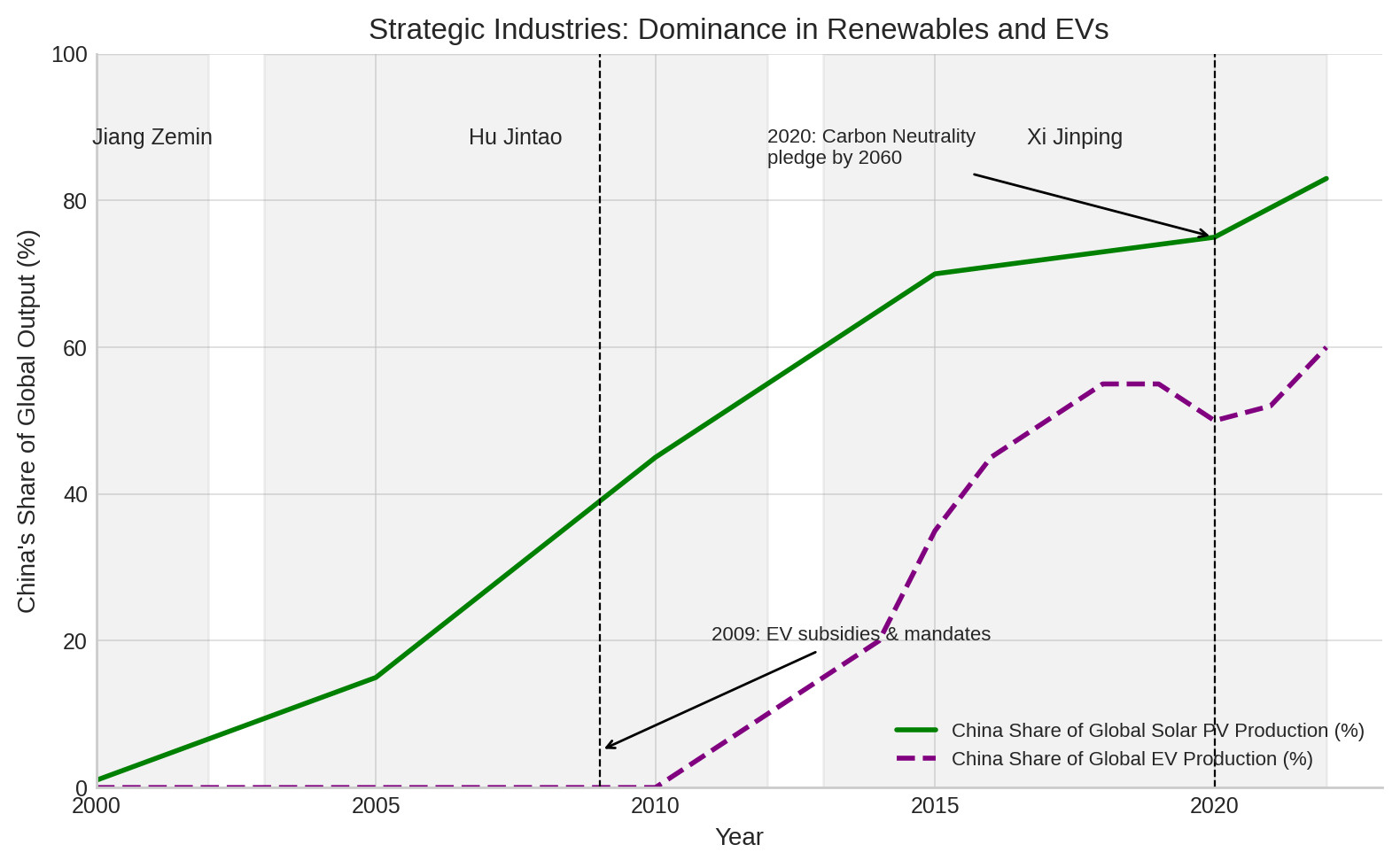
Dominance in strategic industries – China’s share of global solar PV manufacturing (green) and EV production (purple). Note the sharp rise after ~2010 as China’s industrial programs took effect (e.g. EV subsidies from 2009, and a carbon-neutral pledge in 2020 accelerating renewables). By Xi’s era, China leads overwhelmingly in these sectors. Sources: Bloomberg New Energy Finance, CATARC (China Automotive Technology & Research Center), IEA.
Control of Critical Minerals Supply Chains
Beyond finished products like panels or batteries, China has systematically secured upstream resources and processing capacity for the critical raw materials of the green economy:
- Rare Earth Elements (REEs): These 17 metals are vital for high-performance magnets in EV motors, wind turbines, and numerous defense applications. China recognized their importance early. By offering cheap, environmentally lax refining and mining, it undercut other producers in the 1980s-90s. By 2010, as noted, China produced almost 97% of rare earths. After the 2010 embargo scare, other countries restarted some production (like Mountain Pass in the U.S.), so China’s share of mining is now lower (around 60%). However, China still controls the processing: even rare earth ores mined in the U.S. or Myanmar often get sent to China for refinement. This chokehold means China can still influence supply and price. The government has also consolidated its rare earth industry into a few giant state-owned groups to exert more control and prevent illegal exports. It has used export quotas and tariffs in the past to prioritize domestic manufacturers. For example, when Japan faced the sudden cutoff in 2010, it highlighted how dependent high-tech industries were on Chinese rare earths. That dependency remains in many ways, giving China a strategic ace card—one it has signaled it could play again if pushed (Chinese state media in 2019 warned that rare earths could be withheld from the U.S. amid the trade war).
- Lithium and Cobalt: Lithium is the “new oil” of the EV era, key for batteries. China doesn’t have the world’s largest lithium ore resources (which are in places like Australia, Chile, Argentina), but Chinese companies aggressively invested in mining assets globally and, crucially, built the world’s largest lithium processing facilities. Today, China processes around 70% of the world’s lithium for batteries (battery-grade lithium). It recently tightened export controls on advanced lithium battery technology, which can be seen as protecting its advantage. Similarly, cobalt, predominantly mined in the Democratic Republic of Congo, is largely refined by China. Chinese firms have significant stakes in Congo’s mines, securing supply for Chinese battery makers. Nickel for batteries is another focus (Indonesia’s nickel is being heavily invested in by Chinese entities). This upstream lock-in ensures that as EV demand surges, Chinese companies can source materials reliably and even exert control over who else gets them and at what price.
- Polysilicon and Critical Components: For solar panels, beyond assembly, China also dominates production of polysilicon (the raw material for most solar cells), ingots, and wafers. Chinese firms scaled up these mid-stream stages massively. By controlling the full chain, they can outcompete others on cost. The concentration is such that any disruption in Chinese supply (due to, say, sanctions or disasters) would reverberate worldwide, stalling solar deployment elsewhere.
China’s strategy has been described as vertical integration: acquire mines abroad, bring the raw materials home for processing in Chinese factories (Leveraging strategic industrial policies and advanced manufacturing capabilities), and then manufacture end products for export. This not only creates value-added domestically but also places China at key nodes of global supply. If another country wants to build batteries or wind turbines domestically, they might still have to import refined materials or components from China.
Beijing views control of these critical materials as both economic opportunity and strategic insurance. Economically, it’s a burgeoning field where demand will skyrocket as the world goes green – a chance to secure wealth and jobs for Chinese industry (consistent with MIC2025’s goals for new energy vehicles and materials). Strategically, it reduces China’s vulnerability to foreign pressure. For instance, if China were reliant on foreign battery materials, adversaries could cut those off. Instead, China turned the tables, making others reliant on Chinese materials. It flips the leverage: now Western car companies, for example, must engage with China to get battery supplies (or scramble to develop alternate sources at higher cost and slower pace).
In recent years, the U.S. and Europe have woken up to this dependency. They are investing in their own battery plants, rare earth processing, etc. But catching up will take time and huge investment, and China is not standing still either. Meanwhile, Chinese policymakers can use the prospect of supply disruption as a deterrent. Just as Russia has leveraged its gas exports to Europe, China’s dominance in cleantech supply chains is a form of geoeconomic leverage – though China may be cautious to overtly weaponize it because it could accelerate decoupling. Still, the mere existence of this leverage gives China diplomatic clout.
Outmaneuvering Western Competitors and Building Influence
China’s success in greentech also underscores a pattern of strategic industrial policy outmaneuvering Western market-driven approaches. Western companies initially welcomed China’s involvement – for example, they shifted solar production to China for cost savings, or sold mining rights for profit. But with strong state backing, Chinese players eventually took such a commanding lead that Western industries withered, leaving a strategic vacuum. Now Western governments talk of re-shoring and subsidy programs to revive these sectors, effectively having to mimic China’s industrial policy to catch up.
From China’s vantage, this was a double win: it strengthened China’s economy and sapped rivals’ capabilities. The solar industry is illustrative – Europe was a leader (Germany, Spain) in early 2000s; now Europe depends on imported Chinese panels for its climate goals. Similarly, if European automakers don’t transition fast enough, they risk being overtaken by Chinese EVs in their home market (already, Chinese EV brands are entering Europe competitively). Sensing this threat, the EU launched an anti-subsidy investigation into Chinese EVs in 2023, subsequently imposing targeted tariffs of up to 45% to protect its domestic automotive industry and counterbalance China’s aggressive market expansion. Beijing responded sharply, warning Europe against protectionism, which shows how these industries become diplomatic friction points. For China, defending its greentech exporters is now a national interest – they’re both money makers and vehicles for expanding influence.
Influence comes in several forms:
- Economic Ties: Countries that buy into Chinese green tech become economically linked to China. For instance, developing nations who get Chinese solar panels or who host Chinese-built renewable projects often finance them via Chinese loans as part of BRI. This can deepen bilateral ties and give China leverage (the country doesn’t want to upset China lest financing or maintenance support for its power plants be withdrawn). An example: many African countries are installing Chinese solar streetlights or small grids – soft influence but builds goodwill and dependency on Chinese tech support.
- Standards and Norms: If Chinese equipment dominates, Chinese technical standards may become default. For example, China is pioneering ultra-high-voltage power transmission to integrate renewables; if other countries adopt these Chinese standards/tech, they align more with China’s ecosystem. Similarly, in EV charging or battery recycling standards, China’s domestic standards can shape international ones if their products flood markets.
- Green Diplomacy: China uses its leadership in renewables to bolster its image as a responsible major power in climate change mitigation. This is partly to counteract criticism of its emissions (as the largest emitter, though also the largest investor in renewables). By offering green solutions to others (often cheaper than Western options), China positions itself as an indispensable partner in global climate efforts. This narrative can win diplomatic points and possibly temper Western criticisms—e.g., when pressured on emissions cuts, China can point to how it’s enabling renewable deployment worldwide, not just at home.
- Strategic Alliances: In regions like Latin America, China’s hunger for lithium has led it to deepen ties with countries like Argentina, Bolivia, and Chile (the lithium triangle). By investing in their mining and offering infrastructure, China secures resources while those countries gain alternative partners beyond Western mining firms. Over time this can translate into political alignment or at least sympathetic stances toward China.
However, being at the top also carries risk of dependency on global markets. The EU has imposed tariffs on Chinese EVs following an anti-subsidy investigation, while the U.S. enforces trade restrictions favoring domestic solar and battery production, constraining China’s exports. But China’s home market is huge and growing, giving it a base demand to sustain industries. Moreover, China’s cost advantages are hard to beat; many countries may find they simply need the cheaper Chinese products to meet renewable targets affordably, despite political desires to diversify.
From a realpolitik perspective, China’s greentech dominance is part of its broader “comprehensive national power.” It’s not simply about making money or helping climate; it’s about who owns the industries of the future and can use them as strategic leverage. In the 20th century, oil was the strategic commodity – the Middle East’s oil gave it outsized geopolitical weight and the U.S. and USSR vied for influence there. In the 21st century, one could argue technologies and materials for clean energy could play a similar role. China, by positioning itself as the “Saudi Arabia of renewable energy tech” so to speak, has already altered the strategic equation. It can potentially exercise influence akin to OPEC but in solar panels or battery materials – for example, coordinating production to affect prices.
We should note that China’s own motivation is also energy security: it wants to reduce dependence on imported oil/gas (where U.S. naval power could threaten supply routes). So electrifying transport and expanding renewables at home improves energy security. Indeed, China is the world’s largest installer of solar and wind energy domestically by far, and it is poised to achieve 50% of new car sales as electric vehicles by 2025, well ahead of the initial target set for EV adoption. By cornering the global market, it ensures it can supply itself abundantly and cheaply. If a geopolitical crisis caused an oil cutoff, China could better weather it with its EV and renewable infrastructure – a long-term hedging strategy.
In summary, the greentech case reveals China’s strategic modus operandi: identify a critical emerging sector, mobilize state-driven resources to become the world leader, integrate up and down the supply chain (even literally digging into the ground worldwide), outcompete foreign rivals to the point of dependency, and then leverage that position for broader national advantage. It’s an economic strategy serving geopolitical ends. Importantly, this landscape is marked by fierce domestic competition, where aggressive players vie for market share, highlighting that while government support is vital, it is the whole competitive dynamism that truly drives success. Western countries, due to laissez-faire or shorter-term approaches, realized the strategic implications somewhat late, giving China a sizable head start.
China will likely aim to maintain its lead by continual innovation (they invest heavily in R&D for better batteries, next-gen solar tech, etc.) and scaling (driving costs so low others can’t catch up easily). How the world responds – through diversification, alliances, or grudging acceptance – will determine whether China can convert this dominance into lasting strategic influence or faces pushback that erodes its control.
Sector Analysis 2: AI and Semiconductors in Great Power Competition

If green tech is one pillar of future power, artificial intelligence (AI) and semiconductors are another – arguably the core of the ongoing U.S.-China technological rivalry. Mastery of AI and chip technology is seen as critical to economic competitiveness, military strength (due to their applications in advanced weapons and intelligence), and even ideological supremacy (AI is tied to control of information and surveillance capabilities). China has made extraordinary strides in AI research and adoption, and it has invested massively in building a domestic semiconductor ecosystem. This case study explores how China plans and executes its tech rise in AI and chips, how it contends with U.S.-led efforts to contain it, and what this reveals about China’s strategic thinking in the innovation arena.
China’s AI Ambitions and Innovation Ecosystem
China’s leadership views artificial intelligence as a key to global leadership in the 21st century – often analogized as the new electricity or the catalyst of a fourth industrial revolution. In 2017, the State Council issued the New Generation AI Development Plan, explicitly aiming for China to become the world’s premier AI innovation center by 2030, with intermediate goals of catching up to the U.S. by 2020 and achieving major breakthroughs by 2025. This top-level plan galvanized the entire state and commercial apparatus towards AI.
By many measures, China has quickly closed gaps in AI research. China now publishes more AI research papers and files more AI patents than any other country. Chinese tech giants like Baidu, Alibaba, Tencent, and newer companies like SenseTime, Megvii, and Huawei’s HiSilicon have heavily invested in AI R&D. The government has fostered AI hubs in cities like Beijing (around Zhongguancun tech park), Shanghai, Shenzhen, and Hefei, often with special funds and subsidies. As a result, Chinese AI startups have attracted huge funding – in 2017, Chinese startups received 48% of global AI venture funding, surpassing North America. This flood of capital (part public, part private) has enabled rapid progress in areas such as computer vision, speech recognition, natural language processing, and fintech AI. However, subsequent years saw U.S. investments rebound, reshaping the global AI funding landscape.
China’s approach to building an AI ecosystem is multi-pronged: invest in basic research (with government grants and the Chinese Academy of Sciences setting up AI institutes), encourage commercialization (with local governments offering incentives for AI firms, and state-owned enterprises adopting AI solutions at scale), and push educational initiatives (new AI institutes at universities, plans to train tens of thousands of AI specialists). Additionally, China leverages its huge population and relatively lax data privacy regime to gather enormous datasets, a crucial fuel for machine learning. For instance, Chinese companies have troves of user data from hundreds of millions of users of WeChat, Alipay, etc., and extensive surveillance camera networks provide video data used to train vision algorithms. This abundance of data, combined with a strong engineering workforce, gives China a structural advantage in certain AI fields – a fact not lost on policymakers who call data a “national resource.”
Another edge is state support for AI deployment in governance. China is using AI for smart city management, facial recognition for security, predictive policing, and censorship algorithms for internet control. Such applications, while controversial, mean the government itself is a major client driving AI forward. It also aligns AI advancement with the Party’s interests (e.g., maintaining domestic stability through high-tech surveillance). This synergy ensures steady funding and real-world testing grounds. By contrast, Western governments are more hesitant or face public resistance to such uses, which can slow adoption.
Beijing also tries to attract global AI talent. Programs like the Thousand Talents Plan targeted Chinese diaspora and foreign experts to come work in China. Many Western-educated Chinese AI scientists returned in the 2010s to lead labs at Chinese universities or companies, enticed by generous packages and the chance to head their own research groups young – something perhaps less accessible in more saturated Western institutions. While the U.S. has since scrutinized such talent programs as espionage risks, the effect was a significant brain gain for China in AI.
By 2025, China has significantly narrowed the gap with the U.S. in AI, with the competition now more evenly matched across various domains. In areas like facial recognition, Chinese firms remain world-class and continue expanding their global footprint through Digital Silk Road initiatives in developing nations. In voice assistants and fintech, Chinese apps maintain their competitive edge, particularly in Asian markets.
In frontier AI research, the landscape has evolved substantially. While the U.S. still maintains an advantage through companies like OpenAI, Anthropic, and Google DeepMind, Chinese firms have made remarkable progress in developing their own large language models. Companies like DeepSeek have demonstrated capabilities comparable to leading American models at significantly lower costs, representing a potential inflection point in the AI race.
The semiconductor restrictions imposed by the U.S. remain a challenge for China, with most Chinese AI models still reliant on NVIDIA chips. However, China has responded with massive investments in domestic chip alternatives and creative technical workarounds. China’s advantage in data collection persists, with its vast population and data governance approach facilitating the creation of extensive training datasets crucial for machine learning advancement. Meanwhile, China’s deliberate talent development strategy—creating thousands of AI programs across hundreds of universities—is gradually reducing America’s lead in elite AI research talent.
AI is also clearly tied to military modernization. The PLA is investing in AI for autonomous drones, decision-support systems, cyber warfare, and intelligence analysis. Chinese military writings talk about “intelligent-ized warfare” as the future, not just informatized warfare. So being a leader in AI is seen as critical for the PLA to “fight and win wars” of the future. The U.S. recognizes this – hence part of the impetus for restricting China’s access to the highest-end AI chips and technology (fearing it’ll aid the PLA). The competition in AI is thus very much a security-driven race, not just commercial.
China’s vision is to create a domestic environment where AI innovation thrives despite foreign decoupling. That means developing homegrown AI talent, reducing reliance on foreign software frameworks (even trying to create alternatives to Western-dominated platforms), and crucially, securing the hardware base – semiconductors – needed to run AI.
Building a Self-Reliant Semiconductor Industry
Semiconductors (microchips) are often dubbed China’s “Achilles’ heel.” Despite being the world’s largest consumer and assembler of electronics, China historically imported over $300 billion in chips annually – more than it spends on oil. High-end chips (like CPUs, GPUs, FPGAs) were mainly designed by U.S. firms (Intel, AMD, Nvidia, Qualcomm) and often manufactured with equipment from the U.S., Japan, EU. This dependency was stark: Chinese companies like Huawei relied on U.S.-designed chips for smartphones and U.S.-allied fabs (like TSMC in Taiwan) to fabricate their Kirin chips. The strategic vulnerability became evident as the U.S. started imposing export bans on advanced chips to China.
To address this, China has launched an all-out effort to achieve semiconductor self-reliance. This was highlighted in Made in China 2025 with explicit goals (e.g., 70% self-sufficiency in chips by 2025). Even before, China set up the National Integrated Circuit Industry Investment Fund (the “Big Fund”) in 2014, pooling over $20 billion in its first tranche, then $35 billion more in a second, to invest in domestic chip companies and projects. These investments have been used to expand Chinese chip fabrication (foundries like SMIC), support fabless design firms (like HiSilicon, Unisoc, etc.), and boost materials and equipment providers.
Progress has been mixed. On one hand, Chinese companies have grown: SMIC is making chips at 14nm and even 7nm nodes (though 7nm in limited volume, possibly using workaround techniques). China produces plenty of low-end and mid-end chips (for appliances, IoT, etc.). It has also become a leader in some specialized areas like cryptographic chips or certain AI accelerators for domestic use. The number of Chinese semiconductor firms exploded (tens of thousands of new small chip-related firms registered in recent years). However, the cutting-edge (5nm, 3nm chips) still eludes China due to lacking EUV lithography equipment (monopolized by Dutch ASML, which, under U.S. pressure, won’t sell to China). And high-end CPU/GPU design is hard to catch up; though China has entities like Loongson and Phytium designing CPUs, they lag in performance.
U.S. containment measures have intensified the race. Starting with the Huawei ban in 2019 and culminating in comprehensive export controls in 2022 (further tightened in 2023 and 2024) the U.S. moved to choke off China’s access to top-tier chips (especially AI GPUs like Nvidia’s A100/H100) and the tools to make them. The intent is to slow China’s AI and military advancements. China sees this as a major challenge – a “blockade” on key technology – and has responded by doubling down on self-reliance. Xi Jinping frequently urges overcoming “chokepoint technologies” (卡脖子技术). Billions more are being funneled into R&D for indigenous semiconductor equipment (to replace ASML’s EUV, Tokyo Electron et al.), into developing Chinese EDA software (design tools), and into talent recruitment (poaching Taiwanese engineers or bringing home experts from Silicon Valley).
One approach China has taken is to try to innovate in alternate paths. For example, if it can’t get the latest GPUs, it invests in scaling out slightly older tech (using many more 14nm chips for AI, which is less efficient but doable). Or exploring new architectures (like analog computing or photonic chips) where it might carve a niche. Also, companies like Huawei have reportedly been stockpiling chips and are attempting to re-enter the chip game perhaps at 7nm with domestic resources. Indeed, Huawei surprised observers by releasing a new smartphone in 2023 with a 7nm 5G chip presumably made in China (SMIC), suggesting some sanctions evasion or unexpected progress.
The talent component is crucial. China’s universities are expanding semiconductor engineering programs drastically to train its own cadre of chip designers and engineers. There’s recognition that even with money, know-how is the tough part – hence incentives for experts abroad to come teach or work in China remain, albeit more under scrutiny now.
China’s strategy is also to lean on international partnerships where possible to mitigate the U.S. cutoff. For instance, it still obtains some chipmaking tools from countries that haven’t fully aligned with U.S. restrictions (a lot of Japanese, Korean, even some European equipment made its way in before rules tightened). It also fosters collaboration with friendly nations: e.g., working with Russia (which itself now lacks Western tech) on electronics, or seeking to include its tech in markets in the Global South to sustain scale.
The outcome of this chip battle is uncertain, but China’s commitment is unwavering because the stakes are existential in their view. Semiconductors underpin not only consumer electronics but also all advanced military systems and AI – if China remains at others’ mercy for chips, it’s a strategic noose the U.S. can tighten at will. So this is seen as a “must win” battle. It could take a decade or more to substantially close the gap, but recall: similar doubts were cast on other industries where China eventually prevailed (like satellites, supercomputers – China now builds world-leading supercomputers, though current U.S. sanctions aim to hinder even that by denying high-end chips).
It’s worth noting how China’s one-party system mobilizes around this. After the 2022 U.S. controls, Chinese ministries, funds, and companies met to coordinate a response. There were reports of potentially merging some chip firms to concentrate resources, and heavy support for any project that could replace an American component. This top-down urgency mirrors the effort of a war economy (some Chinese commentators liken it to a technology “Long March” or “Sputnik moment”). And indeed, state media casts it as the U.S. trying to stymie China’s rise, which rallies nationalist sentiment to endure hardships (like maybe slower consumer tech advancement) in pursuit of tech sovereignty.
Data point 1: China’s AI and Semiconductor Talent Surge
China has undertaken a massive drive to build domestic expertise in artificial intelligence (AI) and semiconductors as a cornerstone of its tech self-reliance strategy. After announcing plans in 2017 to lead the world in AI by 2030 [1], Beijing poured resources into expanding STEM education and research. By prioritizing talent even over immediate supply-chain fixes [2], China aims to reduce reliance on foreign technology and foster home-grown innovation. This talent-centric approach is paying off: China now graduates more science and engineering students each year than the United States, European Union, and Japan combined [3], feeding a fast-growing pipeline of engineers and researchers to fuel its tech ambitions.
Quantity of Talent: China’s talent surge is striking in scale. It produces millions of new STEM graduates annually – roughly 3.6 million per year as of 2020, versus about 820,000 in the U.S. [4]. The output of advanced experts has likewise boomed. China overtook the U.S. in STEM PhDs in the mid-2000s and the gap is widening; by 2025 Chinese universities are projected to award 77,000+ STEM doctorates per year, compared to ~40,000 in the U.S. [5]. Crucially, much of this growth comes from top-tier institutions, indicating improving quality [5]. To meet demand in strategic fields, over 500 Chinese universities have launched AI-related majors since 2018 [6], and at elite schools master’s enrollments in chip engineering nearly doubled from 2018 to 2022 [2]. China’s talent base in AI research is now the world’s largest by some measures – for example, as of 2021 China had about 105,000 AI researchers, surpassing the U.S.’s ~94,000 [7]. This rapid talent expansion provides the human capital for China’s long-term tech development.
Quality and Output: Alongside sheer quantity, China’s talent buildup is translating into greater R&D output and impact. Chinese researchers have become prolific in AI and chip domains, contributing an increasingly large share of global innovation. By 2020, China had surpassed the U.S. in the total number of AI publications [1], and by 2021 it accounted for 26.2% of the world’s AI conference papers (the highest of any country) [8]. In cutting-edge research and high-impact scientific papers, China’s rise is notable, accounting for about 27% of the top 1% most-cited research articles (2018–2020) versus 25% for the U.S. [9]. In AI specifically, China’s share of highly-cited work has been catching up to the U.S. – by 2020, Chinese authors nearly matched the U.S. in the top 10% most-cited AI papers [1]. These results reflect efforts to improve research quality through “Double First Class” universities and newly founded AI institutes.
Chinese inventors are also dominating in technical innovation outputs such as patents. China has been the largest source of AI patent filings globally since 2017 [10], and its lead is growing. In 2022, Chinese organizations filed roughly four times as many AI patents as U.S. entities, with China’s patent office granting almost three times more than the U.S. [10]. The U.S. still leads in patent quality metrics, but China’s volume creates a vast prior-art footprint. In semiconductors, a similar pattern is evident: 55% of global semiconductor patent applications in 2021–22 were of Chinese origin, double the share of the U.S. [11]. By 2022, Chinese entities also surpassed American and Japanese firms in patents granted in chip-related fields [11]. Notably, China still trails in certain cutting-edge manufacturing (e.g. sub-5 nm nodes) [11]. The U.S. remains home to a large portion of the world’s top AI researchers (over half of “elite” AI scientists work in the U.S. vs only 12% in China) [12], but China is striving to reverse this brain drain. Nearly 26% of elite AI researchers are Chinese-born [12], and more of them are now choosing to work in China’s burgeoning AI industry, drawn by new opportunities and patriotic drive [6].
Investment and Incentives: To support this talent surge, China has ramped up spending on education, R&D, and specialist incentives. Its national R&D expenditure has more than doubled since 2015, reaching 2.4% of GDP by 2020 (on par with the EU average) and on track toward U.S. levels [3]. Chinese tech companies and government programs are offering highly competitive pay packages. The average salary for an entry-level semiconductor engineer in China rose from about ¥200k in 2018 to ¥400k in 2023 (≈$57,000) [2]. China faces an estimated shortage of 200,000 chip engineers and technicians as of 2023 [2]. In comparison, U.S. entry-level chip engineers earn ~$90k–100k [13], so China’s gap is closing fast. For top-tier talent, Chinese firms pay Silicon Valley-level salaries: AI PhDs can command ¥800k–¥1M ($110k–$140k) starting, and superstar experts get eight-figure yuan ($1–2 million+) [6]. As a Chinese Academy of Sciences scholar said, China “needs to prioritize training talent” above all else to secure supply chains [2].
Table: Key Talent Indicators – China’s Tech Talent Buildup vs. U.S. (2018–2025)
| Indicator (Strategic Talent Metric) | China | United States |
|---|---|---|
| Annual STEM graduates (2020) | ~3.57 million [4] (≥40% of all Chinese grads [4]) | ~0.82 million [4] (China now exceeds U.S. + EU combined [3]) |
| Annual STEM PhD graduates (proj. 2025) | >77k [5] (up from ~50k in 2018; top-tier univs) | ~40k [5] (many are foreign students; ~3:1 ratio excluding them) |
| AI R&D personnel (~2021) | ~105k [7] (largest AI workforce globally) | ~94k [7] (U.S. previously #1) |
| Top 1% most-cited research (2018–20) | 27% [9] (leads the world in high-impact papers) | ~25% [9] (#2 globally) |
| AI patent filings (2022) | ~4× U.S. [10] (China #1 since 2017) | Baseline (~1×) [10] (U.S. behind in volume, still leads in quality) |
| Semiconductor patent share (2021–22) | 55% [11] (twice U.S. share; top in newly granted) | ~27% [11] (U.S. about half of China’s total) |
| Entry-level chip engineer pay (2023) | ¥400k [2] (~$57k) – doubled since 2018 | ~$90–100k [13] (China narrowing gap rapidly) |
China’s talent buildup underpins its long-term tech ascendancy. By expanding the pool of engineers and researchers – and upgrading quality via educational reforms and robust incentives – China secures sustained innovation in AI, semiconductors, and other strategic fields. Already, China leads in key metrics like STEM grads, AI patent filings, and some high-impact publications. Meanwhile, the U.S. retains an edge in elite talents and advanced R&D, but some signs of brain-drain reversal suggest China is catching up. In short, human capital is increasingly central to China’s self-reliance aspirations: a strategic asset fueling indigenous breakthroughs and anchoring its global ambitions.
Sources
- “China is closing in on the US in AI research”
- “China tackles chip talent shortage with new courses, higher pay”
- “The Perils of Complacency”
- “The Global Distribution of STEM Graduates”
- “China is Fast Outpacing U.S. STEM PhD Growth”
- “Highest Salary Of 20-Million Yuan – But China Still Facing AI Talent Shortage Of 4 Million By 2030”
- “China and the U.S. produce more impactful AI research when collaborating together”
- “[PDF] Research and Development – AI Index”
- “China overtakes US in contributions to nature and science journals”
- “How Innovative Is China in AI?”
- “How Innovative Is China in Semiconductors?”
- “Stakes Rising In The US-China AI Race”
- “Semiconductor Engineer Salary (March 2025) – Zippia”
U.S. Tech Containment and China’s Counters
The U.S. and allied tech containment strategy has become a defining feature of the AI/chip contest. From China’s viewpoint, this validates their long-held belief that the U.S. will not tolerate China reaching parity and will use its power to “keep China down.” It reinforces the imperative of self-reliance and also shapes China’s approach globally: they accuse the U.S. of “technological hegemonism” and appeal to other countries that this is unfair and needs collective resistance (though many countries share U.S. concerns about security).
China’s counters to containment can be summarized as follows:
- Diversification of suppliers: If the U.S. bans certain items, find other countries willing to sell. For instance, U.S. banned ASML’s EUV, but China can still buy older lithography equipment (DUV) which Japan agreed to restrict only partially later. China also increased dealings with some third-party brokers who might acquire U.S. chips and re-sell (hence the U.S. also trying to clamp down on transit via e.g. Malaysia). There’s cat-and-mouse here.
- Domestic substitution: Accelerate making Chinese versions of everything, from chip design software to machine tools. This is expensive and duplicative on a global scale, but China sees no choice. If successful, it will permanently reduce U.S. leverage – but achieving success in every niche (some are extremely complex like EDA software or certain chemicals) is a tall order and will take time.
- Grey-market and stockpiling: Chinese firms reportedly stockpiled large inventories of critical chips and equipment before new rules kicked in. This gives them a buffer for a few years to keep operations and R&D going hoping domestic sources catch up in the interim. Also, some may clandestinely obtain banned chips via middlemen in third countries (a flow U.S. is trying to police).
- Tit-for-tat restrictions: China can retaliate with its own export controls on things it dominates. For example, in 2023 China announced export controls on gallium and germanium – materials where China is a top producer used in some chip components and defense tech. This sends a message that the U.S. and allies also depend on Chinese supplies in certain sub-sectors. Likewise, hints at rare earth restrictions are a deterrent. Initially, China was measured so as not to spook supply chains too severely. However, by late 2024, China escalated to outright bans on certain critical minerals to the U.S., suggesting increased willingness to leverage these asymmetric advantages despite the risk of accelerating Western diversification efforts.
- Domestic market as lure/punishment: China remains the world’s largest semiconductor market—official data and industry reports indicate its share of global chip sales can range from about one-third to over 50%, depending on the metrics used—and a significant majority of chips are ultimately integrated into products manufactured in its extensive electronics assembly hubs. It can use access to its market as leverage with companies/countries. For example, South Korean firms like Samsung and SK Hynix have huge fabs in China; the U.S. gave them exemptions from chip curbs so far. China could threaten to harm their interests if they fully comply with U.S. bans, implicitly pressuring Seoul to seek waivers. Similarly, U.S. chip firms (Qualcomm, etc.) derive a large share of revenue from China; China can hold up approvals or business for them, which then lobby the U.S. government for a softer approach. Indeed, Beijing’s strategy includes trying to exploit divergences – e.g., European industry wants to keep selling lithography to China, and China encourages that by treating European tech firms more favorably than American ones. However, U.S. has worked hard to align allies (Japan, Netherlands, etc.) so China’s wedge-driving has limits.
- Global narrative and alliances: China paints the tech blockade as against free trade and innovation. It positions itself as champion of an “open global tech ecosystem” (though its own practices can be protectionist). Through BRICS or other forums, it seeks solidarity from others who fear U.S. tech dominance. For instance, suggesting maybe a BRICS cooperation on chips to counter Western controls. While no non-Western country can provide what the U.S. can in chips, diplomatic support can at least blunt the force of isolation.
- Focus on end-use leadership: China might not lead in making the most advanced chips now, but it can still lead in applying AI and other tech at scale. For example, while Chinese AI labs might have slightly less capable hardware than top U.S. ones due to chip restrictions, they have far more deployment (like in super apps or city systems). Over time, innovative algorithms and sheer volume of use could keep them competitive. Also, they are working on AI that is optimized for less advanced chips, which if successful, neutralizes some of the hardware disadvantage.
This contest is dynamic; it’s essentially a technology arms race entwined with policy and industrial muscle. For China, success will be measured in if it can create a chip industry that produces say 7nm or even 5nm chips in volume without U.S. tech. If achieved, the U.S. blockade loses a lot of bite. If China fails to catch up and gets stuck a few generations behind, it could severely hamper Xi’s goal of tech superpower. The outcome will significantly influence the future balance of power.
From a strategic viewpoint, China’s relentless push in AI and chips underscores how it sees technological supremacy as core to comprehensive national power. This isn’t simply about business or pride; it’s about who will have the strategic upper hand. Advanced AI can confer military and intelligence superiority (e.g., AI could break encryption or enable swarms of autonomous weapons). Advanced chips are the linchpin of all modern systems. If China becomes self-reliant and leading here, it removes one of the last major dependencies on the West and can innovate on its own terms, possibly surpassing the West in certain innovations given its scale.
Conversely, the U.S. is determined to at least slow China’s momentum, buying itself time to invest domestically and keep its lead. This leads to a fragmented tech world – something China hoped to avoid by integrating into globalization, but is now forced to adapt to.
In conclusion, the AI and semiconductor case exemplifies a high-stakes power play where China applies its typical formula (state-driven investment, talent mobilization, market size leverage) to break into a field dominated by incumbents. It has achieved notable success in AI algorithms and applications, and moderate success in chips (mostly in less advanced ranges), but faces the toughest opposition here. How China navigates this in the coming years will significantly shape its grand strategy’s outcome, as tech prowess increasingly defines great power status. The Chinese leadership’s commitment is not in doubt; they have essentially declared a “tech war” response of their own – one they are prepared to fight over decades if needed, consistent with their long-term, realpolitik mindset.
Strategic Mindset: Realpolitik with Chinese Characteristics
Throughout the analyses above, a consistent theme emerges: China operates with a strategic rationale centered on power and security, deeply informed by realism but executed with Chinese nuance. Rather than reacting impulsively to external pressures, China’s leadership evaluates moves based on long-term objectives and carefully weighs the trade-offs. This closing section distills how China’s strategic thinking manifests in practice – how it sets goals, what risks it takes or avoids, and how it hedges against counter-moves by others. It underlines that China’s rise is driven by its own calculus of national rejuvenation, not simply as a knee-jerk response to the West, even if U.S. actions figure into that calculus.
Long-Term Objectives vs. Short-Term Risks
Chinese leaders are often playing a long game, with benchmarks like 2035 and 2049 in mind, as previously discussed. Long-term objectives – securing national rejuvenation, becoming a global tech leader, unifying the motherland, and solidifying multipolarity – provide a lodestar that guides day-to-day policy. This means that in decision-making, short-term gains are sometimes sacrificed to avoid jeopardizing the long-term trajectory. For instance, when faced with aggressive U.S. tariffs in 2018, China retaliated proportionally but also sought negotiation rather than extreme escalation, to avoid derailing its development with an all-out economic war. Beijing absorbed some pain (exports hit, growth slightly slowed) but bet that it could ride it out, which aligns with a long view.
This long-term focus is rooted in China’s historical perspective – having endured a century of weakness, a few years of sanctions or setbacks are considered endurable on the road to a century of resurgence. It’s also facilitated by the political system: Xi and the CCP do not face elections, so they can implement policies that might be unpopular or painful in the short run (like deleveraging parts of the economy, or strict tech self-reliance pushes that may duplicate costs) because they judge it will pay off eventually. They also believe the Chinese public, steeped in nationalism, will tolerate hardships if framed as necessary for the nation’s greatness and to resist foreign bullying.
At the same time, Chinese strategy is risk-aware. The leadership constantly evaluates where red lines are – both its own and others’. Beijing is careful not to cross thresholds that would trigger overwhelming backlash or conflict before China is ready. A classic example: China has not moved militarily on Taiwan despite decades of threats, because the perceived risks (a war with the U.S. when China’s military edge is not assured) have outweighed the urgency, given China’s improving position over time through peaceful means (economic attraction of Taiwan, military buildup). This reflects strategic patience and caution in the face of potentially catastrophic short-term risk.
Similarly, in the South China Sea, China gradually built up presence but for years avoided overt militarization. Only after it had built artificial islands and felt confident did it install missiles and airstrips, doing so incrementally to manage U.S. and ASEAN responses. Beijing’s calculus was that pushing too fast could unite Southeast Asian countries fully against it or provoke a strong U.S. military reaction; pushing gradually created faits accomplis without a single casus belli. This showcases a hedging approach – expanding influence but pulling back if a move might trigger a coalition against it.
Internally, China’s economic management tries to balance growth with avoiding crises. For example, while pursuing ambitious projects, they also guard against financial meltdowns (hence sometimes clamping down on debt or shadow banking). It’s a controlled dynamism: aggressive but not reckless. One could say China is willing to accept medium risk for high reward (like assertiveness that might bring sanctions or damage its soft power), but it tries to avoid extreme risk that could cause war or regime-threatening instability.
Balancing Assertiveness and Caution
Under Xi, China’s behavior has undoubtedly become more assertive – some say outright aggressive – on many fronts. Yet even this assertiveness is usually calibrated rather than wanton. Beijing often pursues a strategy of test and adjust: it will take a bold action, gauge international reaction, and if blowback is too severe, sometimes back off slightly or refrain from further escalation in that area. If the reaction is weak or manageable, it will press further.
For example, after years of a combative “Wolf Warrior” diplomatic style (a Western term characterizing China’s assertive approach from 2019-2020) that alienated several countries, by late 2021 some Chinese officials signaled a shift to a “softer tone” to repair relations, especially with Europe and neighbors. This was a tactical adjustment recognizing that constant vitriol was counterproductive to China’s strategic interests. Similarly, trade coercion measures like banning Australian coal and Canadian canola (after political disputes) were eventually lifted when China needed those commodities or sought to improve atmosphere. This shows a pragmatic streak: China is willing to dial down or reverse some pressure if it hinders broader interests.
Another balancing act is between military and economic assertiveness. China has generally steered clear of direct military conflict (no major state-on-state war since the 1979 Sino-Vietnamese war) by favoring gray zone tactics—deploying Coast Guard or militia boats to press claims and leveraging economic influence rather than armed force—to avoid actions that might spiral into uncontrollable war. This measured approach in kinetic conflict goes hand in hand with a bolder stance in economic and diplomatic arenas, where the costs are lower. Fundamentally, Chinese leadership prioritizes economic development and stability, lessons deeply ingrained by its historical experiences during the “Century of Humiliation.” As a result, war is viewed as the ultimate high-risk, last-resort option that could derail decades of progress, while displays of strength below the war threshold—through exercises, base building, and similar measures—serve as a deterrent and signal of rising power.
The leadership also tries to hedge personal or political risk. Xi has centralized authority, which means he often personally balances assertiveness and caution. For instance, his anti-corruption campaign was high-risk domestically (could upset elites) but he balanced it by rallying public support and the Party’s discipline to mitigate backlash, ultimately strengthening his position. On foreign policy, Xi tends to err on the side of strength now, but he also ensures internal preparation for any consequences (e.g., stockpiling, indoctrination of cadres to weather decoupling).
Hedging Against Adversary Responses
China’s strategic planning involves anticipating how other powers, especially the U.S., might respond, and preparing hedges or counters to those responses. We saw this in Dual Circulation – a preemptive hedge against decoupling. Another example: as the U.S. rallied allies like QUAD (U.S., Japan, India, Australia) or AUKUS, China has worked to shore up relations with those allies’ neighbors to complicate containment (e.g., improving ties with South Korea to keep it out of QUAD, or courting ASEAN countries with trade to dilute their alignment with U.S. strategies). China also deepened a quasi-alliance with Russia, which is a hedge against U.S. pressure: having Russia’s strategic partnership secures China’s northern flank, provides energy supplies, and creates a joint front to split U.S. focus. The timing of Xi’s declarations with Putin (like proclaiming a “no limits” friendship just before the Ukraine war) indicates a gamble that closer China-Russia ties will counter Western blocs.
Another key hedge is in supply chains and markets: China doesn’t want to depend solely on U.S. or EU markets, so it has developed other markets via BRI and the Regional Comprehensive Economic Partnership (RCEP) in Asia. If the West tries to economically isolate China, Beijing can pivot to these other partnerships to reduce damage. Similarly, China has hedged on currency by slowly internationalizing the RMB (through swap lines, the digital yuan project, using RMB in some oil deals with Middle East) – so that if the U.S. were ever to sanction China’s access to dollars (as done to Russia), it would have some alternative payment channels. These alternatives aren’t fully mature yet, but China is laying groundwork.
China’s navy expansion is a hedge against the U.S. ability to blockade sea lanes. The Belt and Road’s overland routes and new ports are hedges against reliance on few chokepoints like Malacca. Its space program (e.g., Beidou satellite navigation) is a hedge against dependence on U.S. GPS. In nearly every domain, China’s strategy includes building redundancy and resilience to blunt adversary moves.
Diplomatically, China hedges by positioning itself as champion of the Global South. If a new Cold War bifurcates the world, China wants a large bloc of countries neutral or leaning to its side due to economic ties or shared stance on sovereignty (many developing nations appreciate China’s stance on non-interference). Thus, China invests in Africa, Latin America, and votes at the UN, cultivating goodwill that could translate into at least political support against Western pressure (e.g., many countries back China’s position on Xinjiang or Hong Kong at the UN, offsetting Western criticism).
China also hedges by controlling the narrative internally. It has carefully managed public expectations: for instance, it teaches that the road to rejuvenation will face foreign attempts to suppress China (so people aren’t surprised by U.S. hostility), and that some hardship may be necessary. This way, if the U.S. sanctions cause tech slowdowns or if decoupling means loss of some export jobs, the public is more likely to endure, seeing it as part of a noble struggle. That social resilience is a hedge against adversaries hoping domestic discontent will force CCP capitulation.
Data point 2: China’s Rise in Global Power – A Multi-Dimensional Comparison (China vs. U.S.)
Key Metrics and Data Sources
To visualize China’s transformation from a peripheral actor to a central global power, we compare six strategic metrics (radar chart axes) for China and the United States across different leadership eras (approximated by decades). Each metric is normalized so that 100% represents the peak value achieved by either country over the period, allowing relative performance to be compared on a common scale. The axes and their definitions are:
- Manufacturing Output Share – Each country’s percentage of global manufacturing value-added output. (Source: UN/OECD data)
- Trade Share – Percentage of global merchandise exports (goods trade) accounted for by each country. (Source: UNCTAD/WTO data)
- Technology Output – Share of global innovation output, proxied here by each country’s share of world patent filings (to capture advances in semiconductors, AI, etc.). (Source: WIPO data)
- R&D Investment – Share of global research & development (R&D) spending, reflecting science and technology investment (as % of world total). (Source: World Bank/IMF data)
- Infrastructure Capacity – A proxy measure of capacity to build infrastructure, using share of global steel production (since steel underpins construction and industrial projects, including domestic growth and the Belt & Road Initiative). (Source: World Steel Association data)
- Reserve Currency Use – Each country’s currency share in global foreign-exchange reserves (for the U.S., the US dollar; for China, the renminbi (RMB)), indicating financial influence. (Source: IMF COFER data)
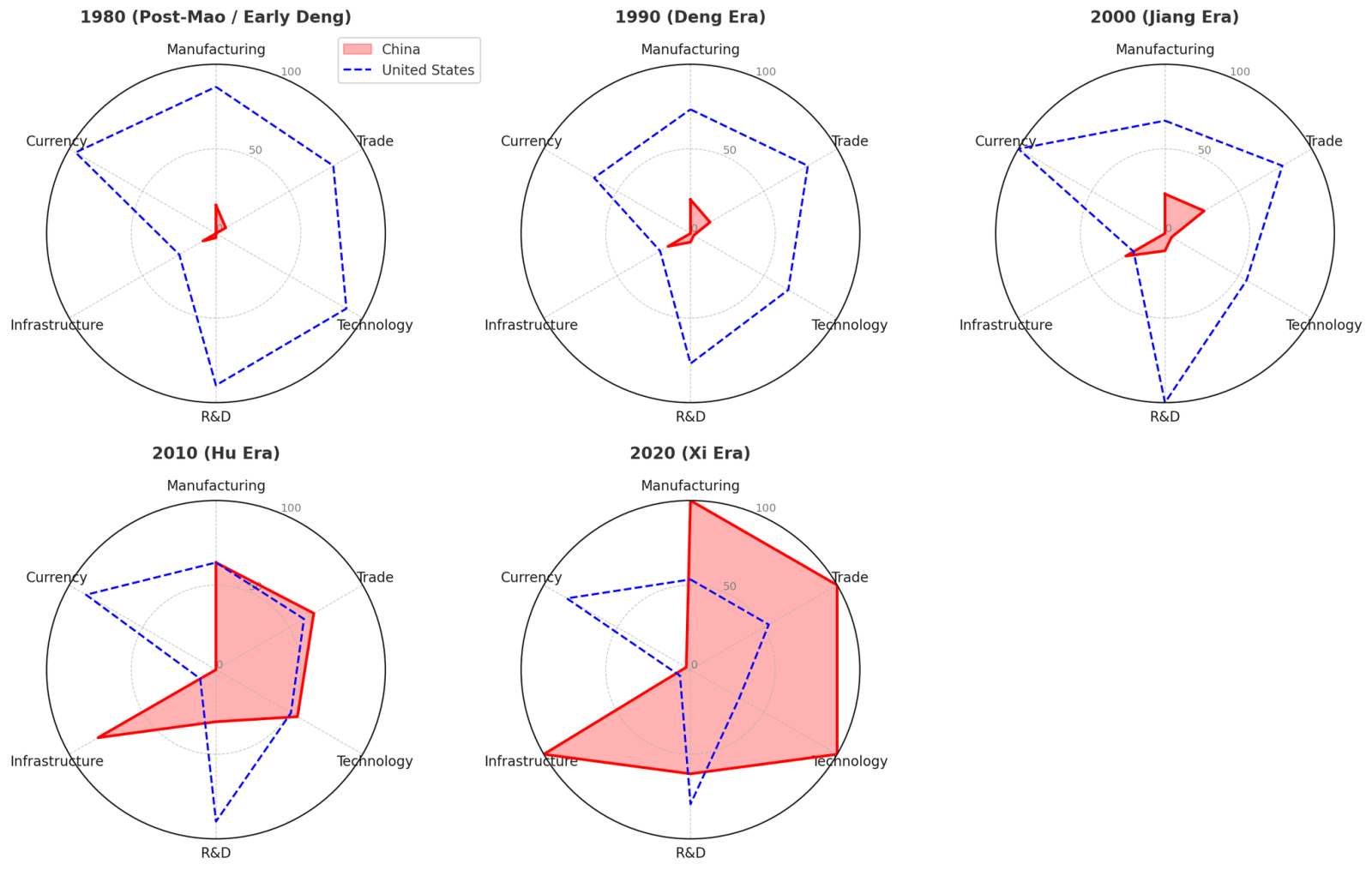
Radar charts comparing China (red) vs. U.S. (blue dashed) across key power metrics in 1980, 1990, 2000, 2010, and 2020. Each axis is scaled so that 100 = highest value achieved by either country on that metric (see text for definitions). China’s dramatic expansion across most axes – especially manufacturing, trade, technology, and infrastructure – is evident, while the U.S. retains an edge in currency and remains competitive in R&D.
Data Consistency: Reliable data before 1980 are limited. Early figures (e.g. 1950s–1970s) are based on historical estimates or proxies and are annotated. For example, China’s pre-1980 patent and R&D activity were negligible (thus treated as ~0%), and RMB reserve use was effectively zero before its recent internationalization. All metrics are scaled to 0–100% of the peak observed value (for either country) to facilitate comparison. Below, we present a radar chart for each period, with China in red (area filled) and U.S. in blue (dashed line), followed by an explanation of the trends.
Synthesis
1980 – Post-Mao / Early Deng: Low Base, U.S. Dominance. China circa 1980 was a minor economic power – its radar footprint is tiny on all dimensions except a slight presence in steel production. The United States, by contrast, led in manufacturing, trade, technology, and finance. This period set the baseline: China was starting far behind the U.S., with an economy mostly focused on domestic needs. The stage was set for rapid changes once China’s reforms accelerated.
1990 – Deng Era Reforms: Gaining Ground in Trade and Industry. By 1990 China had moved out of the periphery in some areas: it was becoming a significant mid-tier manufacturer and exporter. The radar shows modest growth in the Manufacturing, Trade, and Infrastructure axes for China (red), reflecting the early fruits of reform. However, China was still far behind the U.S. in advanced technology, R&D, and international finance – those remained dominated by the U.S. and other G7 nations. China was best described as an up-and-coming industrializing economy at this point, not yet a true global power.
2000 – Jiang Era Globalization: Rapid Climb Pre-WTO. By 2000 China was no longer a peripheral player. Its share of global manufacturing and trade had grown several-fold since 1980, and it had built world-leading industrial capacity (e.g. in steel and other basic industries). The radar chart shows a broader red profile – especially on Manufacturing, Trade, and Infrastructure – reflecting China’s emergence as a major manufacturing power. Still, China lagged in the highest value areas: technology innovation, R&D, and global finance. The U.S. at 2000 was still ahead on all axes in absolute terms, but the gap in the economic and industrial dimensions had begun to narrow.
2010 – Hu Era Emergence: China Becomes a Peer Rival. By 2010 China had clearly become a peer competitor to the U.S. in economic might. The radar chart shows China’s capabilities converging with or even exceeding the U.S. in manufacturing output and trade – a historic shift. China’s innovation drive was starting to pay off, and its sheer industrial capacity was unmatched (for example, producing nearly half the world’s steelepi.org by this time, indicating an ability to out-build any other nation). The U.S. still led in finance (the dollar’s supremacy) and maintained an edge in R&D investment and some advanced technologies, but the margin was thinning. The 2010 snapshot essentially captures China’s arrival as a central global economic power, though not yet equal in soft power or finance.
2020 – Xi Era Dominance: Superpower Status (Except in Currency). By 2020, China had firmly arrived as a global superpower across multiple dimensions. The radar chart’s red shaded area is expansive – China leads (or is on par with the U.S.) in manufacturing output, trade, technology output, infrastructure capacity, and has become a close second in R&D investment. This reflects a transformation from the late 20th century: China now drives global growth and innovation in many fields. The U.S., while still a formidable power (especially in finance, defense, and certain technologies), now faces a peer with comparable economic clout. The only metric where China remains an outlier is reserve currency status, underscoring that financial power lags China’s economic power – the U.S. dollar-centric global financial system persists, giving the U.S. continued influence (and a vulnerability for China). Overall, the 2020 data illustrate China’s transition from a poor, isolated country in 1980 to a central pillar of the world economy in 2020 – an unprecedented rise in such a short time.
China’s rise over these leadership eras is clearly reflected in the comparative radar charts. Under Mao (1950s–70s), China was a minor contributor to global economic metrics. Following Deng’s reforms (1980s–90s), China began a steady ascent in manufacturing and trade. By Jiang and Hu’s tenure (2000s–2010s), China had become a top-tier industrial and trading nation, with huge gains in technology and infrastructure. And under Xi (2010s–20s), China has in many respects become a global powerhouse rivaling or surpassing the United States in economic scale and technological output.
However, a few caveats:
- Data Quality: Early-era figures (pre-1980) are rough estimates. The lack of reliable data for Mao-era China required using proxies (e.g. GDP or output shares) – but the overall trend of a low baseline is unambiguous. From 1980 onward, we relied on consistent data from the World Bank, UN, IMF, WIPO, SIPRI, and industry associations. All axes were normalized to emphasize relative gains, so the charts highlight trends rather than exact quantities. For instance, Manufacturing and Trade axes use percentage shares (which control for global growth). In contrast, R&D and infrastructure axes reflect absolute effort where the world totals also grew – thus China’s improvement there is even more impressive than the percentage share alone might indicate.
- Metric Scope: Some important aspects of power are not directly captured. For example, military power (arms technology, defense spending) is not shown – although China’s advances in manufacturing and R&D translate into greater military-industrial capacity (China now has the second-largest defense budget and indigenous weapons development). Human capital (education levels, STEM graduates) is another area where China made huge strides (now graduating far more engineers than the U.S. annually), feeding into the Technology and R&D axes implicitly. We also included infrastructure (steel output) as an unconventional axis to illustrate capacity that underpins initiatives like the Belt & Road – this is a proxy and doesn’t directly measure quality of infrastructure or things like energy production, but it aligns with China’s well-known construction boom.
- Scope Limitation – Supply-Side Focus: Our analysis centers on supply-side metrics that capture tangible production and export capacities. This focus reflects China’s state-led drive to enhance manufacturing, innovation, and infrastructure (e.g., through initiatives like MIC2025). However, this approach does not incorporate critical demand-side dimensions such as service exports, domestic consumption, capital market influence, and network effects. These factors are essential for a complete picture of economic power but require separate data and methodological approaches. Their integration is a planned avenue for future research.
- Residual U.S. Strengths: While the charts might imply China has surpassed the U.S. across the board, it’s important to note areas where the U.S. still holds qualitative or structural advantages. The U.S. remains the leader in cutting-edge innovation in many sectors (e.g. software, aerospace) and hosts the world’s deepest financial markets (the dollar’s reserve status being one indicator). The efficiency and value-added of U.S. manufacturing is higher in certain advanced industries (semiconductors, aircraft) even if output share is lower. And critically, alliances and soft power – not captured by economic metrics – still favor the U.S. China’s rise has also created dependencies (for instance, other nations rely on Chinese manufacturing, but China in turn relies on imported high-tech components and overseas markets). These nuances mean that raw percentages only tell part of the story.
Underlying Dataset (1990 vs 2022):
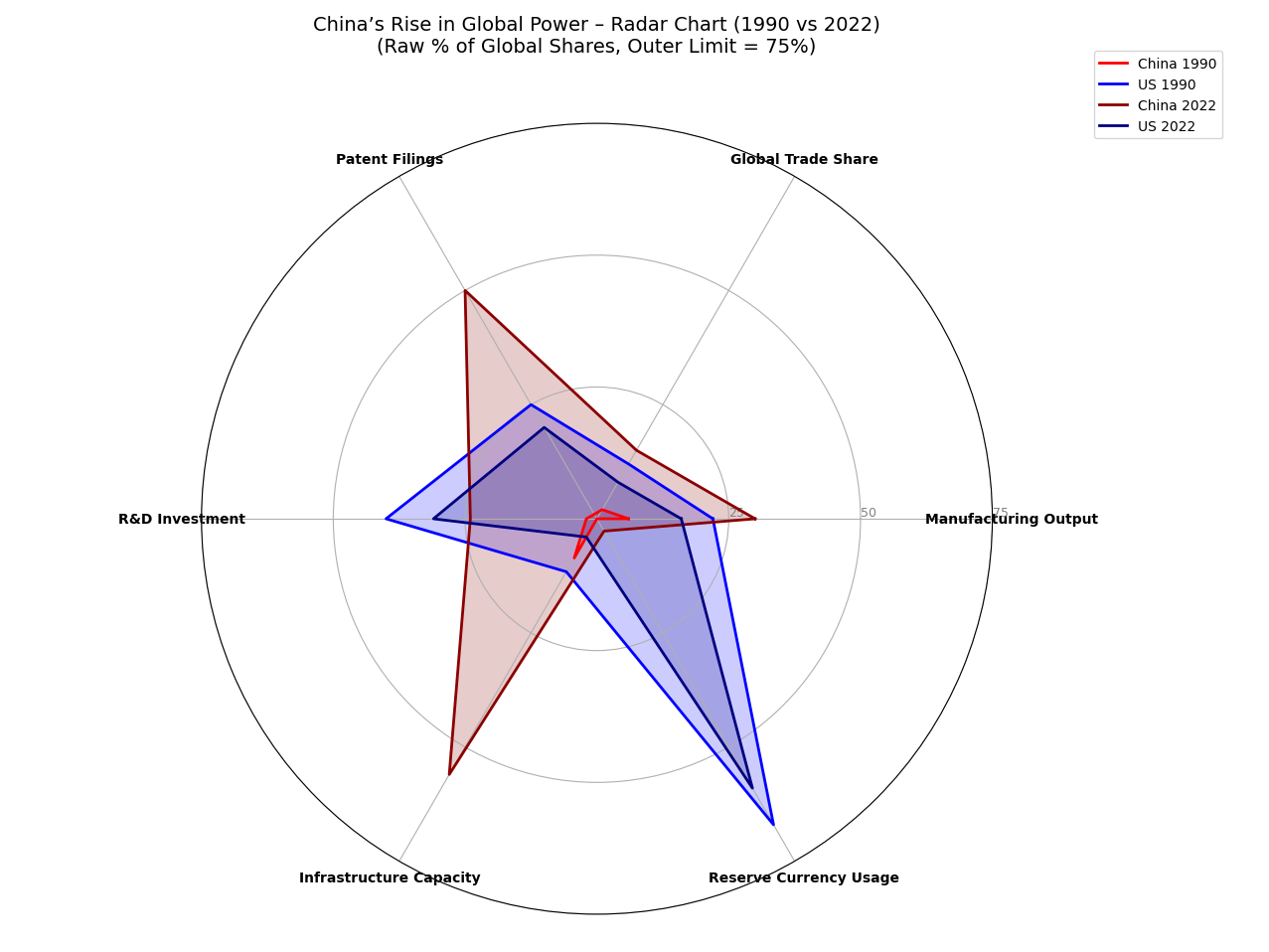
In this radar chart comparing key supply‑side metrics for China and the United States in 1990 and 2022, each metric is presented as the raw percentage share of a global total on a 0–75 scale. We deliberately focus on these production‐oriented indicators because they provide a clear, measurable insight into the state-led industrial and technological transformation that has propelled China’s resurgence.
| Country-Year | Manufacturing Output (%) | Global Trade Share (%) | Patent Filings (%) | R&D Investment (%) | Infrastructure Capacity (%) | Reserve Currency Usage (%) |
|---|---|---|---|---|---|---|
| China 1990 | 6 | 2 | 1 | 2 | 8.6 | 0 |
| US 1990 | 22 | 12 | 25 | 40 | 11.6 | 67 |
| China 2022 | 30 | 15 | 50 | 24 | 56 | 2.7 |
| US 2022 | 16 | 8 | 20 | 31 | 4 | 59 |
Key Messages:
- US Supply-Side Decline:
The data show that the United States has experienced relative declines in key production-based dimensions. Its share of global manufacturing, goods exports, patent filings, R&D investment, and infrastructure capacity has diminished over time relative to its historical peak. - China’s Explosive Growth on the Supply Side:
In contrast, China has surged in every supply-side measure. From 1990 to 2022, China’s manufacturing output increased from 6% to 30%, its goods export share from 2% to 15%, its patent filings from 1% to over 50%, its R&D investment from 2% to 24%, and its infrastructure capacity from 8.6% to 56%. These changes vividly illustrate a transformative, state-led push that has redefined China’s role in the global economy. - The Reserve Currency Exception:
While China has almost universally outpaced the US on the supply side, it remains a junior player in reserve currency usage—reflecting not a failure of policy but rather a deliberate, cautious approach to financial liberalization. The US dollar’s entrenched dominance (67% in 1990, 59% in 2022) is maintained by deep financial markets and long-established institutions. This gap highlights that while China has dramatically enhanced its production capabilities, it has not yet fully translated these gains into global financial influence.
Conclusion
In summary, the comparative radar charts underscore the narrative of the past 40 years: China transformed from an isolated, agrarian economy to an industrial and technological superpower. Across successive leadership eras – from Mao to Deng to Jiang to Hu to Xi – China systematically expanded its share of global manufacturing from ~5% to ~30%, its share of trade from <1% to ~15%, and became the top producer in critical technologies and infrastructure inputs. This rapid catch-up (and in some areas overtaking) of the United States is historically unprecedented. The only dimension where China remains a junior partner is international finance (the U.S. dollar’s dominance). Going forward, whether China can translate its economic might into equal financial and institutional influence – and how the U.S. and China manage this power transition – will be central questions for the coming decades.
This focused analysis underscores that while China’s state-led policies have propelled its supply-side ascent, achieving a truly mature and resilient economy will require further development on the demand side. China is actively working to rebalance its economy—expanding domestic consumption, service exports, and capital market influence—to strengthen its overall resilience. These demand-side strategies, which align with initiatives like Dual Circulation and MIC2025, remain a key area for further research and analysis.
Sources
- China’s Economic Rise: History, Trends, Challenges, and Implications
- “Surging Steel Imports Put Up to Half a Million U.S. Jobs at Risk,” Economic Policy Institute
- “China: The Rise of a Trade Titan,” UNCTAD
- “The Development of China’s Export Performance,” IMF
- “China’s Drive for Leadership in Global Research and Development,” CSIS
- “Animated Chart of the Day: World’s Top Ten Manufacturing Nations, 1970–2017”
- “China is the World’s Sole Manufacturing Superpower: A Line Sketch of the Rise,” VOXEU/CEPR
- “The World’s Top 10 Manufacturing Nations Since 1970,” FEE
- “China Is the Largest Contributor to Global Patent Applications, Substantially Ahead of Other Countries,” Our World in Data
- “Status of the U.S. Dollar as Global Reserve Currency: Share Drops to Lowest Since 1995,” Wolf Street
- “Global Crude Steel Output Decreases by 0.9% in 2020,” World Steel Association
- “Chart: China Is the World’s Manufacturing Superpower,” Statista
- “What Can Patent Data Reveal About U.S.-China Technology Competition?” CSIS
Outlook: China’s Path in a New Multipolar World
As China moves forward, its strategic mindset appears to be one of guarded confidence. The guarded aspect is that leaders know significant challenges lie ahead – slowing economic growth, an aging population, potential pushback from a U.S.-led coalition, and technological bottlenecks. The confident aspect is they believe the “East is rising, West is declining” (a phrase sometimes used in CCP circles) and that time and momentum are on China’s side provided they steer carefully. Xi’s remark to Putin about changes unseen in a century indicates this belief that a historic power shift is happening.
Thus, China is likely to continue pursuing its goals assertively but methodically. We can expect:
- Continued Military Modernization: aiming for parity or superiority in the Western Pacific by the 2030s to secure its regional interests (especially Taiwan contingency). But likely avoiding outright war unless they calculate the balance has shifted enough to win quickly (a very delicate judgment).
- Intensified Tech Self-Reliance and Innovation: If the U.S. decoupling persists, China will pour even more resources into breaking through in semiconductors, biotech, aerospace, etc. It may lag a bit but hope to eventually leapfrog via alternative techniques or sheer scale of research.
- Economic Adaptation: managing a transition from high-speed growth to high-quality growth. The leadership will try to ensure the economy stays stable (no hard landing) because economic strength underpins legitimacy and power. Dual circulation and boosting domestic consumption will be key to reduce vulnerability.
- Global Diplomatic Activism: promoting frameworks that suit Chinese interests – maybe expanding BRICS influence, championing “global security initiative” as counter to alliances, mediating in conflicts to show leadership (as China did between Saudi and Iran in 2023). It will present itself as a pillar of multilateralism in contrast to perceived U.S. unilateral sanctions, to win hearts in Global South.
- Caution not to Unite Opponents: China will likely calibrate actions to avoid pushing countries firmly into the U.S. camp. For example, it might moderate certain behaviors in Southeast Asia to prevent a fully hostile ASEAN, or offer economic carrots to Europe to decouple less from China. It will exploit any transatlantic rifts or differences in threat perception (Europe sees China more as partner/competitor than outright enemy) to prevent a monolithic anti-China front.
- Persistent Ideological Control at Home: The CCP will tighten its monopoly on power to mitigate any instability from domestic issues (economic inequality, etc.). Nationalism will remain the rallying cry to keep the public supportive of the grand strategy despite sacrifices.
In strategic thought, China doesn’t see its rise as aggressive but as restoring a natural order where it’s a top power. It often says it seeks a “community with a shared future for mankind” rather than hegemony. Skeptics note that in practice this looks like a world where China’s interests are respected as paramount in its region and significantly influential globally – which is essentially what any great power would want. So in realism terms, China wants to maximize its power until it feels secure and can shape the system to its advantage.
One might recall Deng’s teaching: “never claim leadership.” Under Xi, China is now essentially claiming a form of leadership (in globalization, climate, etc.), albeit couching it as co-leadership or a new type of great-power relations. The strategic rationale is that as China grew stronger, hiding capabilities became neither necessary nor practical; now it is moving through a window of opportunity where it can increasingly mold the environment. Yet, Xi also insists China “will never seek hegemony or expansion.” This is partly a messaging to avoid alarming others—consistent with China’s long-established “peaceful rise” doctrine—and partly a reflection that China believes it can achieve dominance through economic and diplomatic means rather than colonial-style expansion.
Ultimately, China’s strategic mindset is unsentimental and focused on outcomes. It respects strength and will adjust if met with strength (for example, if a certain line is firmly resisted by many nations, China might hold off and try later differently). Conversely, it will seize opportunities created by others’ weaknesses or distractions. It is neither irrational nor implacably aggressive; it’s highly strategic. That means competitors can negotiate or shape its choices if they understand its interests. But it also means underestimating China’s resolve to achieve what it sees as core interests would be a mistake – it has shown willingness to bear costs for things like territorial integrity or tech independence.
From Mao’s time to now, the constant is the pursuit of power to secure China’s place. The methods have shifted from revolutionary wars to factory floors to cyberspace, but the objective remains: never again weak, never again vulnerable, and ultimately dominant enough to set the terms of the international order rather than be subject to them. This is power politics at its heart, albeit executed in a distinctly Chinese way – with patience of a long civilization, with blending of economic and military tools, and with an eye on both past lessons and future aspirations. China’s grand strategy, as it stands, is an intricate and adaptive campaign to emerge as the central power of a multipolar world, on its own terms and in defiance of any who would prevent that. It is a story still unfolding, but one whose direction has been clearly charted by Beijing’s current rulers.

Conclusion
China’s rise is far from an accident of history; it is the product of deliberate strategic engineering by a leadership that has fused lessons from China’s past, Marxist-Leninist statecraft, and modern realpolitik. At its core, China’s grand strategy is about amassing comprehensive national power to secure the nation’s rejuvenation and insulate it from coercion. In pursuing this, Beijing has displayed a striking consistency of purpose across eras – from Mao’s drive for sovereignty, through Deng’s economic revolution, to Xi’s push for technological and military might – even as tactics and tone have shifted.
We have seen how historical memory shapes China’s worldview: the humiliation by foreign powers forged a resolve to never be weak again, the Soviet collapse warned the CCP to never loosen its grip or let the economy falter, and ancient philosophies gave intellectual heft to centralized authority and pragmatic governance. These factors imbue Chinese decision-makers with a unique blend of patience and urgency – patient in not rushing unready into showdowns, urgent in not wasting the moment of opportunity that now presents itself.
China has leveraged its state-controlled development model to synchronize the instruments of power. Meticulous Five-Year Plans and industrial programs like Made in China 2025 have upgraded its economic and technological base, while initiatives like the Belt and Road and dual circulation extend its influence and reduce vulnerabilities. Across energy, infrastructure, AI, and manufacturing, China has positioned itself to hold critical advantages, often turning Western assumptions of open markets into opportunities to quietly dominate sectors. In parallel, it has methodically modernized a military capable of challenging the U.S. in Asia, and fortified an internal security regime that blunts any subversive forces.
Crucially, China frames its choices through its own strategic lens. It is not merely reacting to the West; it is executing a long-term plan to reclaim what it sees as its rightful status. Western actions – whether engaging, containing, or sanctioning – are variables in Beijing’s calculus, but they do not derail the fundamental trajectory. If anything, moves like U.S. tech restrictions simply reinforce to China why it must double down on self-reliance. Instead, Beijing navigates a complex global transition by methodically pursuing its core interests while managing challengers in an increasingly multipolar landscape where technological, economic, and traditional security considerations are all in play.
The tone underpinning China’s strategy is unmistakably hard realpolitik. Despite the frequent invocations of win-win cooperation, the CCP leadership views international affairs as a contest of power in which China must come out on top to safeguard its regime and nation. Morality or ideology beyond nationalism rarely constrain their decisions – when core interests are perceived as threatened, China responds decisively with measures like economic coercion against trading partners or militarization of disputed seas, consistently framing these as defensive reactions to foreign interference in its internal affairs. Agreements and norms are respected insofar as they align with China’s interests; when they do not, China seeks to reinterpret or replace them. This is not to say China is reckless – on the contrary, it is exceedingly calculating – but it is unsentimental about doing whatever it deems necessary to achieve its ends.
Going forward, the world will increasingly feel the impact of China’s rise on China’s terms. China’s technological and industrial prowess are now fundamental factors in global power dynamics. Nations will have to contend with a China that can offer or withhold critical technologies and investment, a China that can project military force and economic influence in tandem, and a China that expects deference to its red lines. For the international community, especially established powers, the challenge is how to respond to a China that is both an engine of economic opportunity and a determined strategic competitor. Crafting policies that protect their interests without sliding into disastrous conflict will require equal parts firmness and farsighted engagement – essentially, a realpolitik of their own.
In sum, China’s grand strategy as examined is one of relentless strategic ambition guided by a clear-eyed assessment of power. It marries the long memory of a great civilization with the tools of modern statecraft to pursue a vision: a China restored to wealth and strength, beholden to none, and influential enough to shape the world order around its interests and values. Whether that vision fully materializes will depend not only on China’s continued execution but also on how the rest of the world adjusts and responds. What is certain, however, is that China will press forward with confidence in its path – a path that has already transformed the global landscape and promises to redefine the balance of power in the decades ahead.
References (boxes and data points references excluded):
- Confucianism & Legalism (Routledge)
- Xi’s Speech at 14th NPC (Gov.cn)
- Xi Fixated on Humiliation (Politico)
- Self-Reliance in 14th FYP (CFR)
- Dual Circulation (Reuters)
- Made in China 2025 (Wikipedia)
- Counter-Coercion: Senkaku Trawler (CSIS)
- China’s AI Plan (SCMP)
- China Dominates Rare Earths (IER)
- US–China Chip War (Citigroup)
- Not Rising but Rejuvenating (Diplomat)
- Political Thought of Xi (Oxford)
- 75-Year Quest for China Greatness (Diplomat)
- Chinese Perspectives on BRI (INSS)
- How China Leads Solar/Battery (Dialogue.Earth)
- Rare Earth → EV Dominance (RareEarthExchanges)
- Tech Metals Report (InvestorNews)
- Block Processing & Battery Tech (MetalTechNews)
- China Stocked Up on Chips (The Register)
- China’s Path to Tech Superpower (AsiaFundManagers)
 The Carbon Compass