
As the world confronts the imperative to reduce greenhouse gas emissions, the spatial dimension of energy transitions emerges as a key—yet often underappreciated—factor. This article focuses on how power density (the rate of energy production or consumption per unit area) deeply influences the feasibility of large-scale deployments, from fossil fuels and nuclear plants to wind farms and solar arrays. By drawing on the influential work of Vaclav Smil—and integrating insights from other leading studies—we examine how changes in supply-side densities ripple across the broader energy value chain, shaping land use, infrastructure requirements, and policy choices at the macro level.
In particular, we delve into how decarbonization, which often relies on lower-density renewables, could reconfigure today’s energy landscape. Historically, societies have enjoyed the benefits of more compact, high-density resources—especially fossil fuels and nuclear. Yet, as new systems scale, land footprints can balloon, raw material demands intensify, and community acceptance grows complicated. This article connects these spatial considerations with the broader socio-technical challenges of sustaining modern standards of living, dense urbanization, and industrial productivity. In a forthcoming companion piece, we will explore another fundamental dimension—time—highlighting how deployment rates, innovation diffusion, and infrastructural inertia further constrain or enable the transitions underway.
Below is the main text of the article, followed by a set of boxes that deepen specific themes and data points related to power density, supply-chain footprints, policy scenarios, and historical trends. Our aim is to provide a clear, data-driven framework for understanding how decarbonization scenarios hinge on the physical constraints of land, resources, and infrastructural evolution, thereby clarifying the strategic choices facing policymakers and industries in the decades ahead.
Chapter 1: Introduction
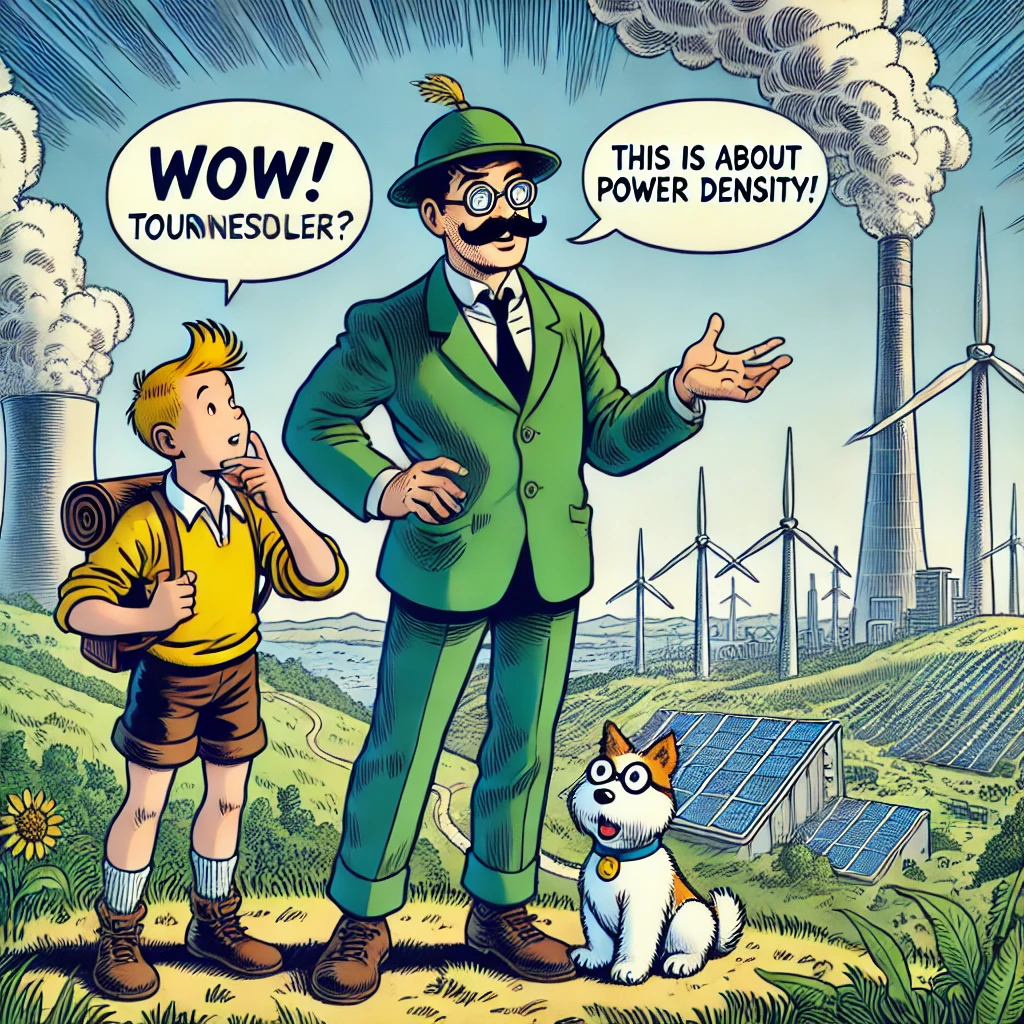
Energy shapes every sphere of human activity, from local farming and transportation systems to globally integrated supply chains and industries. Yet one dimension of energy is often overlooked in policy debates and public discourse: power density, or the rate at which energy can be produced (or consumed) per unit of land area (commonly expressed in W/m²). Developed extensively by Vaclav Smil, this concept clarifies why certain resources—like coal, oil, and nuclear fuel—dramatically reshaped societies through their capacity to deliver large amounts of power from relatively small footprints, while other sources—such as wind, solar, biomass, or low-head hydropower—tend to occupy far more space to achieve comparable outputs.
Today, calls for rapid decarbonization add urgency to understanding power density. For much of the industrial era, ever-denser energy sources propelled urbanization, mechanized agriculture, and mass production. Now, however, efforts to reduce greenhouse gas emissions encourage an expanded role for renewables and alternative systems that, by nature, are lower in power density and more spatially dispersed. This shift has far-reaching implications for land use, materials supply, infrastructure design, and the policymaking that governs them. While power density is only one yardstick in evaluating energy systems—costs, carbon intensity, reliability, and environmental footprints also matter—it nonetheless provides a powerful lens for grasping how disruptive (or feasible) large-scale transitions can be.
In the chapters that follow, we trace the historical evolution of power density, showing how dense fossil fuels and nuclear energy shaped modern infrastructures, and how current reliance on wind, solar, biomass, and certain hydropower projects reverses a centuries-long trend of growing spatial efficiency. We then examine data-driven insights that illuminate the physical and technological realities of scaling lower-density resources. Next, we explore the challenges and uncertainties that arise from constructing a global energy system around distributed, intermittent flows—highlighting issues of land availability, supply chain constraints, public acceptance, and cost. Finally, we conclude with reflections on how policymakers, industries, and societies might navigate these multifaceted pressures and seize emerging opportunities for innovation.
By positioning power density at the forefront of the conversation, this article underscores that decarbonization is not merely about replacing one type of fuel with another. Rather, it is a fundamental reconfiguration of physical infrastructure, economic structures, and social habits. Understanding where power density fits among the broader suite of energy metrics can help us set more realistic timelines, craft better-aligned policies, and unlock creative solutions suited to the complexities of a lower-carbon world.
Chapter 2: Historical Evolution and the Power Density “Reversal”
The story of power density begins with the pre-industrial reliance on biomass—wood, crop residues, and animal muscle—where energy fluxes typically amounted to only 1 W/m² or so. Waterwheels in certain high-head locations could improve on this figure, but most pre-industrial societies were still constrained by the limits of photosynthesis and local hydrological conditions. Populations remained relatively dispersed, cities took shape near waterways and forests for fuel, and manufacturing was scaled to the modest output of small mills or blacksmithing forges.
The Industrial Revolution radically changed those spatial and energy relationships. Coal seams enabled extraction rates of hundreds of W/m² at the mining face, powering steam engines, railroads, and factories that congregated in coal-rich regions. The next leap came with oilfields, where wells could surpass 1,000 W/m² at the wellhead, driving internal combustion engines and global shipping. Natural gas, transported through pipelines and delivering similarly high densities at central power plants, further extended the reach of these fossil-based systems. Nuclear energy, developed in the mid-20th century, offered a still higher site-based density by producing gigawatts from a few square kilometers of land—though fuel cycles and waste management introduced complexities often left out of basic calculations.
By the late 20th century, these dense energy sources had converged into networks that could generate power at large scales from relatively compact footprints. Coal-fired stations, oil refineries, and nuclear plants underpinned grids worldwide, freeing land for other uses and fostering the rise of heavily industrialized metropolises. Yet this historical pattern of rising density now faces a decisive shift. As Vaclav Smil emphasizes, decarbonization strategies prioritize renewables with substantially lower densities. Wind farms rarely exceed 1 W/m² to 2 W/m², utility-scale solar installations often range between 5 W/m² and 20 W/m², and biomass plantations regularly struggle to surpass 1 W/m² given photosynthetic ceilings and land-use competition. Hydropower, while potentially high in mountainous regions, often spreads energy outputs across large reservoirs when built in flatter terrains, yielding densities that may drop below 1 W/m² in extreme cases.
This shift toward lower-density resources—what Smil calls the “fourth grand transformation” of humanity’s energy system—reverses the centuries-long pursuit of more compact fuels. Instead of centralizing power at a handful of mines or reactors, renewables require many dispersed installations, each harvesting diffuse flows of sun, wind, or biological growth. The differences go beyond land footprint: the infrastructure for extraction, distribution, and conversion must also stretch across broad geographies, complicating everything from grid design to supply chains for materials like steel, copper, and rare-earth elements. The very nature of energy’s physical footprint is changing, and with it, the organizational and societal structures that once flourished under dense fossil-fuel regimes.
Understanding this reversal in power density sets the stage for the chapters that follow. While fossil-fueled industrialization built metropolitan centers around compact energy sites, the next era may require a more decentralized pattern of generation—an outcome with profound implications for land use, community engagement, and the rate at which energy infrastructure can be built or dismantled. By tracing these historical and current trends together, we see how any meaningful shift away from coal, oil, gas, and conventional nuclear must grapple with a return to the broader spatial footprints characteristic of wind farms, solar arrays, and biomass plantations. This fact alone helps explain the complexity of the modern energy transition and underscores the need for data-driven, holistic planning.
Box 1: Long-Term Trends in Power Density and the Balance Between Supply and Demand
The historical record shows that shifts in energy supply—especially in power density—run parallel to deep transformations in how societies organize production, settlement, and consumption. In the pre-agricultural era, humankind relied on foraging and hunting, tied directly to low-density biomass flows; in advanced industrial societies, people draw on dense fuels like coal or oil, or on nuclear reactors whose small footprints power entire cities. As climate imperatives push us toward lower-density renewables, this box explores whether our heavily “compacted” demand side—embodied in dense cities, industrial processes, and advanced infrastructure—can remain at odds with the “decompacting” of supply that relies increasingly on more diffuse wind, solar, or bioenergy.
1. Tracing the Evolving Supply–Demand Equilibrium
1.1 Pre-Farming Eras (Foraging & Hunting)
- Low-Density Biomass:
Early hunter-gatherers relied on wild plants and animals, with power densities often below 0.1 W/m². Gathering enough calories required a large territory. - Dispersed Demand:
Populations were small and highly mobile. Typical settlement densities might be 0.01–1 person/km². The energy system (directly capturing local biomass) matched the spread-out nature of demand.
1.2 Early Agriculture & Shifting Cultivation
- Incremental Increase:
Domestication of cereals, livestock, and horticulture raised biomass yields slightly (often 0.2–0.5 W/m² for fields) but still below 1 W/m². Settlements became more stable. - Emergence of Towns:
People coalesced around fertile land and waterways, but overall population density remained low. Demand was still mostly on-site food and fuels (wood, dung), matched by similarly low-density supply.
1.3 Traditional Agrarian Civilizations
- More Organized Farming:
Systems like wet-rice cultivation in China or advanced irrigation in Mesopotamia nudged agricultural power densities toward 0.5–1 W/m². Over centuries, some regions attained yields that supported cities and specialized crafts. - Rise of Urban Cores:
Even with robust farming, only a fraction of the population could afford to live in large cities—since the hinterland still had to sustain them. Nonetheless, an emerging disparity between slightly denser supply (well-managed farmland) and denser urban demand led to early trade in fuels (charcoal, firewood) and food.
1.4 Industrial Revolution & Fossil Fuels
- High-Density Breakthrough:
Coal seams, oil wells, and natural gas fields delivered hundreds to thousands of W/m² at the extraction face. This radical jump in supply density empowered railroads, steam engines, and later automobiles. - Massive Urban Growth:
Dense fossil energies enabled urban agglomerations: London, New York, Tokyo soared in population. Factories concentrated in industrial centers, drawing on dense power flows. The supply–demand system grew compact: a coal mine or oil field, plus a cluster of power plants or refineries, could support millions of city dwellers.
1.5 Post-War & Late 20th Century (Nuclear & Global Oil)
- Further Compaction:
Nuclear plants exceed 1,000 W/m² in narrow calculations at the reactor site. Oil and gas, too, can produce vast amounts of energy from small well pads. Global supply chains (super-tankers, pipelines) reinforce this high-density supply. - Megacities & Consumer Lifestyles:
Car-centric suburbs and skyscraper-filled downtowns define demand. The electricity grid, fed by few but powerful nodes (coal, nuclear, gas plants), fosters lifestyles heavily reliant on on-demand energy services.
2. A Potential “Reversal”: Lower-Density Supply vs. High-Density Demand
Today, the drive to decarbonize compels a pivot from fossil fuels (and in some cases nuclear) toward renewables—with typical power densities of 1–20 W/m² for wind and solar, even lower for biomass. This “decompacting” on the supply side collides with continued “compacting” on the demand side: ongoing urbanization, global supply chains reliant on just-in-time logistics, and high peak loads in dense industrial or commercial centers.
- Urbanization Continues:
Over half of humanity now lives in urban regions, expected to reach ~70% by 2050. Metropolitan areas from Tokyo to Mumbai have tens of millions of inhabitants. - Distributed Low-Density Generation:
Wind or solar can be sited near consumption, but large-scale deployment frequently occurs where resources are strongest (e.g., desert solar, windy plains), necessitating extensive grids. - Bioenergy & Land Conflicts:
Using farmland for energy crops often competes with food. Cities have soared in size, partly because rural land is highly productive at feeding them. If that farmland diverts to biomass fuels, less area remains for food or biodiversity.
3. Historical Patterns of Supply–Demand “Compactness”
| Era | Approx. Timeline | Supply Density (Indicative) | Demand Density | Typical Per-Capita Energy Use (GJ/cap/yr) | System Characteristics |
|---|---|---|---|---|---|
| Pre-Agricultural | Until ~10,000 BCE | < 0.1 W/m² (wild biomass) | ~0.01–1 person/km² | < 5 GJ/cap/yr (mainly food & simple fuels); wide range (2–10 GJ/cap/yr observed in some foraging societies) | Small, mobile groups reliant on direct biomass. Gathering/hunting yields minimal surplus. |
| Early Agriculture | ~10,000 BCE to ~3,000 BCE | 0.2–0.5 W/m² (basic crops) | 1–10 people/km² in stable settlements | ~5–15 GJ/cap/yr typical (basic cereals, wood fuels). Yields ~1–2 t/ha in some cereals → ~10–20 GJ/ha/yr | Some surplus enabling proto-urban hubs, but still modest total energy usage. Land mostly for staple crops and small herds. |
| Traditional Civilizations | ~3,000 BCE to ~1700 CE | ~0.5–1 W/m² (intensive farmland) | 10–100 people/km² in city-states | ~15–30 GJ/cap/yr in more prosperous regions; farmland yields 2–3 t/ha, ~20–30 GJ/ha/yr. | Irrigation, crop rotation, more urban trade. Charcoal/wood main fuels; surpluses feed specialized crafts. Urban population still a small fraction overall. |
| Industrial Revolution | ~1700 CE to late 1800s | 100–500+ W/m² (coal, steam) | 100–1,000+ people/km² (industrial cities) | ~30–70 GJ/cap/yr by mid-19th century in Europe; rising to ~80–120 GJ/cap/yr in advanced industrial centers by late 19th century | Coal mining, steam engines, railroads enable intense urbanization. Dense energy flows feed factories and growing cities. Commodity production soars. |
| 20th Century to Present | ~1900s to early 2000s | 500–2,000+ W/m² (fossil/nuclear) | 1,000–10,000+ people/km² (megacities) | In affluent countries often 150–300 GJ/cap/yr (oil, gas, electricity). Some regions exceed 400 GJ/cap/yr. | Oil, gas, nuclear with global trade networks. Car-centric suburbs, air travel, consumer goods flourish. On-demand power fosters modern lifestyles in dense urban clusters. |
| Decarbonized Future? | ~21st century onward? | 1–20 W/m² (wind/solar) or 0.2–0.5 W/m² (biomass) | > 10,000 people/km² in urban cores? | Could be 100–200 GJ/cap/yr (if large efficiency gains) or higher if demand remains robust. Biomass yields might stay near ~30–40 GJ/ha/yr | Supply “decompacts” as renewables need more land. Demand intensifies with megacities, raising questions about whether high living standards can persist under lower-density energy flows. |
(Figures are illustrative orders of magnitude, reflecting broad historical transitions rather than uniform data. “Per capita energy use” often includes food, heating, fuels, or electricity, depending on the era.)
4. Feasibility of Keeping Demand Compact Under Lower-Density Supply
- Infrastructure & Land-Use Pressures
- If supply relies on large wind/solar expansions, the total area used for capturing energy can balloon. Maintaining high consumption nodes in cities demands new or expanded transmission networks.
- In principle, offshore wind or rooftop solar can offset some land claims, but the net shift is still from a few large, high-density extraction sites to many distributed, lower-density installations.
- Does “Decompacting” Demand Become Necessary?
- One hypothesis: if supply density drops, societies might need to spread out or reduce energy demand for an easier match—e.g., less energy-hungry building patterns, more local production.
- Another view: advanced technologies (higher solar panel efficiencies, larger wind turbines) partially mitigate land expansions, while highly efficient end-use appliances offset some demand growth.
- Countertrends
- Urbanization typically raises per-capita energy consumption for transport, HVAC, and services but also can concentrate infrastructure and enable some efficiency gains (mass transit, district heating).
- Digitalization may reduce certain physical demands (paper, commuting) but can raise electricity loads (data centers, device chargers).
5. Lessons from the Past—and a Caution for the Future
Historically, each step up in supply density (coal, oil, gas, nuclear) allowed a more compact, energy-intense civilization—larger and denser cities, rapid transport, sprawling industrial complexes. Reversing that trend, at least in part, means ensuring low-density resources (wind, solar, biomass) can still fulfill the appetites of megacities and advanced industries. If combined with efficient consumption patterns, decoupling “prosperity” from heavy energy usage is possible, but not guaranteed:
- Urban forms might evolve to integrate local generation (rooftop PV, micro-wind) and reduce carbon footprints.
- Demand moderation (e.g., improved building efficiency, electrified transport, rethinking supply chains) could offset some supply “decompacting.”
- High-density corners remain, e.g., nuclear or large-scale hydropower, bridging the gap.
In the end, while low-density supply might clash with dense demand, societies have navigated major transitions before. Just as coal and steam once reconfigured 19th-century urban life, 21st-century decarbonization could spur new solutions—distributed grids, advanced storage, “energy-smart” urban design. Yet the mismatch poses a stark warning: sustaining the affluent, high-powered lifestyle that centuries of dense energy enabled could prove more demanding on land and infrastructure if the global system shifts to resources an order of magnitude (or more) less concentrated.
Concluding Perspective
From the hunter-gatherer epoch to the fossil-fueled industrial age, rising power densities on the supply side propelled more compact societies on the demand side. Cities, industries, and high living standards were all rooted in concentrated energy flows. Now, faced with a pressing need to curb carbon emissions, a move toward lower-density renewables raises questions about whether we can keep demand side so dense and energy-intensive.
- If technology, policy, and urban planning can manage intermittent, distributed renewables at scale, dense cities may persist.
- If not, societies might need to “decompact” or reconfigure demand patterns, potentially reversing the centuries-long trend of extreme urban concentration.
Either way, historical precedent suggests that every major shift in supply density—and the infrastructures enabling it—reshapes not only how energy is produced, but how entire civilizations organize, live, and thrive.

Supporting Note for the Power Density Timeline
This graph illustrates how power density (W/m²) on the supply side has evolved over millennia, alongside a rough estimate of annual energy consumption per capita (in gigajoules). Its primary purpose is to convey the qualitative jump from low-density biomass flows in hunter-gatherer societies to the high-density fossil and nuclear era, and how a future reliant on low-carbon sources might “decompact” supply once again.
Data Caveats and Sources
- Pre-agricultural (Hunter-Gatherers): The chart tentatively shows ~2–10 GJ/cap/yr, but historical reconstructions vary. Metabolic needs alone (food intake) can be on the order of ~1 GJ/cap/yr, and small additional amounts for cooking, shelter, and tool production might raise the total toward a few gigajoules. Some anthropological estimates suggest that certain well-endowed coastal or riparian foraging groups could reach the higher end of that range, while others stayed closer to ~2–5 GJ/cap/yr.
- Early Agriculture: Basic crop cultivation, domestic animals, and modest biomass fuels likely yielded ~5–15 GJ/cap/yr for subsistence and rudimentary workshops. Yields vary by climate, soil fertility, and irrigation.
- Traditional Civilizations: With more intensive farming (irrigation canals, plow techniques, manure/fertilizer), per capita usage could climb to ~15–30 GJ/yr—still largely in the form of biomass (wood, charcoal, straw) but gradually supplemented by small-scale water or wind mills in certain regions.
- Industrial Revolution: Fossil-fuel-based societies in the 18th–19th centuries begin at around ~30 GJ/cap/yr in early industrial centers and rise above 70 GJ/cap/yr by late stages. Steam engines, coal mining, and railroads drastically increase total energy throughput.
- 20th Century to Present: Affluent nations can reach 150–300 GJ/cap/yr (or more), thanks to abundant oil, gas, and electricity. These figures have wide global variation—some countries remain below 50 GJ/cap/yr.
- Decarbonized Future?: Ranges of ~100–200 GJ/cap/yr assume that even with efficiency gains, advanced lifestyles still demand substantial energy. Actual levels could be lower (if policy and behavior significantly shift) or higher (if emerging economies replicate current affluent patterns).
Overall, these numbers serve as heuristic benchmarks, not strict universal truths. Local contexts—such as climate, diet, technological level, and trade—can yield significant variation in per-capita energy usage, especially in premodern eras where comprehensive records are scarce.
Chapter 3: Data-Driven Insights
A full appreciation of power density emerges by scrutinizing the concrete numbers that shape each energy system—from extraction or cultivation, to conversion, distribution, and eventual end use. Vaclav Smil’s work, supplemented by contemporary field data, underscores how these figures translate into real-world land footprints, supply chain demands, and infrastructure choices.
One striking contrast appears when comparing the raw spatial intensities of different sources. Fossil-fuel extraction sites—coal seams, oil wells, and gas fields—can register hundreds or even thousands of watts per square meter (W/m²) at the immediate point of resource removal. Nuclear facilities, focusing solely on the reactor footprint, achieve similarly high or higher densities, often generating gigawatt-scale outputs within a few square kilometers. By contrast, onshore wind farms typically hover between 1 W/m² and 2 W/m² once spacing is factored in, and utility-scale solar installations range roughly from 5 W/m² to 20 W/m² depending on latitude, module efficiency, and mounting designs. Biomass for electricity or liquid fuels usually tops out below 1 W/m² due to photosynthetic limits and competing land needs, though certain high-yield plantations can approach the upper end of that range.
At first glance, these snapshots might seem to imply a simple hierarchy, but more nuanced indicators broaden the picture. Capacity factor—how much of the time a plant runs at or near maximum output—significantly reshapes perceptions of power density. Coal, gas, or nuclear plants can sustain capacity factors above 70 percent, sometimes near 90 percent, whereas wind and solar often operate far below that figure unless sited in especially favorable locations or combined with storage. Even hydropower, which can surpass 50 percent or more, depends heavily on seasonal water availability. Such variations highlight why an onshore wind farm with a nameplate capacity of 1 GW might generate less electricity over a year than a 1 GW gas-fired station operating at a consistently high load.
Lead times for project development further illustrate the complexities. A nuclear reactor might take a decade or more from groundbreaking to commissioning, while large hydro reservoirs can require extensive planning and environmental reviews that stretch for years. Onshore wind and solar farms, in contrast, often need just two to five years per project. Yet scaling them to meet national or global targets involves replicating this build process across vast regions, intensifying demands on capital, labor, and materials. In Germany’s Energiewende, for instance, adding tens of gigawatts of onshore wind has required continuous expansion of turbine manufacturing, grid upgrades, and local permitting efforts. This cascade of parallel projects can strain financing and generate unforeseen logistical challenges.
Another layer of data-driven insight arises when looking beyond nameplate capacity to life-cycle or “system boundary” assessments. Fossil-fuel supply chains include rail corridors, pipelines, and refineries; nuclear’s broader footprint involves uranium mining, fuel enrichment facilities, and waste disposal sites. Renewables have their own upstream footprints, from the extraction of rare-earth elements for turbine magnets to the production of silicon wafers and specialized coatings for solar panels. Factoring in material intensity per unit of energy generated, wind and solar can demand higher volumes of steel, copper, glass, and concrete per megawatt-hour over their lifetimes compared to a compact coal plant—though, crucially, without the ongoing emissions of carbon dioxide.
Hydropower adds its own spectrum of variability. In mountainous regions with steep drops, a small reservoir might yield tens or even 100 W/m². Conversely, sprawling low-head dams spread out over broad floodplains, diluting effective density to 1 W/m² or less. Regardless of the site, large dams inevitably reshape regional ecosystems and can displace local communities, leading some policymakers to focus on run-of-river schemes or expansions of smaller high-head projects.
Together, these data points paint a picture of energy systems that are neither monolithic nor easily reduced to a single metric. Power density remains an indispensable yardstick—particularly for understanding spatial constraints, land-use conflicts, and infrastructure demands—but capacity factors, lead times, resource availability, and material intensity also determine the viability and desirability of large-scale deployment. By analyzing the full chain of inputs and outputs, we see more clearly why moving from dense fossil fuels and centralized nuclear to lower-density renewables reshapes not only power production sites but entire economic and environmental landscapes. It is precisely this systemic impact, made tangible by numbers on land use, capacity, and materials, that frames the next step of the discussion: how to manage and mitigate the wide-ranging challenges inherent in building a global low-carbon future.
Box 2: Power Density Ranges Across Energy Sources and Systems
| Energy Source | Typical Range (W/m²) | Extreme Range (W/m²) | Key Constraints (Lower Range) | Key Enablers (Higher Range) | Effect of Broader Boundaries |
|---|---|---|---|---|---|
| Solar (Utility-Scale) | 5–20 | ~1 (very poor siting/large spacing) to ~30 (top-tier efficiency in deserts) | – Low insolation, cloud cover – Panel spacing, roads, infrastructure – Efficiency < 20 % | – High insolation zones – ≥ 20 % module efficiency – Close-packing/tracking – Rooftop or dual-use installations | – Narrow (module area only): ~15–20 W/m² in sunny spots – Broad (roads, storage, buffers): ~5–10 W/m² |
| Wind (Onshore) | 1–2 | ~0.5 (low wind resource) to ~3–4 (prime onshore corridors); ~6 offshore | – Moderate average wind speeds – Large wake spacing – Capacity factors ~20–35 % | – Strong wind corridors, coasts – Taller turbines, higher CF – Offshore ~40 %+ | – Narrow (just turbine pads): “effective” density can appear higher – Broad (land for spacing, access): ~1–2 W/m² |
| Biomass / Biofuels | 0.2–1 | ~0.1 (marginal yields) to ~2 (high-yield plantations + efficient conversion) | – Photosynthetic ceiling – Competing land use (food vs. fuel) – Suboptimal climate/soil | – Intensive agriculture, irrigation – Energy-dense crops (e.g., switchgrass) – Waste/residue co-firing | – Narrow (plant footprint only): can appear larger – Broad (fields, transport, low net yields): typically < 1 W/m² |
| Hydropower | < 1 (up to ~20) large low-head; ~50–100+ high-head | < 0.5 (huge shallow reservoir) to > 300 (very high-head mountain sites) | – Extensive flooded area – Seasonal/drought flow – Multi-purpose dams (irrigation, flood control) | – Steep topography with narrow gorges – Consistent water flow – Minimizing reservoir size | – Narrow (energy-only share in multipurpose dam): tens to hundreds of W/m² – Broad (full reservoir + ecosystem buffer): can drop below 1 W/m² |
| Geothermal | 2–10 | < 1 (marginal fields) to ~50 (if only counting wellhead/power block in prime sites) | – Low-temperature fields – Multiple wells needed – Varied, complex geology | – Very high-temperature fields (Iceland, volcanic zones) – Efficient plant tech (binary, flash) | – Narrow (plant + immediate well pad): can exceed 10 W/m² – Broad (injection wells, pipelines): ~2–10 W/m² |
| Nuclear | ~70–1,600 (various “low,” “medium,” and “high” scenarios) | ~50 (when including all upstream/downstream) to > 1,600 (plant site alone) | – Uranium mining & enrichment – Cooling towers, safety buffer – Long-term waste storage | – High capacity factors (≥ 80 %) – Small fenced footprint – Advanced fuel cycles | – Narrow (only reactor site): easily > 1,000 W/m² – Broad (full fuel cycle + waste): can fall near 300 W/m² or below |
| Coal | ~300–1,000 | ~100 (less-productive seams) to ~2,300 (high-yield, open-cast focus) | – Low-quality coal – Overburden & reclamation – Transport, spoil heaps | – Thick, shallow seams – Minimal overburden – Mine-mouth power plants | – Narrow (active face only): often > 1,000 W/m² – Broad (spoil, hauling, reclamation): ~300–500 W/m² |
| Oil | ~100–300 | < 50 (heavy oil, remote operations) to > 1,000 (giant “super-giant” fields) | – Declining reservoirs – Extended pipelines, refineries – Complex distribution | – Giant fields (e.g., Ghawar) – High output per well – Short pipeline distances | – Narrow (wellhead core): > 1,000 W/m² in prolific spots – Broad (full chain + refining): often ~100–300 W/m² |
| Natural Gas | ~100–500 | < 100 (shale/tight gas, wide footprint) to > 2,000 (high-pressure conventional wells) | – Fracking multiple pads – Compression, LNG liquefaction – Long pipeline systems | – High-pressure conventional fields – Minimal infrastructure – Nearby markets | – Narrow (single big-flow pad): > 1,000 W/m² – Broad (processing, pipelines, LNG export): typically < 500 W/m² |
Supporting Commentary
Most of the energy harnessed by human activities ultimately derives from solar radiation, whether directly (solar photovoltaics or solar thermal) or indirectly (wind, hydropower, biomass). Fossil fuels—coal, oil, and natural gas—are stock energies formed over geological timescales from ancient organic matter. Nuclear taps the decay of uranium (itself formed in cosmic processes), while geothermal leverages Earth’s internal heat generated by radioactive decay in the crust and mantle.
In each category, narrow system boundaries (focusing on a single well pad, reactor fence, or turbine foundation) boost the apparent power density. Broad boundaries—including upstream extraction (mines, uranium milling, or farmland for biomass), downstream waste management, and transport lines—often cut the final figure by an order of magnitude or more.
As a very rough order-of-magnitude reminder, extracting or generating power from fossil fuels and nuclear can often yield in the hundreds to thousands of W/m² (500–2,000 W/m²), whereas most renewables typically span from around 0.1–1 W/m² (biomass) up to 10 W/m² (solar PV), with wind and hydropower commonly falling somewhere in between (~1–10 W/m²). These disparities highlight the complexity of replacing historically dense energy stocks with more spatially diffuse energy fluxes, underscoring why infrastructure, land use, and resource availability remain central to any large-scale energy transition.
Box 3: From Solar Radiation to Biomass and Biofuels—A Bottom-Up Demonstration
This box illustrates two representative pathways—(A) “Solar → Wood” and (B) “Solar → Biofuels”—to show how photosynthesis and subsequent processing steps cause steep reductions in power density, ultimately yielding values well under 1 W/m². In contrast, dense fossil fuels or nuclear resources can easily exceed 500–2,000 W/m².
(A) Route 1: Solar → Wood
(Temperate Plantation Example)
| Step | Typical Data | Notes |
|---|---|---|
| 1. Solar Irradiation | ~100–200 W/m² (annual avg) | Varies by latitude/season; only a fraction is photosynthetically usable. |
| 2. Photosynthetically Active Radiation (PAR) | ~40–50 % of total (e.g. 40–100 W/m²) | Blue & red wavelengths drive photosynthesis; rest is less useful. |
| 3. Photosynthetic & Canopy Losses | Net plant conversion often < 1 % of PAR in real fields | Reflectance, respiration, suboptimal conditions further reduce net capture. |
| 4. Above-Ground Biomass Production | Typically ~10 t/ha/yr oven-dry in temperate stands | Equates to ~190 GJ/ha/yr if wood is ~19 GJ/t. |
| 5. Raw Power Density | ~0.6 W/m² (190 GJ per 10,000 m² over 1 year) | Smil’s examples put temperate-tree yields in the 0.5–1 W/m² range. |
| 6. Final Use (Heat/Electricity) | 20–30 % efficiency in a modern biomass plant → 0.1–0.3 W/m² | Further losses in combustion or gasification; real systems often cluster near 0.2 W/m². |
Illustration: If we start with 10 t/ha/yr, that’s ~0.6 W/m² of stored chemical energy in wood. Burning it for electricity at 25 % efficiency leads to ~0.15 W/m² final output—thousands of times lower than a typical coal mine or gas well.
(B) Route 2: Solar → Biofuels
(U.S. Corn Ethanol Example)
| Step | Typical Data | Notes |
|---|---|---|
| 1. Solar Irradiation | ~150–220 W/m² (annual avg, U.S. Midwest) | Seasonal variation; only ~40–50 % is PAR. |
| 2. Photosynthetic Conversion | Net yields typically < 1 % of PAR in industrial cornfields | Respiration, suboptimal light, water stress all reduce efficiency. |
| 3. Grain Yield | ~10 t/ha/yr (dry) → ~80–100 GJ/ha of chemical energy in corn* | Intensive inputs (fertilizer, irrigation) raise yield but also environmental impacts. |
| 4. Ethanol Refining | Theoretical max: ~0.36 kg ethanol per kg corn; actual yield lower due to process losses | Conversion, distillation, handling losses typically reduce net energy by 20–30 %. |
| 5. Net Ethanol Energy | ~60 GJ/ha/yr (some cases 30–70 GJ/ha, region-dependent) | Varies with technology and region; e.g. 10 t/ha → ~3.6 t ethanol → ~96 GJ minus refining losses = ~60–70 GJ. |
| 6. Power Density | ~0.2 W/m² (range ~0.1–0.3 W/m²) | 60 GJ/ha/yr = 60 × 10⁹ J/(10,000 m²·3.154 × 10⁷ s) ≈ 0.19 W/m². |
| 7. End-Use Efficiency | Vehicle engines ~20–30 % efficient on ethanol, or co-firing in power plants | Actual delivered service can drop below 0.2 W/m² overall. |
Illustration: Even at industrial yields of ~10 t/ha/yr, net ethanol power density often hovers around 0.2 W/m²—orders of magnitude below oilfields delivering 1,000 W/m² at the wellhead.
Highlighting the Gap: Biomass vs. Fossil Fuels
- Wood vs. Coal: A well-managed plantation might yield ~0.6 W/m² (raw) vs. a thick coal seam with hundreds or over 1,000 W/m² at the mine face.
- Ethanol vs. Oil: Corn ethanol typically under 0.3 W/m² vs. a super-giant oilfield’s 1,000+ W/m² in prime production zones.
These stark contrasts underscore why relying on biomass for large-scale decarbonization is problematic. Beyond low densities, bioenergy competes with food production and can exacerbate fertilizer use, water depletion, and habitat loss. While it can serve niche or transitional roles (e.g., using agricultural residues, integrating combined heat-and-power), expecting biofuels or wood to replace a significant share of fossil fuels runs into fundamental biophysical limits—even before factoring in pressing environmental and societal trade-offs.
Chapter 4: Challenges and Uncertainties in Transforming a Global Energy System
Shifting from dense fossil fuels and centralized nuclear plants to lower-density renewables and advanced alternatives demands an overhaul of unprecedented scope. What took over a century to build—coal mines, oilfields, refining complexes, and nationwide grids—must be reconfigured or replaced in just a few decades to meet climate goals. This acceleration intensifies the inherent risks of undertaking complex infrastructure projects and amplifies longstanding debates about equity, cost, and environmental stewardship.
One of the most pressing hurdles is financing and speed of deployment. Although solar and wind have seen steep cost declines, ramping up renewables to meet targets in the 2030s and 2040s entails trillions of dollars in capital investment worldwide. Many nations already face mounting public debt and competing budgetary priorities, which can slow approvals for new transmission lines, storage facilities, or industrial conversion. Moreover, deploying large-scale wind or solar projects in parallel across multiple regions often strains manufacturing capacity, permitting processes, and local acceptance—an issue illustrated by Germany’s Energiewende, where success in building out wind power quickly encountered bottlenecks in grid expansion and public support.
A second layer of complexity surrounds material supply chains and geopolitical pressures. Wind turbines and solar panels require steel, copper, critical minerals (such as neodymium or dysprosium for magnets), and specialized components that may come from a handful of producing countries. Shifting global demand can spark price swings, leaving developers exposed to unexpected cost increases or supply disruptions. Nuclear reactors, too, depend on internationally traded uranium, specialized fuel fabrication, and cross-border technical expertise. These realities can shape diplomatic relations much like oil and gas once did, redrawing lines of dependency or partnership on a map where “resource-rich” might mean rare-earth metals or desert solar corridors.
Beyond economics and supply chains, public acceptance remains a pivotal factor. Lower-density renewables are more visible: a single gas or coal plant may have once powered millions from a condensed footprint, but renewables are distributed over larger areas. Proposals for wind turbines on ridgelines, solar farms on farmland, or multi-purpose hydropower dams that flood valleys often spur debates about local land rights, ecosystem integrity, and aesthetic values. Even high-density nuclear, with its small land footprint, faces community concerns over safety, waste disposal, and accident risk. The delicate balance between encouraging swift decarbonization and respecting local needs underscores that technology alone cannot dictate the pace of adoption.
These challenges intersect with uncertainties in technology and innovation. While perovskite-silicon tandem solar cells or next-generation wind turbines promise efficiency gains that may shrink land requirements, many breakthroughs stall in pilot phases or require years of scaling before making a true impact. The same holds for energy storage: lithium-ion batteries currently dominate, but researchers explore sodium-ion, flow batteries, hydrogen-based systems, and more. Each path carries different constraints—material inputs, round-trip efficiencies, or cost profiles—and no single technology has yet emerged as a guaranteed game-changer.
Case studies from around the world highlight how real-world conditions can diverge from theoretical expectations. California’s abundant sunshine boosts solar output, yet afternoon peaks followed by steep drops at sunset force the grid to rely on flexible peaking units or large-scale batteries. Canada’s hydro-dominated provinces can stabilize intermittent sources, but major dams raise thorny questions about indigenous lands and altered river flows. In France, a strong legacy of nuclear power cuts emissions while occasionally revealing vulnerabilities when reactors require simultaneous repairs, driving up electricity costs and importing from neighbors. These regional experiences reinforce the notion that each resource—be it wind, solar, nuclear, biomass, or hydro—exists within a specific social, environmental, and political context.
Ultimately, there is no one-size-fits-all energy solution. Each technology’s power density, material demands, capital intensity, and externalities must be weighed against local conditions and global climate imperatives. Where wind excels, solar may not; where high-head hydro can flourish, biomass might remain marginal. Addressing the countless intersections—between engineering feasibility, economic viability, and social license—necessitates flexible strategies that can adapt as technology evolves and local circumstances shift. In this sense, the very uncertainties and challenges of a low-density energy future underscore why careful planning, realistic timelines, and continuous dialogue remain crucial to building a resilient, low-carbon system.
Box 4: Making Sense of Primary vs. Final Energy—Physical Realities and Supply Chain Dimensions
A key part of understanding the “physical” side of energy systems—and by extension, power density—is knowing where and how we measure energy flows. Discussions of “primary energy” sometimes seem abstract, yet they are central to framing the real footprints, supply chains, and infrastructures that underpin modern societies. By contrast, “final energy” or “useful energy” focuses on what actually reaches end-users, having passed through refineries, power plants, or distribution grids. The gap between these two reflects conversion losses, transport inefficiencies, and the sheer complexity of linking raw resources to final applications. Below, we expand on these ideas with more detailed data on global energy supply chains, including fossil, nuclear, and renewables, and clarify how these flows tie back to power density calculations—whether measured at a primary or final energy stage.
1. Defining Primary vs. Final Energy
- Primary Energy
Refers to energy in its raw, unconverted form at the initial extraction or harnessing point. This includes fossil fuels right at the mine or wellhead, nuclear heat from fission, sunlight reaching photovoltaic panels, or water potential for hydropower. Measuring primary energy quantifies the total resource flow before any transformation or end-use losses. - Final (or Delivered) Energy
What consumers actually receive—e.g., gasoline in a car’s fuel tank, electricity at the socket, or pipeline gas for home heating. Substantial reductions may occur from extraction to final delivery due to conversion losses (in refineries, power plants), fugitive emissions (methane leakage in gas systems), or long-distance transport inefficiencies.
Because power density typically measures energy production per unit area (W/m²), using primary instead of final energy can change how we see land claims and supply-chain footprints. Focusing solely on a power station’s fence line might seem compact, but counting upstream extraction areas or downstream infrastructure reveals the bigger “primary” footprint. Conversely, analyses at the final energy stage help illustrate how much land is required per unit of useful energy delivered to consumers—but often skip the raw flux (e.g., the total solar irradiation or total biomass harvest).
2. Why These Distinctions Matter for Transitioning Away from Fossils
A system heavily dependent on high-density fossil or nuclear sources typically shows modest direct footprints at individual plants—yet runs on a global web of drilling rigs, pipelines, railways, and refineries. Many of these routes overlap with other transport networks, which can obscure total land use. By contrast, low-density renewables—wind farms, solar arrays, biomass plantations—have more visible on-site footprints because the raw resource is scattered in nature, and you harvest it “where it is.” Counting only the final electricity from a solar farm might overlook the upstream footprint (manufacturing of panels, rare-earth mining for wind turbines), while ignoring the fact that sunlight is already a diffuse primary flow rather than a dense stock like oil in a well.
3. Expanding on Global Supply Chains and Quantities
A closer look at annual global energy flows reveals why primary-energy views matter. Below are approximate figures (latest publicly available) for the world’s main energy carriers in a typical recent year. They illustrate both the mass/volume of each resource (“physical measure”) and its energy content (EJ or TWh). Final energy is usually lower due to conversion losses.
| Resource | Approx. Annual Global Production | Primary Energy (EJ) | Equivalent (TWh) | Key Supply Chain Elements |
|---|---|---|---|---|
| Coal | ~7.5 Gt/year | ~160 EJ | ~44,400 TWh | Mined in surface or underground operations; often transported by rail, barge, or ship. Produces ash, requiring land for disposal. |
| Crude Oil | ~4–4.5 Gt/year (~30–33 Gbbl/year) | ~170–180 EJ | ~47,000–50,000 TWh | Extracted via onshore/offshore rigs; refined in thousands of refineries worldwide; transported by pipelines/tankers; large petrochemical networks. |
| Natural Gas | ~4 trillion m³/year | ~130–140 EJ | ~36,000–39,000 TWh | Compressed in pipeline systems, or liquefied (LNG) for tanker export; distribution networks crisscross continents. |
| Nuclear | ~2,700–2,800 TWh electricity output (~25–30 EJ)* | ~25–30 EJ (thermal** ~70–90 EJ) | ~7,000–8,300 TWh (electric) | Requires uranium mining, milling, enrichment; reactor operations with waste storage. “Primary energy” can be defined by reactor heat or by substitution. |
| Hydropower | ~4,200 TWh electricity output | ~15 EJ (final electricity) | ~4,200 TWh (electric) | Dams, reservoirs, river diversions; prime sites often used up. Large land footprint for big reservoirs; can exceed 1 W/m² or dip below 1 W/m². |
| Wind (global capacity ~900 GW) | ~1,900–2,000 TWh electricity output | ~7 EJ (final electricity) | ~1,900–2,000 TWh (electric) | Manufacturing supply chain: steel, concrete, rare-earth magnets. Spread-out land use for wind farms. |
| Solar PV (global capacity ~1,000 GW) | ~1,500–1,700 TWh electricity output | ~5–6 EJ (final electricity) | ~1,500–1,700 TWh (electric) | Silicon, glass, specialized metals for panels. Diffuse resource, often 5–20 W/m² at array scale. |
| Biomass (modern energy use) | ~60 EJ primary*** | ~60 EJ | ~16,700 TWh | Vast land requirements (agriculture, forestry). Conversion (ethanol, biodiesel, pelletizing) can be energy-intensive. |
*Nuclear “primary energy” can be reported in different ways—some methods count the reactor’s total thermal output (roughly 2–3× the electricity), others use “substitution” to equate nuclear with typical fossil efficiencies.
**Numbers vary by source due to differences in how nuclear is converted to primary energy.
***Traditional biomass (wood, dung) can add ~40–50 EJ more, but data are uncertain.
Alongside the raw tonnages and volumes, each supply chain has its own material intensity—from drilling equipment and pipelines for fossil fuels, to the steel, concrete, and specialized metals for wind turbines, solar modules, or nuclear reactors. Transport routes (rail, pipeline corridors, shipping lanes) underpin these flows. When discussing power density in a broad sense—i.e., land footprints for the entire chain—these material and logistic aspects become crucial.
4. Primary or Final Energy for Power Density? Clarifying the Boundary
In scientific literature (including references often cited on this topic):
- Power Density as Final-Energy:
- Some studies measure W/m² based on electricity at a solar farm fence line or “usable heat” from a biomass plantation. This underscores how much land is needed for each watt delivered to consumers.
- Example: “Wind farm X produces 500 MW of electricity over Y square kilometers → Z W/m² on a final-energy basis.”
- Power Density as Primary-Energy:
- Others expand to the upstream resource (coal face at a mine, or total solar irradiance for a PV array) plus ancillary land for transport, waste, and so on. This approach can drastically lower or raise the ratio, depending on what’s included.
- Example: “A coal mine plus rail lines and ash disposal might yield 300–500 W/m² if focusing on active seams, or 100–200 W/m² if including overburden, reclamation, etc.”
- Hybrid Extended Ratios:
- Some researchers aim to reflect both upstream extraction (primary) and the final delivered energy, combining them into an “extended power density.” This can involve weighting each conversion loss along the chain, or summing footprints at each stage. It often yields a wide range, depending on how thoroughly boundaries are drawn.
In other words, power density can shift by large factors if you define the baseline as primary resource (the raw input) vs. final service (the net useful energy).
5. Linking These Aspects to Physical Footprints
Examining primary flows ensures we account for all raw extraction, refining, and transport footprints—critical for fossil fuels, biomass, and nuclear fuels. For low-density resources (wind, solar), final-energy power density often aligns closely with the site itself (since the sun/wind is “harvested” on-location), but manufacturing footprints (steel mills, aluminum smelters, silicon refineries) can be far removed, potentially raising total land claims if counted under broad boundaries.
Thus, the main question for policymakers or analysts is: “Which boundary is relevant for your planning?” If you’re comparing a single wind farm to a single coal plant on direct land use, you might lean on final-energy footprints. If you aim to capture the entire cradle-to-grave chain—including mines, logistics, disposal—then a primary-energy boundary or hybrid approach reveals more of the hidden physical infrastructure.
6. Tying It All Together: Extended Power Density Across the Whole Chain
Because energy transitions involve massive changes in resource type and conversion, a purely final-energy viewpoint can overlook how deeply new supply chains must scale. Conversely, sticking solely to primary-energy might mask how some renewables skip certain midstream steps. Ultimately, each method of measurement can be justified—but each leads to different numbers.
- Fossil & Nuclear Chains:
- High “plant-level” power density (hundreds to thousands of W/m²), but a more scattered upstream footprint for mines, wells, pipelines, or uranium enrichment. Full “extended” ratio may still remain moderate because of the enormous energy density of coal, oil, gas, and nuclear fuel.
- Renewables:
- Often a direct final-energy measure (wind/solar farm output) can look low (1–20 W/m²) because the resource itself is diffuse. Adding manufacturing or material supply footprints can further lower the ratio, unless offset by co-locating arrays on rooftops or farmland used for grazing.
- Biomass:
- Especially sensitive to “primary vs. final.” If counting farmland, fertilizers, transport, and conversion losses, the net power density can plummet to well below 1 W/m².
Concluding Remarks
Understanding primary vs. final energy is more than a technical distinction: it defines how we perceive the entire energy chain, from raw extraction to end-use conversion. By mapping out global supply chains in gigatonnes, exajoules, and TWh, we see the vast scale of physical flows—fossil shipments, biomass harvests, nuclear fuel cycles, or the industrial networks behind solar/wind hardware. When we then apply power density at either the primary or final stage, we reveal different faces of the same reality:
- Primary-based studies highlight cradle-to-gate footprints, essential for planning raw material needs, upstream infrastructure, and broad ecological impacts.
- Final-based views emphasize how much land or capacity is required to deliver each watt of actual service to homes and industries.
In the end, no single approach is universally correct. Each boundary—primary, final, or hybrid—helps policymakers, engineers, and stakeholders see where land, materials, or transportation become bottlenecks. Only by acknowledging these distinctions can we form robust strategies for phasing out high-density fossil fuels or scaling up low-density renewables in ways that realistically account for the enormous physical transformations and supply chains that any major energy transition demands.
Box 5: Transitioning to Net-Zero with Low-Power-Density Energy Systems—Final Scenarios and Land Requirements
This box outlines a scenario-based approach for contrasting high-density vs. low-density energy deployments in several countries. It harmonizes units by expressing primary energy in exajoules (EJ) and terawatt-hours (TWh), while land areas appear in both square kilometers (km²) and million hectares (Mha). The analysis differentiates between direct footprints (e.g., the fenced boundaries of a power plant or well pad) and total footprints (adding broader supply chains, buffer zones, transport corridors, etc.). All data and estimates derive from publicly available energy statistics and leading references on power density.
1. Methodological Overview
- Primary Energy Baseline
- Each country’s annual primary energy consumption is taken in EJ, then converted to TWh (1 EJ = 277.78 TWh).
- Dividing TWh/year by 8,760 hours/year gives an approximate average power (GW).
- Power Density Assumptions
- High-Density (Fossil/Nuclear): ~500–2,000 W/m² if only counting the plant site or immediate extraction face, but often 50–500 W/m² if total chains (mines, pipelines, waste) are included.
- Low-Density (Wind, Solar, Biomass, Hydro):
- Wind (onshore): 1–2 W/m²
- Solar (utility-scale): 5–15 W/m²
- Biomass: 0.2–0.5 W/m²
- Hydro: from < 1 W/m² (large low-head reservoir) up to > 50 W/m² (steep high-head).
- In “blended” renewables scenarios, overall densities can vary from ~1 W/m² (if biomass dominates) to ~10 W/m² (if solar dominates).
- Scenarios
- 80% Low-Density: e.g., majority wind/solar/biomass/hydro, with 20% fossil or nuclear.
- 80% High-Density: predominantly fossil/nuclear at 80%, with 20% low-density.
- Footprint Definitions
- Direct Footprint: The physical area of energy extraction or generation (plant site, well pad, turbine footprint).
- Total Footprint: Adds supporting infrastructures (roads, rail, storage, waste disposal, supply chain, etc.). Studies vary in how broadly these boundaries are drawn.
2. Scenario Calculations: Four Illustrative Countries
The table below summarizes each country’s approximate land use for two contrasting scenarios—80% low-density vs. 80% high-density—alongside a short commentary on feasibility and constraints.
| Country | Primary Energy(EJ / TWh) | Scenario(80% low-density or high-density) | Assumed Blended Density(W/m²) | Direct Footprint(Mha / % of land) | Total Footprint(Mha / % of land) | Key Observations |
|---|---|---|---|---|---|---|
| USA | ~105 EJ≈ 29,160 TWh(≈ 3,330 GW avg) | Low-Density(wind/solar/hydro/biomass) | 1–5 | ~13–66 Mha(~1.4–7% of ~950 Mha total) | Could rise to 25–50% in worst-case broad boundary (heavy biomass) | Land impact hinges on renewables mix. Past data show total US energy system claimed ~0.5% in 2010, mostly high-density. |
| High-Density(fossil/nuclear) | 500–1,000+ | ~0.3–0.7 Mha(~0.03–0.07% of territory) | ~5 Mha (≤ 0.5%) when counting full supply chain | Historically feasible but high GHG or nuclear waste concerns. 2010 data suggest all energy uses ~0.5% total with broad boundary. | ||
| China | ~145 EJ≈ 40,300 TWh(≈ 4,600 GW avg) | Low-Density | 1–5 | ~18–90 Mha(~2–9% of ~950 Mha total) | Could surpass 15–20% if biomass is significant. | North-south mismatch: wind/solar in remote areas, large grid expansions needed. Hydro is substantial but nearing limits. |
| High-Density | 500–1,000+ | < 1 Mha direct | Possibly 10–20 Mha if broad mining + refining included | Strong dependence on coal/nuclear. Environmental constraints on coal expansions. | ||
| France | ~10 EJ≈ 2,780 TWh(≈ 320 GW avg) | Low-Density | 2–6 | ~3–9 Mha(~5–15% of ~55 Mha total) | Possibly more if land for biomass/hydro expansions are included. | Historically nuclear-heavy, so a big shift to wind/solar would demand noticeable farmland repurposing. |
| High-Density | 500–1,000+ | < 0.05 Mha direct | ~0.5–1 Mha total if including uranium cycle/waste | Low direct footprint but sustainability of uranium supply/waste. | ||
| UK | ~7 EJ≈ 1,945 TWh(≈ 220 GW avg) | Low-Density | ~1–4 | ~5–20 Mha needed (the UK totals ~24 Mha) | Risk of nearing entire territory if low efficiency or large biomass share | Some studies suggest fully decarbonized system at ~1 W/m² might approach or exceed UK land area. |
Notes
- USA: 1 Mha = 10,000 km²; total US area ~950 Mha (~9.5 Mkm²). Historical data show the 2010 energy system covered ~0.5% of US land under broad boundaries, mostly high-density sources. Shifting to an 80% low-density mix can push that figure to 5–10 % or more, depending on how heavily biofuels feature.
- China: ~950 Mha of land, with substantial existing hydro. Expanding wind/solar in deserts or high plateaus might mitigate farmland conflicts but demand long transmission.
- France: ~55 Mha total area. Any major pivot away from nuclear (which has a tiny direct footprint) toward wind/solar/biomass would be visible in farmland use.
- Range Bars: The “Total Footprint” can climb significantly if roads, input materials (fertilizers for biomass), and buffer zones are included.
- Density Variation: Using 1–5 W/m² for renewables is approximate; solar can be > 10 W/m² in prime sites, but wind/biomass/hydro expansions often pull the average down.
3. Commentary and Synthesis
- Direct vs. Total Footprint
- For fossil fuels and nuclear, narrow definitions (just well pads, reactors) yield tiny fractions of total land—under 1%. When adding mining, pipelines, waste disposal, the total might rise to a few percent. In the US, for instance, the broad boundary in 2010 still remained only ~0.5% because fossil energy is physically dense, and many pipelines/roads overlap with existing infrastructure.
- For wind, solar, biomass, hydro, the direct footprints can also appear small in certain configurations (e.g., onshore wind with farmland co-use, rooftop solar). But to supply the bulk of national primary energy, large-scale arrays and land-intensive biomass plantations can push total claims to 5–25 % of territory—or even higher if the share of biofuels is large and if system boundaries account for input supply or water storage expansions.
- Influence of Bioenergy
- Scenarios that lean heavily on biofuels or woody biomass typically produce the largest land requirements (some analyses top 25–50 %). Lower-yield photosynthesis and farmland competition amplify the area needed.
- Hydropower’s Role
- Existing large dams often have high capacity factors, but new expansions typically involve low-head sites with low densities or face environmental pushback. Many industrialized countries have tapped prime spots already.
- Local Feasibility and Constraints
- China relies heavily on remote deserts and high plateaus to accommodate solar and wind, but must build extensive HV transmission.
- France or the UK, with higher population densities, will confront farmland or scenic land conflicts. Offshore wind can offset onshore footprints but at higher cost.
- The US has ample area, but local acceptance and new corridors remain contentious.
- 80% Low-Density vs. 80% High-Density
- Low-density expansions can claim from ~5% up to half a country’s area, depending on boundaries, resource quality, and biomass share.
- High-density expansions remain under a few percent in total footprint, but raise concerns over carbon emissions (fossils) or nuclear waste and fuel cycles.
- Technological Evolution
- If solar module efficiencies double or wind turbines double capacity factors, the overall required area could halve. Yet even a twofold boost may still mean multi-million hectare footprints for large nations.
Addendum: Checking Primary Energy Figures and Defining “Primary Energy”
To clarify the numbers used above, it is prudent to note that primary energy refers to the total energy content of resources as extracted or harvested before any conversion losses—essentially the “raw” energy inputs (e.g., coal at the mine, crude oil at the wellhead, solar irradiation at the array site). Different statistical agencies may report slightly different annual values depending on whether they use the “physical content” or “substitution” method for nuclear/hydro, and how non-commercial biofuels are accounted for.
- United States: Recent figures often hover between 95 and 105 EJ per year.
- China: Common estimates range from 140 to 155 EJ per year, reflecting rapid growth over the past decade.
- France: Typically cited between 9 and 10 EJ per year.
- United Kingdom: Often near 7–8 EJ annually.
In all cases, minor revisions of a few EJ can shift land-use estimates by a corresponding percentage. For instance, if the U.S. is at the lower end (95 EJ instead of 105 EJ), total area requirements in the “low-density” scenario might decrease by roughly 10 percent. The tables and calculations presented remain illustrative of orders of magnitude rather than exact predictions, reflecting typical boundary choices and power densities found in the literature.
Concluding Remarks
Comparing 80% low-density versus 80% high-density scenarios underscores how net-zero objectives fundamentally revolve around land use and infrastructure design. Renewables can be deployed widely, but large-scale coverage raises land conflicts, while continuing with fossil or nuclear plants constrains direct footprints yet perpetuates other environmental, societal, or geopolitical challenges. The range of results—spanning a few percent of national territory to potentially half—reflects core assumptions about technology mix, system boundaries, and resource quality. Policymakers must weigh these spatial realities alongside climate targets, economic constraints, and public acceptance when charting energy transitions at scale.
Chapter 5: Conclusion and Next Steps

Power density offers a powerful lens for understanding the magnitude and complexity of transitioning to a lower-carbon energy system. Historically, societies thrived on ever-denser fuels—coal, oil, gas, and, in many countries, nuclear—that compressed production into relatively small footprints. Today’s imperative to cut emissions pushes us toward resources that, despite major technical advances, remain fundamentally more diffuse: solar, wind, most hydropower, and various forms of biomass. Rather than a straightforward replacement of one technology with another, this pivot alters every link in the energy chain, from resource extraction to final consumption.
The previous chapters traced the implications of this “reversal” in density and illuminated the constraints and opportunities it creates. In practical terms, scaling lower-density resources involves building and integrating dozens or even hundreds of facilities where a single coal-fired power station or nuclear plant once sufficed. It also means coordinating supply chains for critical minerals, extending high-voltage lines across multiple jurisdictions, and addressing local land-use tensions—whether in rural communities wary of large solar farms or urban neighborhoods hesitant about transmission corridors. Meanwhile, nuclear’s density advantage can falter under mounting construction costs, lengthy lead times, and public reservations, while hydropower’s promise is limited by geography and ecosystem impacts. Each choice triggers local controversies and intersects with global markets, revealing a messy and highly context-dependent energy landscape.
Yet this daunting picture also contains opportunities. Innovation in advanced photovoltaics, larger and more efficient wind turbines, modular nuclear reactors, and emerging storage technologies can help mitigate land pressures and intermittency. Electrifying transport and industry opens up design efficiencies; digital tools promise more precise grid management, enabling better integration of renewables. Above all, recognizing the spatial and infrastructural realities of low-density energy fosters more realistic timelines and policy frameworks. Power density, though not the only metric for decision-making, forces us to measure and manage the physical scale of our ambitions.
Moving forward, policymakers and industry leaders face three core tasks. First, they must acknowledge that decarbonization within a few decades demands robust planning at multiple scales—from municipal zoning and permitting to international trade agreements for critical materials. Second, they must embrace a balanced portfolio of solutions, harnessing regions’ natural advantages while remaining pragmatic about technology readiness, grid constraints, and local acceptance. Third, they must stay flexible in the face of technological leaps: if breakthroughs sharply raise solar cell efficiency or battery energy density, the power-density equation will shift, and new opportunities will arise.
In the end, this grand reconfiguration of modern energy promises substantial rewards: reduced carbon emissions, potentially more resilient infrastructure, and a broader distribution of economic benefits across regions that can harness wind, sun, or other resources. By placing power density at the center of these deliberations—while also factoring in cost, carbon footprints, social license, and other key metrics—stakeholders can craft strategies that address not just the ‘what’ of decarbonization, but the ‘where’ and ‘how’ as well. This nuanced, systems-level thinking is essential if we are to navigate the intricate path toward a sustainable and equitable energy future.
References
- Smil, V. (2015). Power Density: A Key to Understanding Energy Sources and Uses. MIT Press.
- Smil, V. (2017). Energy and Civilization: A History. MIT Press.
- IEA (International Energy Agency). (2021). World Energy Outlook 2021. Paris.
- BP. (2022). Statistical Review of World Energy 2022. London.
- IPCC. (2022). Sixth Assessment Report: Mitigation of Climate Change. Cambridge University Press.
- Denholm, P., & Margolis, R. (2008). Land-use Requirements and the Per-capita Solar Footprint for Photovoltaic Generation in the United States. Energy Policy, 36(9), 3531–3543.
- National Renewable Energy Laboratory (NREL). (2022). Solar and Wind Energy Resource Data. https://www.nrel.gov
- Patzek, T. (2006). Thermodynamics of the Corn-Ethanol Biofuel Cycle. Critical Reviews in Plant Sciences, 23(6), 519–567.
 The Carbon Compass