
Foreword
My commitment to realism as the central theoretical lens for understanding international relations underpins this series of articles. I argue that power politics fundamentally drive the international system, making realism the most coherent and analytically robust framework for interpreting contemporary global dynamics. Alternative theories, such as liberalism and constructivism, offer valuable perspectives primarily in periods of stable hegemony—like the unchallenged U.S. dominance prior to 2016—but they remain secondary to the enduring realities of power-driven state interactions.
This series of four articles systematically elucidates key principles of power politics in a clear yet thorough manner, serving as a complement to the broader analyses presented on my website, “The Carbon Compass.” The first article, “Power Politics Reborn: Realism as the Guiding Lens in a Tech-Driven Multipolar Era,” establishes an analytical foundation by integrating historical insights and essential realist concepts, clarifying how these factors influence today’s geopolitical tensions and structural transformations.
The subsequent pieces provide detailed regional analyses, examining strategic developments specific to the United States, China, and the European Union. The analysis of the United States focuses on its strategic reshoring initiatives and industrial policies amidst growing geopolitical uncertainties. China’s analysis explores its state-driven technology ambitions aimed at bolstering national resilience and economic strength. The European Union analysis discusses its ongoing challenges in balancing internal cohesion with external sovereignty concerns. Each regional perspective highlights historical trajectories, cultural contexts, and local dynamics, framed against the broader analytical structure, to illustrate unique strategic challenges and opportunities in the current global power recalibration.
Recognizing the complexity and multidimensional nature of this topic, I acknowledge the inherent limitations of any singular analytical perspective. My goal is not to provide definitive conclusions but to illuminate core strategic realities and the underlying mechanisms shaping state behaviors amid risk, uncertainty, and shifting hegemonies.
Drawing from my expertise in the interconnected realms of power politics, climate change, and global energy transitions, this research highlights technological innovation and global value chains as critical arenas of geopolitical contestation. Low-carbon technologies, central to economic competitiveness, resilience, and national security, exemplify fierce strategic competition. Concepts like decoupling, reshoring, friendshoring, and de-risking illustrate state strategies to safeguard essential supply chains against geopolitical disruptions and rivalries.
Throughout, theoretical insights are reinforced by concrete case studies and robust empirical data, demonstrating how technology and industry fundamentally shape national power and international influence.
Ultimately, this series enhances our understanding of contemporary geopolitical dynamics by examining structural forces that shape technology, value chains, and broader social, economic, and political contexts. Grounded in a commitment to realism, the articles reflect my independent exploration at The Carbon Compass. They aim to provoke thoughtful reflection and foster deeper comprehension without providing explicit recommendations or policy directives.
“Right, as the world goes, is only in question between equals in power, while the strong do what they can and the weak suffer what they must.” – Thucydides, The Peloponnesian War
Introduction: The Return of Hard Power Realism
In contemporary international relations, idealistic visions of a cooperative liberal world order have given way to the cold logic of power politics. The landscape is increasingly defined by hard realism – an unforgiving paradigm that views global affairs as a struggle for power and security in an anarchic system. Realism regards states as unitary, rational actors relentlessly pursuing their national interests and survival above all else. Other theoretical lenses such as liberal institutionalism and constructivism still offer insights, but their influence has been eclipsed by a resurgent realpolitik mindset that emphasizes competition and conflict over cooperation.
Today’s strategic environment underscores this shift. After a generation of post-Cold War optimism, great power competition has roared back to center stage. The 2017 U.S. National Security Strategy bluntly declared that “after being dismissed as a phenomenon of an earlier century, great power competition returned,” citing assertive moves by China and Russia to challenge the existing order. In Washington, Beijing, Moscow, New Delhi, Brussels, and beyond, geopolitical calculations are being reset according to a hard-nosed logic: might makes right. As John Mearsheimer observed, major powers often “talk like liberals and act like realists.” Liberal rhetoric may adorn their speeches, but when vital interests are at stake, even liberal states fall back on power politics, later regretting any liberal policies “at odds with realist logic”. In essence, ideals bow to interests.
This realist revival is not an academic abstraction; it directly shapes policy. The United States has shed the pretense that China might be socialized into a “responsible stakeholder” of a U.S.-led liberal order. Instead, U.S. strategy now views China as a revisionist competitor seeking to “erode U.S. economic and technological dominance” and “undermine U.S. influence”. China, for its part, decries what it sees as U.S.-led containment: President Xi Jinping excoriated America’s “Cold War mentality” of “containment, encirclement and suppression” against China. In Europe, the brutal return of war with Russia’s invasion of Ukraine shattered the illusion that interdependence alone could guarantee peace. As German Chancellor Olaf Scholz noted, February 24, 2022 marked a global Zeitenwende (turning point), forcing Europe back into the realm of defense and deterrence, reminiscent of the darkest days of the 20th century.
This article explores how power politics and realism have reasserted primacy in explaining international affairs, examining the hierarchy of realism vis-à-vis other theories and highlighting the transformative role of technology and industrial capacity in state power. It argues that techno-industrial ecosystems and value chains have become arenas of power competition as crucial as military might. Historical analogies – from the Peloponnesian War to the Cold War – ground the analysis, showing how shifts in power and technology have repeatedly upset global orders. We trace how today’s geostrategy and geoeconomics are being restructured by technological revolutions, from AI to semiconductors, and by the weaponization of interdependence. Finally, we assess the ongoing power transition in the context of U.S.-China rivalry and an emerging multipolar system, drawing parallels to past power shifts to illuminate present dynamics.
Throughout, the tone is hard-edged and unsentimental – a deeply realist take on global strategy shorn of wishful thinking. This is not a prescriptive piece about what should be done, but an analytic dissection of what is happening. As Thucydides did, we focus on facts, causes, and forces, rather than moral judgments. The concluding section offers a glimpse ahead to region-specific implications (to be detailed in forthcoming articles on China, the US, and Europe), tying this overarching framework to on-the-ground geopolitical shifts. The goal is a fluid, interconnected narrative that binds together power politics, technological change, and the new multipolar reality in a cohesive strategic picture.
Realism Ascendant: Why Power Politics Prevails
In the grand debate of international relations theory – realism vs. liberalism vs. constructivism – the events of recent years have dealt a decisive hand in favor of realism. At its core, realism contends that the international system is anarchic – there is no central authority to enforce order. In this self-help world, states cannot trust others for their security and thus prioritize military and economic power to ensure survival. Cooperation is possible, but always fragile and contingent on the balance of power. By contrast, liberalism envisions a world where institutions, interdependence, and norms foster cooperation, and constructivism emphasizes the shaping role of ideas and identities. These latter perspectives dominated discourse when the West was at its post-Cold War unipolar zenith. But as power has diffused and competition sharpened, realism’s predictive power has been vindicated.
Consider the Ukraine war. Liberals long argued that economic interdependence would make war between Europe’s intertwined economies unthinkable in the 21st century. Germany’s post-Cold War Ostpolitik, for example, was predicated on Wandel durch Handel (change through trade), assuming commerce with Russia would encourage political moderation. Instead, in 2022 Russia launched the largest conflict in Europe since WWII, and Europe’s deep energy and trade ties with Moscow did not prevent it – they constrained Europe’s initial response. Decades of cheap Russian gas had lulled Germany and others into a false sense of security; interdependence became a vulnerability that Russia exploited. As one observer noted bitterly, “They talked like liberals and acted like realists” – Europe spoke of norms and cooperation, but in the end had to scramble for tanks and gas rationing, power politics intruding rudely upon postmodern dreams.
Realists, by contrast, long warned that NATO’s expansion and Russia’s lingering great power ambitions would eventually collide. From Moscow’s perspective, NATO’s push east (especially talk of Ukraine membership) was an unacceptable threat. As far back as 2014, Mearsheimer argued that Ukraine was caught in a tug-of-war where Western attempts to pull it into NATO/EU orbit would provoke Russia to take drastic measures. The tragic outcome in 2022 affirmed realist logic: security dilemmas are alive and well. Russia felt encircled and acted ruthlessly to secure what it saw as vital interests, while the West, suddenly remembering Clausewitz, united to counter Russia with force (albeit indirectly via massive arms shipments to Kyiv). The high-minded principles of the UN Charter offered no protection to Ukraine – illustrating Hobbes’s dictum that “covenants, without the sword, are but words and of no strength to secure a man at all.” International law and norms failed to prevent a great power from doing what it had the power to do.
Across the globe, similar stories abound. China’s rise has tested liberal hopes that growing wealth and integration would make Beijing a “responsible stakeholder.” Instead, a richer and more globally integrated China has become more assertive, nationalistic, and determined to reshape rules to its advantage. As the Trump Administration’s NSS concluded, decades of U.S. engagement to socialize China into the liberal order largely failed – “China appears to be rising at the expense of the sovereignty of others” – and U.S. policy pivoted to open rivalry. Realism would say this outcome was predictable: a rising power will inherently seek a sphere of influence commensurate with its clout, and the ruling power will resist. This is Thucydides’s Trap, named after the ancient historian’s analysis that “the growth of the power of Athens, and the alarm which this inspired in Lacedaemon, made war inevitable.” While war between the U.S. and China is (one hopes) not inevitable, the structural stress of power transition is manifest. The United States, like Sparta facing a surging Athens, feels its primacy challenged. China, like Athens, feels hemmed in by the existing Spartan (American) order. Mutual suspicions mount, arms build-ups ensue, and flashpoints like Taiwan and the South China Sea become potential ignition points. The realist lens, focusing on power shifts and security dilemmas, explains these dynamics far better than liberal wishful thinking that trade or institutions alone could avert them.
Even middle powers and small states are behaving in ways that align with realist expectations. Countries from India to Turkey to Saudi Arabia are hedging and balancing, not blindly upholding liberal norms. India deepened ties with the Quad (US, Japan, Australia) to counter China, yet also buys oil from Russia and abstains on UN votes condemning Moscow – classic realist hedging between major powers. Turkey, a NATO member, purchased advanced S-400 missiles from Russia, pursuing its own strategic autonomy despite U.S. sanctions (Russian Arms Sale Clouds U.S.-India Ties – Foreign Policy). Saudi Arabia, long a U.S. partner, surprised Washington by inking a Chinese-brokered détente with Iran in 2023, signaling that Riyadh will play great powers off each other for its benefit, not camp permanently in one bloc. As Lord Palmerston said in the 19th century, nations have “no eternal allies and no perpetual enemies, only eternal interests.” In an increasingly multipolar world, states are openly guided by this ethos. They cooperate on one issue and clash on another, form flexible coalitions, and keep all options open – exactly what realist theory predicts.
Meanwhile, liberal internationalists lament the decay of the rules-based order as institutions falter. The World Trade Organization’s authority wanes amid trade wars; arms control treaties unravel (the INF, Open Skies, potentially New START); even universal human rights norms are backsliding as authoritarian confidence grows. Constructivists who emphasize ideas must grapple with a world where one dominant “idea” is the raw contest for power. Nationalism and civilizational identity are on the rise, certainly – but rather than transcending power, they often fuel it, providing motivating narratives for power politics (e.g., “Make America Great Again,” “The Chinese Dream of national rejuvenation,” “Russian World” ideology, etc.). In short, material power realities are driving the bus; ideational factors are often along for the ride or exploited to serve power aims.
The hierarchy between realism and other theories is evident in policymaking: faced with security threats, governments default to realist behavior regardless of their professed ideology. As Mearsheimer notes, “Great powers must be forever vigilant and never subordinate survival to any other goal, including prosperity.” (TOP 22 QUOTES BY JOHN MEARSHEIMER | A-Z Quotes) Germany, after years of commerce-first policy, is now rearming and rationing energy for security. Japan is boosting defense spending and coordination with the U.S. as Chinese power looms. The U.S. itself, despite its liberal self-image, when pressed by a peer competitor, responds with tariffs, tech embargoes, and alliance-building – instruments of hard power statecraft. In crises, the “high-minded” often bow to the “hard-headed.” In the words of an English schoolboy’s parody, “The essence of the Treaty of Westphalia: Be thou not defenceless, else thou shalt surely be prey.”
None of this is to say institutions and interdependence do not matter – they do, but increasingly as tools or weapons in service of state competition. Realism doesn’t claim morality or justice rule the world; it claims power does. And repeatedly, events show that when the chips are down, power – military, economic, technological – decides outcomes. As Mearsheimer succinctly put it, “The sad fact is that international politics has always been a ruthless and dangerous business, and it is likely to remain that way.” So long as anarchy endures, realism argues, states will compete for power, form balances, and occasionally fight – whether in Thucydides’s time, Hobbes’s time, or today.
In summary, realism has re-emerged as the primary lens because it best accounts for the behavior we observe: strong states imposing their will, weak states bandwagoning or balancing as they can, and every state worrying first and foremost about its security. The hierarchy of theories is such that realism provides the baseline; liberalism and constructivism offer modifications and nuances where conditions allow (like among EU democracies under the U.S. security umbrella), but when push comes to shove, realpolitik governs the choices of nations. As we proceed, we apply this realist frame to understand the role of innovation and technology in shaping power competition, and how today’s techno-economic struggles resemble and diverge from past contests.
Technology and Innovation: The New High Ground of Power
Throughout history, technological innovation has been entwined with national power. From the triremes of Athens to the longbows of England, the dreadnought battleships of 1906 to nuclear missiles, states that harness breakthrough technologies have gained disproportionate advantage. Today, the “Fourth Industrial Revolution” – characterized by AI, quantum computing, biotech, hypersonics, and more – is once again reshaping the foundations of power. In this era, innovation and industrial capacity are as strategic as battleships and bombs. Realists increasingly view techno-industrial prowess as the currency of power politics – a realm where the U.S., China, and others are vying for supremacy with the fervor of an arms race.
Historical Parallels: From Dreadnoughts to Digital Dominance
Consider the early 20th century naval arms race between Britain and Germany. In 1906, Britain launched HMS Dreadnought, a revolutionary battleship that instantly rendered all others obsolete. This leap in warship technology – with heavy guns and steam turbines – gave Britain a brief edge, but also sparked Germany to redouble its efforts. Kaiser Wilhelm’s Germany, eager to challenge British naval hegemony, entered a frantic building program. As a result, from 1906 onward, the naval race locked both in a cycle of action-reaction, consuming vast resources and inflaming tensions. While Germany ultimately couldn’t overtake the Royal Navy (and shifted focus to its army by 1910), the damage to relations was done. The dreadnought episode shows how a single innovation can upend the balance of power, force rivals to respond, and contribute to conflict dynamics (the Anglo-German naval rivalry was one factor feeding WWI’s outbreak). It was an early 20th-century foreshadowing of what we see now: whoever leads in key technologies gains a strategic upper hand, compelling others to catch up or risk falling behind.
Now fast-forward to the Cold War space and arms races. When the Soviet Union launched Sputnik in 1957, it signaled not only prowess in rocketry but potential ICBM capability, stunning the United States. America responded with Apollo and a moonshot, vaulting ahead by the late 1960s. Yet the Soviets then achieved nuclear parity, leading to the MAD (mutually assured destruction) stalemate. Importantly, both superpowers poured resources into science – from satellites to microchips (much of early semiconductor tech was driven by U.S. defense needs). This technological one-upping underscored a lesson: in modern great power competition, military and technological innovations are interdependent. Nuclear weapons, jet engines, spaceflight, early computers – all arose from or spurred intense geopolitical rivalry.
Today’s competition is no different at its core, but the scope has expanded. Instead of dreadnoughts or nukes alone, we have a sprawling techno-security competition. AI algorithms, advanced semiconductor chips, autonomous drones, cyber weapons – these are the new “arms” being developed. President Vladimir Putin captured this when he remarked in 2017 that “whoever leads in artificial intelligence will rule the world.” It was a hyperbolic statement, but not without merit: AI and automation could revolutionize both economies and warfare (think AI-driven cyberattacks or drone swarms), so leadership in AI is seen as a strategic imperative. China’s government certainly believes this; it has proclaimed intent to be the global leader in AI by 2030, investing massively in R&D. The U.S., for its part, via DARPA and private sector dynamism, seeks to maintain its edge, wary of China’s quick advances. A de facto AI arms race is underway, with echoes of the Cold War’s scientific competitions. The difference is that today much innovation is commercial, diffuse, and involves corporate giants as key players (more on that later), but both Washington and Beijing are acutely aware of the national security stakes of winning the AI race.
Another historical parallel: the Industrial Revolution bestowed global dominance on early adopters. Britain’s steam engines, textile mills, and railways in the 19th century enabled its imperial primacy. In the 20th century, American mastery of mass production (the “Arsenal of Democracy”) was decisive in WWII and underpinned U.S. economic supremacy. Now, some speak of a coming Fourth Industrial Revolution (4IR) – a convergence of AI, robotics, Internet of Things, and digital fabrication – that will reorder economic might. Just as Britain and the U.S. rose on industrial revolutions, China aims to rise on the next one. Beijing’s “Made in China 2025” plan and follow-on initiatives explicitly seek to dominate advanced industries like robotics, aerospace, and green tech, reflecting the leadership’s conviction that technological innovation is the foundation of national power. This notion aligns with realist assessments: Mearsheimer observes that “economic might is the foundation of military might”, and in turn, technology is often the foundation of economic might. Wealth and innovation yield military power, and thus all are intertwined in the struggle for relative advantage.
Box 1: Five Centuries of Shifting Powers—From Europe’s Age of Discovery to the Rise of China
(Integrating Technology, Industrial Innovation, and Broader Socio-Political Drivers in Global Power Transitions)
1. Context & Rationale
Across half a millennium, technological and industrial innovations have repeatedly served as key catalysts for power shifts. Yet technology alone is rarely sufficient to secure lasting dominance. Empires and states also leverage trade networks, financial systems, diplomatic alliances, and social-political structures to transform new inventions into comprehensive power. Today’s U.S.–China rivalry for digital supremacy—centered on AI, semiconductors, and advanced manufacturing—echoes earlier eras, but also involves systemic dimensions like global commerce, finance, and diplomatic clout. This box examines five centuries of hegemonic transitions, illustrating how technological breakthroughs function in tandem with wider social, economic, and political factors to reshuffle world orders.
2. Historical Overview: Technology + Industrial + Socio-Political Impacts
- Age of Discovery (15th–17th Centuries)
- Technologies: Improved ship designs (caravels, galleons), navigational instruments, gunpowder artillery.
- Trade & Finance: European states established far-flung colonies, extracted resources, and set up joint-stock companies (e.g., Dutch VOC, British East India Company), fueling capital flows.
- Diplomacy & Alliances: Rival maritime empires (Portugal, Spain, the Netherlands, England) formed or broke alliances to secure trade routes.
- Outcome: A new “world system” emerged with Atlantic powers at its commercial core, leveraging both military and financial innovations.
- Industrial Revolutions (18th–19th Centuries)
- Technologies: Steam engines, mechanized textiles, mass steel production, railways.
- Industrial-Economic Networks: Britain’s industrial capacity underpinned its global empire; harnessing capital markets in London and forging new consumer markets abroad.
- Socio-Political Reforms: Mechanized production required mass labor, accelerating urbanization and social changes that favored more adaptable states.
- Outcome: Britain initially dominated, yet Germany and the U.S. later capitalized on larger resource bases, broad-based industrial policy, and expanding educational systems to challenge British primacy.
- Late 19th–Early 20th Century (Dreadnoughts + Early Global Finance)
- Technologies: Battleships (dreadnoughts), telegraphs, advanced metallurgy, early aviation.
- Financial & Trade Systems: The gold standard and emergent global banking networks (e.g., London, Paris, Berlin, New York) underwrote ambitious military expansions.
- Diplomatic Alliances: Europe’s complex alliance webs (Triple Entente vs. Triple Alliance) reflected shifting balances tied to industrial output and colonial resources.
- Outcome: Germany’s industrial surge threatened Britain’s naval lead, sparking a naval arms race. WWI reconfigured the financial and diplomatic landscape, tilting influence across the Atlantic toward the U.S.
- Mid–Late 20th Century (Nuclear, Space, Bretton Woods)
- Technologies: Nuclear weapons, rocketry (ICBMs, space race), jet aviation, transistor-based electronics.
- Institutional & Economic Foundations: Post-WWII Bretton Woods system (IMF, World Bank) and U.S. dollar hegemony reinforced America’s lead; the Marshall Plan rebuilt Western Europe as a U.S.-aligned bloc.
- Socio-Political Dimension: Cold War ideological standoff shaped education (STEM emphasis), scientific output (NASA, DARPA), and alliances (NATO vs. Warsaw Pact).
- Outcome: The U.S. sustained a global web of trade, finance, and military pacts, outpacing the USSR economically. By 1991, America stood unipolar, blending technological prowess with structural advantages (reserve currency, global institutions).
- Digital & AI Age (Late 20th Century–Present)
- Technologies: Semiconductors, internet platforms, AI, advanced robotics, biotech.
- Trade & Financial Networks: The U.S. championed neoliberal globalization (WTO, free trade agreements), while China leveraged manufacturing scale and mass labor to become the “factory of the world.”
- Diplomacy & Socio-Political Shifts: As China accumulates capital surpluses, invests in R&D, and strengthens educational output, it competes for digital infrastructure control (e.g., 5G, AI standards).
- Outcome: A new systemic rivalry emerges: the U.S. retains strong alliances (NATO, Pacific alliances) and the dollar’s reserve role, yet China’s state-led industrial policy, Belt and Road Initiative, and domestic scale challenge Western-centric finance and commerce.
3. Data Snapshot: Blending Tech, Trade, and Socio-Political Drivers
| Era | Key Tech Innovations | Industrial/Financial Enablers | Diplomatic/Political Dimensions | Leading Powers |
|---|---|---|---|---|
| 1500–1700 | Caravels, galleons, maritime artillery | Joint-stock companies, mercantilist policies | Colonial competition, shifting alliances for trade routes | Portugal, Spain, Netherlands, England |
| 1750–1900 | Steam engine, railways, mechanized textiles, steel | Capital markets in London/NY, global commodity trade | Socio-political shifts (urban labor, reform movements) | Britain (first), then Germany, U.S. |
| 1900–1945 | Dreadnoughts, telegraphs, early aviation, tanks | Gold standard finance, industrial arms races | Complex alliances; WWI & WWII reconfigured power distribution | Britain (naval), Germany (continental), rising U.S. |
| 1945–1990 | Nuclear weapons, rocketry, transistor electronics | Bretton Woods (IMF, World Bank), U.S. dollar hegemony | Cold War blocs: NATO vs. Warsaw Pact; ideological “free vs. red” | U.S. vs. USSR (bipolar), U.S. emerges as unipolar leader |
| 1990s–2020s | Internet, semiconductors, AI, biotech, advanced robotics | WTO-centric globalization, cross-border capital flows | U.S.-anchored alliance system vs. China’s strategic expansions | U.S. (dominant post-1991), China rises as a formidable rival |
4. Linking Technology to Other Pillars of Power
- Trade & Finance:
- In every epoch, controlling trade routes or having robust financial institutions multiplies the impact of new technology. E.g., Britain’s industrial might was amplified by London’s financial capital; the U.S. dollar-based system after WWII funneled global investment back into American innovation.
- Diplomacy & Alliances:
- Technological supremacy gains greater weight if a state can align partners who adopt its standards or form security pacts. E.g., U.S. tech leadership thrived under NATO’s security umbrella, fueling global adoption of American systems (e.g., internet protocols).
- Social & Educational Foundations:
- Societies that mass-produce skilled labor (via literacy, STEM education) exploit technology faster. Germany’s 19th-century research universities and the U.S.’s mid-20th-century “GI Bill” expansions gave each an edge. China’s push for millions of STEM graduates similarly underpins its high-tech ambitions.
5. Relevance to “From Dreadnoughts to Digital Dominance”
The interplay of technology with industrial, financial, and social-political factors has always set winners apart from laggards. The dreadnought race exemplified how a tactical naval innovation—if supported by robust shipyards, steel output, and state financing—could threaten incumbent hegemonic powers. Today, digital dominance (AI, semiconductors, data networks) fills a similar niche: states capable of harnessing big data, AI ecosystems, and advanced supply chains (backed by financial clout, alliances, and skilled populations) stand poised to shape the future order. That is why the U.S. and China are locked in more than just a “tech race”: it’s a systemic rivalry linking advanced R&D, capital deployment, alliance-building, and cultural legitimacy.
6. Conclusion
Over five centuries, technological innovations repeatedly triggered paradigm shifts in global power. But technology alone never guaranteed supremacy—rather, it synergized with broad-based industrial capacities, financial strength, supportive diplomacy, and adaptive socio-political institutions. Whether it was the maritime empires of early modern Europe, Britain’s industrial ascendancy, the U.S.’s nuclear and digital leadership, or today’s Sino–American competition, winners integrate multiple pillars—economic, diplomatic, educational, and technological—to maximize their advantage. As “digital dreadnoughts” (AI, semiconductors, advanced networks) redefine power in the 21st century, states that holistically combine innovation, capital, alliances, and social development are likeliest to shape the next global order.
Innovation Ecosystems as Strategic Assets
It’s not just single technologies, but whole innovation ecosystems and industrial value chains that states now view as strategic assets. The term “techno-industrial ecosystem” refers to the entire network of R&D institutions, skilled labor, companies, supply chains, and infrastructure that allow a country to innovate and produce advanced products (like semiconductors or aircraft). These ecosystems are overarching systems of power competition in the modern era – because controlling them can secure long-term dominance.
Take the example of semiconductors, often called “the new oil” of the digital age. These tiny chips are the brains of modern technology, from smartphones and cars to missiles. The supply chain for cutting-edge chips is complex and has historically been dominated by a few players: research (USA), design software (USA), fabrication (Taiwan’s TSMC, South Korea’s Samsung), fabrication tools (the Netherlands’ ASML for lithography, Japan for materials). For years, this globalized chain hummed quietly, largely outside geopolitics. But as China lagged in the most advanced chips, it became dependent on foreign suppliers for a critical resource – a vulnerability for a would-be superpower. The U.S. recognized its own vulnerability too (relying on Asian manufacturing). Thus, semiconductors moved to the heart of U.S.-China strategic competition. In 2022, the Biden Administration imposed sweeping export controls on advanced chips and chipmaking equipment to China, aiming to strangle Beijing’s progress in high-end semiconductors that could power AI and military tech. The U.S. even pressured allies – notably the Netherlands and Japan – to restrict sales of chip machinery (like ASML’s EUV lithography machines) to China (United States–China semiconductor standoff: A supply chain under stress – Atlantic Council). This is unprecedented: a tech blockade akin to cutting off oil, but in the realm of electrons and bits.
China, for its part, launched a “whole-of-nation” drive for chip self-sufficiency. It poured colossal sums (a $47.5 billion state fund in 2024 alone) into its domestic semiconductor sector. Beijing’s message was clear: never again be at others’ mercy for a technology so vital. President Xi Jinping has made achieving semiconductor independence a key priority, especially after the shock of U.S. sanctions. And there are some results: China’s share of mid-level chip production is rising, though it still struggles at the cutting-edge (its self-sufficiency in chips is estimated around only 15-20% for now). The chip battle illustrates a broader point: techno-industrial value chains are being securitized. They are seen as foundations of power that must be either protected (reshored or “friend-shored” among allies) or, conversely, attacked (through export bans, sanctions) to hobble rivals.
This is part of what scholars Henry Farrell and Abraham Newman term “weaponized interdependence.” Global networks – whether SWIFT financial messaging, rare earth mineral supplies, or semiconductor value chains – can be turned into weapons by those who control key nodes. The U.S. has skillfully done this with finance: controlling dollar clearing and SWIFT gives it leverage to impose crippling sanctions (as on Iran, or now Russia). In tech, the U.S. similarly wields chokepoint advantages: American firms dominate chip design software (EDA tools) and certain optical electronics, so denying those chokes off a rival’s advancement. China, though less dominant in existing networks, is trying to build alternative ecosystems – e.g., its own payment systems, its Belt and Road digital infrastructure – to reduce U.S. chokehold power. Both are racing to carve spheres of technological influence, almost akin to the separate economic blocs of the Cold War but in a deeply interconnected 21st-century economy.
Beyond semiconductors, telecommunications infrastructure has also become strategic. The saga of Huawei – the Chinese telecom giant – shows how innovation and geopolitics collide. Huawei’s 5G wireless equipment is world-class and cheaper than Western rivals, but the U.S. saw its spread as a security threat (potential Chinese surveillance backdoors, plus loss of Western corporate primacy). The U.S. lobbied allies to ban Huawei from 5G networks and put the company on an export blacklist (Techno-nationalism – 360). In effect, a single corporation’s tech prowess triggered an international dust-up, reflecting great-power competition. Likewise, rare earth elements – obscure minerals used in high-tech components – became a pawn when China (which produces the majority) withheld exports to Japan in 2010 amid a territorial spat (Geoeconomics explained | Chatham House – International Affairs Think Tank). This Chinese action was a clear example of a techno-industrial lever used for geopolitical pressure.
Importantly, innovation is not just hardware; it’s data and software too. We see battles over data sovereignty (who controls the flows of big data which feed AI algorithms) and over standards-setting in international bodies (for emerging tech like 5G, IoT, etc.). Countries that set the technical standards can give their companies an edge and even bake their values into tech governance (e.g., whether internet systems favor free flow of information or state control). In the past, British standards for rail gauges or telegraph codes followed the Union Jack; today, China seeks to write rules for things like facial recognition tech exports or smart city architectures.
It’s also crucial to note the role of private tech giants as quasi-geo-strategic players. Apple, Google, Microsoft, Amazon – their market caps rival many countries’ GDPs, and their services are embedded worldwide. As one scholar put it, “Tech giants help define their home countries’ mix of nationalism and globalism. They are bishops in their states’ strategic and long-term chess game for world power.” (Techno-nationalism – 360) These firms collaborate with their governments at times (e.g., SpaceX’s Starlink aiding Ukraine at the behest of the U.S., or Chinese firms aligning with state goals under party oversight). At other times they are independent or even at odds (e.g., when Google resisted Pentagon AI contracts due to ethical concerns, or when Chinese tech firms chafe under heavy-handed state intervention). Nonetheless, controlling advanced tech companies and keeping them linked to national objectives is itself a facet of power. The U.S. benefits from an innovative private sector that (generally) aligns with U.S. global dominance (the world runs on American-designed software, platforms, and standards – a form of soft power cum structural power). China, recognizing this, has nourished its own giants (Alibaba, Tencent, Huawei) – though it also cut them down to size in recent years with regulatory crackdowns, seeking to ensure the party’s ultimate control.
Box 2: Huawei as a Microcosm of China’s Techno-Industrial Ascent—and U.S. Efforts to Curb It
(A Realist View of Flagship Companies, Profits, and Strategic Competition)
1. Scope & Rationale
Huawei’s trajectory reflects more than just a success story in telecommunications. It spotlights how a flagship Chinese tech firm can leverage domestic demand, global market share, and policy support to funnel profits into broader industrial capacities. From a realist perspective, the U.S. sees Huawei’s rapid advancement not merely as commercial rivalry but as a potential geopolitical threat—capable of reinforcing China’s entire high-tech ecosystem (e.g., semiconductors, AI, networking). The U.S. campaign to halt Huawei’s expansion thus symbolizes a structural pivot from open globalization to systemic competition between the two powers.
2. Historical Background & Company Profile
- Founding & Growth (Late 1980s–2000s)
- Origins: Huawei was founded in 1987 by Ren Zhengfei, a former PLA engineer, initially selling imported telecom equipment.
- Early Expansion: Throughout the 1990s–2000s, Huawei invested heavily in R&D, capturing rural China’s network markets before venturing abroad. By 2009, it had become a leading 3G/4G equipment supplier globally.
- Smartphone & 5G Leadership (2010s)
- Device Surge: By 2018, Huawei ranked as the #2 global smartphone vendor (surpassing Apple), hitting peak revenues of over $100 billion.
- 5G Edge: Huawei emerged as a top provider of 5G infrastructure—cutting-edge base stations, integrated chips, and advanced radio solutions.
- Global Footprint: Over 170 countries used Huawei equipment or devices, with a massive presence in Europe, Africa, and Asia.
- Flagship Role in China’s Tech Ecosystem
- Massive R&D: Huawei invests $15–$20 billion annually in R&D, topping most Western competitors except for a handful of U.S. giants.
- Partnerships with Chip Foundries: Collaborations with SMIC (Semiconductor Manufacturing International Corp) and other local fabs help develop advanced Kirin SoCs (system on chips) under the HiSilicon brand, fueling domestic chip know-how.
3. Key Data & Facts Illustrating Huawei’s Centrality
| Indicator | Peak / Year | Recent Levels (2021–2023) | Comment |
|---|---|---|---|
| Global Revenue | $122 billion (2020) | $91.6 billion (2022) | Revenue dipped post-U.S. sanctions and smartphone slump, but still robust. |
| Smartphone Shipments | ~240 million units (2019) | ~150 million units (2022) | Lost top-3 vendor status globally after losing Google services & advanced chips. |
| R&D Spending | $19.2 billion (2021) | ~$22 billion (2022)* | Continues heavy R&D outlays (15–20% of revenue), focusing on 5G, AI, and chip design. |
| Markets Banned/Sidelined | U.S., UK, Australia | Canada, Japan (restricted 5G gear) | Many Western nations excluded Huawei from 5G networks citing security; deeply impacting future infrastructure sales. |
| HiSilicon Chip Production | ~70 million SoCs (2019) | ~25–30 million SoCs (2022) | Dependent on TSMC for advanced manufacturing. Shifts to SMIC for partial 7nm solutions post-sanctions. |
*Estimated: Actual 2022 R&D figures varied by source but remain above $20 billion.
Sources: Huawei annual reports, Canalys smartphone data, OECD, international press.
4. The Realist Interpretation: Why Target Huawei?
- Profits Fueling the Techno-Industrial Hub
- Revenue → R&D: Huawei’s global sales funnel billions each year into advanced semiconductor design, AI research, and 5G/6G development.
- Spillover Effects: Supplier partnerships (e.g., with SMIC) accelerate China’s entire chip ecosystem. Profits from Huawei’s commercial success cross-subsidize next-gen manufacturing capacity—exactly what the U.S. aims to stall.
- Geopolitical Leverage
- 5G Infrastructure: Controlling next-gen networks implies potential influence over data flows and critical communications—raising espionage concerns in Western capitals.
- Diplomatic Inroads: Huawei’s 5G deals in Africa, Latin America, and parts of Europe challenge the U.S. foothold in those regions, reflecting a broader Sino-centric economic sphere.
- Synergistic Ties to the Chinese State
- Huawei denies direct state ownership, yet Chinese policy (e.g., Made in China 2025) designates telecom and semiconductors as strategic sectors.
- Western intelligence repeatedly claims questionable “backdoor” or data-sharing risk, fueling the narrative that Huawei = extension of Beijing.
- In 2018, the U.S. Justice Dept indicted Huawei CFO Meng Wanzhou for alleged sanctions violations, further intensifying the standoff.
5. U.S. Measures & Impact on Huawei
- Entity List & Export Controls
- 2019 Blacklisting: Denies Huawei access to critical U.S. tech, including Google’s Android ecosystem and certain semiconductor components.
- Advanced Chip Ban: In 2020, expanded restrictions prevented TSMC from supplying leading-edge Kirin chips to Huawei. Europe and Japan joined partial curbs on 5G equipment.
- Allied Alignment
- 5G Bans: Countries like the UK, Australia, Japan, and Canada either fully or partially exclude Huawei from 5G rollouts.
- Ongoing Tightening: U.S. Commerce Dept. continues adding more affiliates to blacklists, targeting HPC GPUs, AI accelerators, and advanced lithography for Chinese fabs.
- Consequences for Huawei
- Smartphone Plunge: Market share crashed outside China; by 2021, shipments fell drastically.
- Domestic Shift: Doubling down on Chinese consumer market (40%+ local share in 2022) and pivoting to enterprise solutions (cloud computing, AI-based data centers).
- Kirin 9000s Breakthrough: 2023 reports of a new 7nm SoC powering Mate 60 Pro, implying partial success circumventing sanctions (via older DUV processes at SMIC).
6. Broader Significance: Huawei as a Symbol of U.S.–China Systemic Competition
- Open Globalization → Systemic Rivalry: For decades, Chinese firms integrated easily into global supply chains, but the “Huawei saga” shows an era where the U.S. imposes draconian restrictions.
- Spillover to Other Chinese Giants: ZTE faced similar sanctions, while AI companies (SenseTime, Megvii) are blacklisted for alleged ties to human rights violations. This indicates a pattern of targeted clampdowns.
- China’s Response: Ramping up “indigenous innovation,” investing in domestic lithography (SMEE), supply-chain redundancy, and forging alternative trade alliances in the Global South.
7. Conclusion
Huawei’s clash with the U.S. transcends normal corporate rivalry. In realist terms, a powerhouse telecom player like Huawei can catalyze China’s entire high-tech ecosystem—particularly in semiconductors and AI—thus enhancing Beijing’s geopolitical leverage. The U.S. sees choking Huawei as crucial to denying China the revenue and scale needed to master advanced chips and global network standards. By limiting Huawei’s market access, Washington hopes to “showstop” an iconic Chinese tech champion, stalling China’s broader quest to overtake Western leadership in next-generation industries. This microcosm exemplifies the new era of systemic competition—where limiting an adversary’s flagship firm is as strategic as building one’s own domestic capacities.
Techno-Industrial Arms Race: Security Through Self-Reliance
A defining feature of current power politics is the drive for techno-industrial self-reliance – a modern twist on autarky, focused not on grain or steel, but on high tech. Beijing calls this “dual circulation” – relying on domestic innovation and supply (“internal circulation”) for critical technologies, while still engaging global markets for others. The impetus is partly defensive (shield against foreign sanctions) and partly offensive (capture global market share). The U.S., in turn, has embraced an industrial policy revival: the CHIPS Act pours subsidies into domestic semiconductor fabs; the Inflation Reduction Act does similarly for EV batteries and green tech. Ostensibly about resilience and jobs, these moves are also about strategic primacy – ensuring the U.S. remains the hub of innovation and not dependent on an adversary for key goods. Other countries are following suit (EU “Digital Compass” plans, India’s production-linked incentives in electronics, etc.), further blurring lines between economics and strategy.
This trajectory resembles the Cold War’s “two worlds” in some ways. During the Cold War, the Western and Soviet blocs had largely separate technology bases (with limited interchange – apart from occasional espionage or détente-era trade). Each aimed to outperform the other – e.g., the Space Race, or the competition in nuclear missile tech, or in computing (U.S. IBM vs. Soviet BESM machines). The difference today is the starting point: the U.S. and China have been tightly interwoven in a globalized economy, with supply chains spanning both. Decoupling these is far harder than starting separate from scratch. It’s like trying to untangle two entwined giant octopuses without killing both. Yet, step by step, partial technological decoupling is happening. The risk is a bifurcated world: distinct techno-spheres of influence – one centered on the U.S. and allies (with their standards, companies, and supply chains), another on China and its partners. Already we see e.g., satellite navigation systems (GPS vs China’s Beidou), internet ecosystems (Google/Facebook in much of world vs. Baidu/WeChat in China and some Belt & Road countries), and possibly soon financial networks (SWIFT/dollar vs. China’s CIPS/digital yuan). An extreme scenario is a “digital iron curtain” where each bloc’s tech doesn’t interoperate with the other’s – a far cry from the universal internet of the 2000s. More likely is selective bifurcation: deeply separate in high-tech, still interlinked in other commerce.
The role of innovation in hard power is also direct via military tech. Breakthroughs in hypersonic missiles (which China and Russia have tested, potentially evading U.S. missile defenses) or in space weapons (like anti-satellite systems) can tilt military balances. The U.S. worries that if China gains a lead in certain defense-critical tech (AI-assisted drone swarms, say), it could challenge U.S. military preponderance in Pacific theaters. Thus, maintaining the innovation high ground is seen as essential to deterrence. The proverbial high ground of warfare has moved from holding the hills, to air superiority, to now perhaps algorithmic superiority – dominating the AIs that may direct future conflict.
Yet realism reminds us that offense-defense balances shift with technology. Some innovations favor attackers (e.g., tanks and blitzkrieg in 1940), others favor defenders (machine guns and barbed wire in WWI). It’s not yet clear how cyber and AI will tilt that balance. But the uncertainty itself drives arms racing: no one wants to be caught on the wrong side of a revolution in military affairs. All major powers are investing in potential game-changers like quantum computing (which could break encryption) and AI for intelligence analysis and autonomous weapons. The risk of miscalculation looms: as in 1914, if leaders believe a new tech gives a quick win advantage, they might be more prone to aggression – a scary prospect if applied to AI-controlled weapons or cyberwar (imagine a state thinking it can blind another’s command systems with a cyber blitz and thus win a war in days; if wrong, it could start a disaster). Thus, technological competition not only fuels power shifts but can also destabilize strategic equilibria.
In summary, innovation and technology have become central to power politics – perhaps more than ever. States that lag technologically risk military inferiority and economic subservience; those at the frontier can turn capability into coercive leverage. Techno-industrial ecosystems are now prized geostrategic terrain. Nations are scrambling to fortify their own and, where possible, sabotage or co-opt others’. It’s a 21st-century Great Game: instead of Kipling’s Central Asian mountains and passes, the contest is over semiconductor fabs, AI labs, undersea cables, and rare earth mines. But as in the old Great Game, the stakes are influence and security. The next section examines how this tech-driven rivalry is restructuring geostrategy and geoeconomics – effectively rewriting the maps and playbooks of statecraft.
Geo-Economics and Geostrategy: The Fusion of Markets and Might
In classical geopolitics, military strength and territorial control were the main determinants of power. Today, geoeconomics – the use of economic instruments to achieve strategic ends – has moved to the fore. Edward Luttwak famously argued in 1990 that “the methods of commerce are displacing military methods – with disposable capital in lieu of firepower, civilian innovation in lieu of military-technical advancement, and market penetration in lieu of garrisons and bases.” In other words, states can “win” without fighting by dominating economically. While military force remains the ultima ratio, major powers increasingly wage battles through supply chains, trade policy, infrastructure financing, sanctions, and standards-setting.
Weaponized Interdependence and Strategic Trade
Globalization, ironically, created vulnerabilities that astute states now exploit. In a world of tightly linked economies, one state’s leverage can be another’s dependence. The U.S. for long enjoyed unmatched leverage, controlling key global economic nodes – from the dollar-centric finance system to advanced technology supply networks. It could thereby coerce adversaries without firing a shot, by denying access to these networks. The severe sanctions on Russia following its 2022 Ukraine invasion exemplify this: Russia was cut off from much of Western finance (frozen reserves, bank bans), trade (embargoes on oil/gas by some, export bans on tech), and even seen companies from McDonald’s to Boeing exit en masse. Despite economic resilience, Russia has faced technological regression under sanctions, exemplified by reportedly repurposing consumer electronics components for military equipment. This is geoeconomics in action: punishment via economic isolation rather than direct conflict with Russia (NATO avoided direct war).
However, interdependence cuts both ways. Europe found itself painfully reliant on Russian natural gas – a geoeconomic weapon Putin wielded by cutting flows, causing energy prices to spike in 2022. Europe scrambled to find alternate sources, demonstrating the peril of dependence on a strategic rival for critical commodities. Now Europe is vowing never again – accelerating diversification and renewables to neuter the gas weapon. Again, economic choices (energy sourcing) carry strategic weight (national security).
China, as a rising geoeconomic power, has been a quick study in this game. Its Belt and Road Initiative (BRI) is often seen not just as development aid, but as a way to gain economic footholds translating into political influence. By financing infrastructure in dozens of countries, China becomes their major creditor and builder – leverage it can use to sway votes in the UN or secure port access for its navy. In Africa and parts of Asia, China’s geoeconomic outreach has already paid dividends in terms of diplomatic alignment. Beijing has also shown willingness to coerce via trade: when South Korea deployed a U.S. THAAD missile defense system, China unleashed informal sanctions – banning group tourism to Korea, harassing Korean businesses in China – costing Seoul billions. When Australia in 2020 called for a COVID investigation, China slapped tariffs or bans on Australian wine, beef, barley, and coal, sending a message (though Australia found other markets and stood firm). The rare earth embargo on Japan in 2010 (mentioned earlier) is another classic case. These episodes teach smaller states a clear lesson: cross China on core interests, and you may face economic pain. Many in ASEAN, for example, tread cautiously on South China Sea disputes, mindful of their deep trade with China.
The United States, in turn, has weaponized trade by erecting tariffs and export controls not just for economic reasons but strategic ones. The tariff war the Trump administration launched in 2018 against China was partly about trade imbalances, but largely about tech leadership and supply chain decoupling. The tariffs aimed to pressure companies to shift manufacturing out of China (to reduce China’s export income and technological learning). Similarly, export controls on Huawei sought to stunt China’s 5G leap. Some American strategists explicitly speak of denying China the benefits of globalization that it used to rise. They note that previous U.S. policy naively helped enrich a strategic adversary, and now propose a harder-edged approach: trading with friends, and depriving rivals of capital and innovation.
This reflects a broader shift: the era of “win-win” globalization is over; geoeconomics is zero-sum in the eyes of competing powers. As the Gateway House analysis of Trump’s NSS noted, “Trump’s NSS does away with multipolar niceties, and welcomes back Great Power competition” (Trump’s NSS and Great Power competition – Gateway House) – meaning economic tools are now wielded unabashedly for relative gain, not mutual gain. Countries still trade and invest, but it’s increasingly about “us versus them” advantages: secure critical supply chains at home, lock up resources abroad (e.g., China signing long-term contracts for cobalt, lithium, etc.), and deny adversaries opportunities.
Box 3: From Open Globalization to Systemic Competition
(Tracing China’s Rise and the Technological Pivot That Unsettled the Global Order)
1. Context & Rationale
For decades, the world witnessed an era of open globalization, where multinational companies, low-cost manufacturing, and relatively frictionless trade networks intertwined. Advanced economies—led by the United States and its allies—held primacy in high-end technological domains (software, electronics design, cutting-edge R&D), while emerging markets provided low-cost assembly. Yet China’s rapid ascent up the value chain—moving from low-end factories to strategic high-tech sectors—disrupted this division of labor. Simultaneously, great powers realized supply chains had become strategic weapons: controlling critical components (e.g., semiconductors, rare earths) confers leverage over rivals. This box examines how we pivoted from an era of open globalization to a systemic competition shaped by “weaponized interdependence” and a scramble for industrial-technological advantage.
2. Key Milestones & the Progressive Pivot
- Outsourcing & China’s Low-End Boom (1980s–2000s)
- Western Offshoring: U.S. and European firms relocated labor-intensive manufacturing to China, lured by cheap labor and Beijing’s export-oriented policies.
- China’s “Factory of the World”: By 2005, China’s share of global manufacturing output hit ~12% (vs. ~3–5% in 1990). The West believed it retained “high-value” links (R&D, branding), seeing little risk.
- Climbing the Value Chain (2000s–2010s)
- Heavy R&D Investments: China’s R&D spending soared from ~1% to over 2% of GDP. By 2019, it accounted for ~20% of global R&D—second only to the U.S.
- High-Tech Catch-Up: Chinese firms emerged as leaders in telecom infrastructure (Huawei), digital platforms (Alibaba, Tencent), and increasingly semiconductors (SMIC). This blurred the lines between “cheap assembly” and “cutting-edge innovation.”
- From Openness to Weaponized Interdependence (2015–2020)
- Strategic Tech Dependencies: Rare earths, advanced electronics, and 5G networks turned from mere trade items into potential coercive tools. Supply chains became recognized as choke points.
- Chinese State Ambitions: Initiatives like Made in China 2025 formalized the push for domestic leadership in AI, robotics, biotech, and semiconductors, fueling Western fears of being outflanked.
- Systemic Competition (Late 2010s–Present)
- U.S. Tech Restrictions: By 2018–2020, the U.S. imposed tariffs, blacklisted Chinese tech giants, and tightened export controls on semiconductor equipment. Allies were pressured to ban Huawei’s 5G gear, exemplifying “weaponized trade.”
- Global Realignment: Supply chains—once purely cost-driven—became strategic battlegrounds. Nations pivoted from laissez-faire deals to industrial policies (e.g., CHIPS Act, IRA) to safeguard or reshuffle critical manufacturing.
3. High-Level Table: The Shift from Open Integration to Strategic Rivalry
| Phase | Approx. Timeline | Core Dynamics | Illustrative Data & Facts |
|---|---|---|---|
| Open Globalization | 1990s–mid-2000s | – Western MNCs outsource low-end assembly to China – Belief in “win-win” free trade | – China’s share of global manufacturing rises from ~3–5% (1990) to ~12% (2005). – U.S. focuses on “high-value” tasks (R&D, design); cost-driven strategies dominate supply chains. |
| China’s Tech Catch-Up | 2000s–2015 | – China invests heavily in R&D, fosters domestic champions (Huawei, Lenovo) – Moves into mid/high-tech | – China’s R&D spending: ~1% of GDP (2000) → ~2.2%+ (2015). – Huawei emerges as #2 global smartphone vendor by 2018; Alibaba, Tencent lead in e-commerce & social platforms. |
| Weaponized Interdependence | 2015–2018 | – Recognition of supply-chain vulnerabilities (rare earths, 5G) – China’s “Made in China 2025” alarms West | – Rare earth episodes (China controlling ~80–90% refining). – U.S., EU realize critical dependencies on Chinese suppliers for advanced manufacturing, pharma ingredients, etc. |
| Systemic Competition | 2018–present | – Tariffs, tech blacklists, export controls, and allied coordination to block adversary’s ascension | – U.S. blacklists Huawei (2019) & imposes extensive chip controls (2020–2023). – CHIPS Act & IRA channel billions into onshore semiconductor/battery production. – China invests further in self-sufficiency (SMIC, local AI). |
4. Sharpening the Focus: Technology & Industrial Systems as Power Multipliers
- Complex Industrial Ecosystems
- It is no longer just about “who designs the best microchip” or “who builds the cheapest product,” but who controls entire supply-chain architectures: from raw materials to advanced R&D to final assembly.
- Strategic Choke Points
- Semiconductors, rare earths, advanced batteries, and 5G networks are prime examples. Whichever state or bloc dominates these nodes wields disproportionate geopolitical clout.
- The U.S. push to reshore chips (CHIPS Act) or block Chinese AI progress (export restrictions) underscores the new centrality of “weaponized” supply lines.
- Shifts in Trade Diplomacy
- Tariff wars, blacklists, and broad investment screenings replace the more benign “free trade” impetus of the 1990s. Alliances increasingly revolve around critical tech alignment (e.g., U.S.-Japan-Netherlands chip tool restrictions).
5. Conclusion
Where once open globalization prioritized cost efficiencies, systemic competition spotlights how techno-industrial capacity underpins national power and global influence. With both the U.S. and China deploying strategic trade tools (tariffs, export controls) and forging new manufacturing coalitions, supply chains have become the new strategic terrain. As the next chapter will show, this transition from bases to supply chains marks a profound shift—states seek control over core industrial nodes, rewriting geostrategy around sourcing, R&D, and industrial alliances rather than purely geographic military bases.
Restructuring Geostrategy: From Bases to Supply Chains
Geostrategy – how states project power and secure interests spatially – is adapting to this new reality. In the past, one thought of alliances, military bases, and buffer zones as geostrategic tools. Now, supply chain control and infrastructure presence are equally strategic. For instance, China’s naval expansion (new bases in Djibouti, perhaps Pakistan’s Gwadar in the future) is one facet of its power projection, but its control of strategic ports through commercial leases (e.g., Sri Lanka’s Hambantota, Greece’s Piraeus) extends influence in a less overt way. Some have dubbed this the “String of Pearls” – a network of ports from the South China Sea to the Indian Ocean that serve China’s economic and potential military interests. Beijing doesn’t need formal colonies; controlling debt and infrastructure can suffice to ensure access and sway.
The U.S. and allies are responding with their own infrastructure initiatives (like the Blue Dot Network, or G7’s recently announced Partnership for Global Infrastructure and Investment) to offer alternatives to BRI, trying to prevent a Chinese monopoly on development finance in the Global South. Standard-gauge railways and fiber optic cables are the new battlegrounds, akin to how coaling stations and telegraph lines were in the 19th century scramble.
Economic blocs and partnerships are also being reconfigured. The U.S. is shoring up its alliances not just militarily but economically – note the emphasis on reshoring manufacturing to the U.S. or friendly nations (like Mexico, which is experiencing a manufacturing boom from “near-shoring”). New minilateral groupings like the Quad (US-Japan-India-Australia) have an economic and tech dimension (e.g., vaccine supply, semiconductor cooperation) besides the security focus. The Indo-Pacific Economic Framework (IPEF) is a U.S.-led attempt to engage Asian partners economically given the U.S. refused trade deals like TPP. China, for its part, promotes the BRICS and SCO (Shanghai Cooperation Organization) as counterweight forums to Western-led groups, and it formed the RCEP trade pact (Regional Comprehensive Economic Partnership) anchoring Asia around itself. Even Middle Eastern players hedge: Saudi Arabia and UAE cozy up to China economically (selling more oil east, inviting Chinese investment) while still relying on U.S. security.
Regional supply hubs are shifting: for example, to reduce reliance on Chinese factories, Western firms are investing in Vietnam, India, and others – a strategy dubbed “China+1”. Vietnam’s FDI has surged as companies seek a manufacturing base outside China. India is another magnet (e.g., Apple now assembling iPhones there). These moves have strategic subtext: they give smaller countries stakes in the U.S-led economic network and prevent China from being the sole workshop of the world. Meanwhile, China’s Belt and Road is forging South-South linkages – like a rail line from China through Central Asia to Europe, port projects across Asia and Africa – which could in time reduce Chinese dependency on choke points controlled by U.S. allies (like the Malacca Strait, long a worry for China’s oil imports).
One fascinating aspect is the return of industrial policy and even mercantilism, long shunned in the free-market era. Now phrases like “economic security” and “industrial sovereignty” dominate policy discussions from Washington to Brussels to Tokyo. States are subsidizing strategic industries (chips, EV batteries, pharmaceuticals, rare earth mining) to ensure they aren’t beholden to rivals. It harks back to Alexander Hamilton’s 19th-century argument for nurturing infant industries for national power – albeit updated for semiconductors and solar panels. Even the notion of stockpiling has returned: China has amassed massive stockpiles of grains, strategic minerals, and oil. The U.S. and allies stockpile rare earths and medical supplies. In a world where trade routes might sever in conflict, having reserves is strategic insurance.
Sanctions and economic statecraft have reached new prominence too. The U.S. Treasury today is as much a part of national security architecture as the Pentagon. Sanctions on Iran, North Korea, Venezuela, and now the deluge on Russia show the prevalence of financial warfare. However, as seen with Russia, when a major power is sanctioned, it seeks ways around. Moscow, with some success, has rerouted trade to China and India (selling sanctioned oil at discount) and used alternative financial channels. Over time, wide use of sanctions on big players may hasten efforts to de-dollarize. Russia and China trade more in ruble/yuan now; BRICS talk of a new reserve currency basket; even U.S. allies like India have explored rupee settlements to keep options open. The dollar’s dominance remains, but realism suggests others will try to escape any noose – creating a more fragmented global financial system.
Thus, the geoeconomic order is restructuring along multipolar lines. We may end up with parallel systems: one led by the U.S. and G7 (wealthier, but smaller in population; controlling legacy institutions), another loosely led by China/BRICS (large population and resources, controlling new institutions like the AIIB, New Development Bank, etc.). They will overlap but also diverge. Countries in the middle – e.g., in Southeast Asia, the Middle East, Africa, Latin America – will hedge and navigate between systems. Already ASEAN states do significant trade with China while relying on U.S. security; Middle East oil states sell to all sides; African nations receive Chinese investment but also U.S./European aid. This dynamic is reminiscent of the non-aligned movement during the Cold War, but now with more economic clout among the “non-aligned” to play off the big powers.
Military Posture Adjustments
While economics has become more weaponized, traditional military geostrategy hasn’t gone away – it is simply adapting to new economic realities. The U.S. still maintains by far the strongest global military presence (800 bases worldwide, dominant naval and air capabilities). But the challenges to that dominance are rising in key regions.
In East Asia, China’s military buildup aims to deny U.S. forces access in a conflict (through missiles that can hit U.S. carriers, anti-air systems, submarines, etc.). This strategy, known as Anti-Access/Area Denial (A2/AD), seeks to raise the cost for the U.S. to intervene near China’s shores (like in a Taiwan scenario). The U.S. in turn is adjusting its posture – dispersing forces across more islands, building new alliances (e.g., U.S.-Japan-Australia integrating surveillance, Philippines giving U.S. more base access again) – all to reinforce a favorable balance of power. It’s an arms race coupled with alliance network shifts. Realism at work: balance against the power that threatens you.
In Europe, after decades of drawdown, the U.S. and NATO have significantly bolstered their eastern flank post-Ukraine invasion. Troop rotations, new deployments to Poland and Baltics, Sweden and Finland joining NATO (Finland’s accession in 2023 doubled NATO’s border with Russia) – these are major strategic shifts (Trump’s NSS and Great Power competition – Gateway House). Germany’s pivot to invest €100 billion in its long-neglected Bundeswehr, and Poland’s massive military procurement (it aims to field Europe’s largest land force) will alter the balance on NATO’s side. Russia, while tied down in Ukraine and sanctioned, still poses a nuclear and residual conventional threat, so NATO is effectively rebalancing to deter Moscow for the long haul. The continent is securitized again; neutrality is scarce (even Switzerland broke historic neutrality to sanction Russia). Here we see geostrategy (troop movements, alliances) triggered by geoeconomic events (gas cutoff, sanctions) and vice versa – an entwined feedback.
In the Indo-Pacific, a nascent “coalition of the willing” is coalescing around the U.S. to manage China’s rise: the Quad, AUKUS (Australia-UK-U.S. tech/military pact to supply Australia with nuclear subs), and closer U.S. ties with Singapore, Vietnam, India, etc. China calls it encirclement; the U.S. calls it a free and open Indo-Pacific. Whichever, it’s classic balancing behavior. Meanwhile, Beijing has strengthened security ties with Russia (joint exercises, bomber patrols), and doubled down on militarization of the South China Sea (SAMs and airstrips on artificial islands). The maritime domain is critical: as Mahan said, “Whoever rules the waves rules the world.” The U.S. Navy still rules the waves, but China’s navy is now the world’s largest by ship count (though quality and reach lag). To protect sea lanes (through which vital oil and trade flow), China is shifting from a historically continental strategy to a combined continental-maritime one. The Indian Ocean and Western Pacific are increasingly crowded with warships, an arms race afloat.
Nuclear weapons remain the ultimate backdrop. The U.S., Russia, and China are all modernizing arsenals. An unsettling development is China’s nuclear expansion – building new silos and likely aiming to achieve at least a secure second-strike capability that could approach parity with the U.S. and Russia (traditionally China kept a much smaller deterrent). If the strategic nuclear balance becomes tripolar, it complicates deterrence stability. It could also embolden China if it no longer feels at a significant nuclear disadvantage in a regional clash. That said, nuclear deterrence still imposes caution – it’s why despite friction, the U.S. and China avoid direct armed conflict, and why even a conventionally weakened Russia can’t be completely pushed aside.
Regional geopolitics are being rewritten accordingly. In the Middle East, the U.S. footprint has shrunk post-Iraq/Afghanistan, creating space for Russia (in Syria), Turkey (asserting itself regionally), and China (economically). The China-brokered Saudi-Iran deal of 2023 stunned observers – Beijing stepping into a mediator role long seen as Washington’s turf. It symbolized a shifting geostrategic influence: Middle East partners hedging with China, not solely relying on the U.S. The multipolar tilt is evident – Saudis invite China, UAE buys Chinese jets, while still hosting U.S. bases – a far cry from Cold War binary alignments.
In Asia, India’s rise adds complexity. India sees itself as an independent pole, aligning sometimes with the U.S. (against China), but maintaining ties with Russia (for arms and oil) and championing Global South interests. As one analysis notes, “there is little to suggest that either China or the United States will be able to dictate India’s foreign policy positions”. India’s strategic autonomy means a potential third major player in Asia’s balance, not a simple U.S.-China dichotomy. Similarly, medium powers like Japan and Australia, while U.S.-aligned, are boosting their own capabilities and could act more independently if U.S. credibility faltered. Such dynamics harken back to the multipolar concert of powers in the 19th century – fluid partnerships rather than rigid blocs.
Multipolarity and the New Balance of Power
All these trends point towards a world that is undeniably moving toward multipolarity. The unipolar moment of U.S. hyperpower is over; we are transitioning through what might be a de facto bipolarity (U.S. vs China as primary axis) into a looser multipolar system with the U.S., China, and perhaps a cluster of other powers (EU, India, maybe a resurgent Global South coalition) having significant sway. A Yale historian, Odd Arne Westad, describes it as “a power shift from a unipolar world with the U.S. at the center to a much more multipolar framework” – not a handoff from the U.S. to China per se, but the emergence of multiple regional great powers. In such a world, great powers primarily focus on their regions, though the U.S. and China will still see themselves as global actors.
Historically, multipolar systems have been unstable (e.g., the pre-WWI system) or at least complex to manage (19th century Europe required constant Congresses and crises). They can, however, allow for shifting coalitions that prevent any one power from dominating – the classic balance of power approach Britain used in Europe for centuries. Some optimists hope a 21st-century multipolarity could be managed through negotiations akin to the Congress of Vienna era, fostering a stable equilibrium. The pessimist counter: multipolarity contributed to WWI, as multiple powers with complex obligations miscalculated – indeed, Westad warns that in 1914 leaders acted out of fear, and “the war came” when escalation spiraled beyond control (U.S.-China Relations Under a Second Trump Administration | GJIA). The concern is a more multipolar world is “messy and chaotic”, with no clear hegemon to enforce rules, making crises harder to contain. We see a hint of this with the war in Ukraine – multiple powers involved (Russia, NATO, others indirectly) and no global authority to end it; or in Syria’s civil war earlier, where a multipolar mix of actors (Russia, U.S., Turkey, Iran, Gulf states) prolonged conflict.
Still, multipolarity is not inherently catastrophic; it depends on whether powers exercise restraint and craft new norms of coexistence. The Congress of Vienna (1815) successfully gave Europe nearly a century without general war (the Concert of Europe), by acknowledging spheres of influence and regularly consulting. Perhaps a “Concert of Powers” could emerge – say, regular summits or backchannels among the U.S., China, EU, Russia, India, Japan to manage flashpoints. Right now, that feels distant – trust is low among key players, and we lack a shared vision. But sometimes severe crises (Cuban Missile Crisis-like scares) are what push states to establish guardrails.
One thing is clear: the U.S.-China power transition is the central drama that will shape whether a new equilibrium is found or not. This transition is not as complete as, say, the UK to U.S. handover in the 20th century (peaceful and within an allied context). It is fraught with Thucydidean tensions, exacerbated by ideological differences (democracy vs one-party state) and a potential direct territorial dispute (Taiwan). Realists often point to the “security dilemma” at work here: defensive steps by one side are seen as offensive by the other, creating a spiral of mistrust. The U.S. builds alliances to encircle China – which it sees as defensive, upholding the status quo; China sees it as aggression aimed at containment. China builds more carriers and island bases – which it says are defensive to secure its near seas; the U.S. and neighbors see expansion and intimidation. Without careful management, such dynamics have historically led to war (think WWI’s spiral, or the Peloponnesian War). But with nuclear weapons in play, a direct U.S.-China war would be catastrophic for all – a powerful incentive to avoid it.
Thus, strategic competition short of war is the order of the day, and likely for years to come. This means maneuvering in the gray zone: cyber espionage, economic jostling, propaganda, diplomatic chess – all intense, but below the threshold of open conflict. It also means internal strength-building: both Washington and Beijing emphasize innovation, unity, and military readiness. In the U.S., bipartisan consensus now views China as the pacing threat, fueling large defense budgets and efforts to out-innovate China. In China, the narrative is one of “national rejuvenation” amid hostile encirclement, fueling nationalism and support for the CCP’s tight grip (party control being justified as necessary to withstand Western pressure).
Meanwhile, other powers take advantage of the focus on U.S-China. Russia, though weakened by its Ukraine gamble, still factors – it can be a spoiler aligning more with China (a nightmare for the U.S. to face two theaters) or, conceivably down the road, it could recalibrate and play China and West against each other if it regains some leverage. Europe (EU) is trying to become more strategically autonomous – balancing maintaining the U.S. alliance with not being just a pawn in a U.S.-China rivalry. For instance, President Macron of France has spoken of Europe not having to follow the U.S. on Taiwan blindly, seeking a role as a “third pole.” But European unity on that is far from achieved; Eastern Europeans remain Atlanticist due to the Russian threat, and Germany is in flux between economic ties to China and security ties to the U.S. India sees an opportunity to rise as a key swing power – courted by the West, but determined to keep independent relations with Russia/Iran, etc. It could become the tipping weight in the balance in Asia if it fully aligns with one side or remains non-aligned.
All these machinations underscore a final point: geostrategy and geoeconomics have fused. One cannot analyze military alliance patterns without also understanding trade dependencies and tech flows, and vice versa. The old dividing line between security and economics has eroded. As Chatham House experts note, geoeconomics is essentially the “interplay of economics, geopolitics, and strategy”. That interplay is now front and center. For example, will Europe allow Chinese firms in sensitive sectors? That’s an economic call with strategic import. Will Asian countries join U.S. trade initiatives or China’s RCEP? That shapes alignments. Will supply chain disruptions (like a chip shortage) prompt nations to cooperate or blame each other? During COVID, we saw both: initial “vaccine nationalism” and mask hoarding, followed later by some vaccine diplomacy. The pandemic was a wake-up that certain goods (e.g., medical) are strategic, and their supply a matter of national security.
Energy geoeconomics deserves mention here: a fundamental power factor. The U.S. shale revolution made it energy independent and a net exporter, giving it freedom of maneuver and a tool (LNG exports to Europe to offset Russian cuts). Russia’s war has Europe accelerating a renewable pivot (wind, solar) which, if successful, could free it from energy blackmail and even position it as a green tech leader – a new form of power leverage in a carbon-constrained future. China, the world’s largest oil importer, still has a vulnerability in energy security which it tries to address by diversifying suppliers (buying more from Iran, Venezuela under sanctions – thus gaining favor with those by defying the U.S.). Also, China leads in renewable energy manufacturing (solar panels, EV batteries), which could become a geoeconomic advantage if it dominates the clean tech that others depend on for climate goals.
In essence, control of the “techno-industrial value chains” now joins control of territory and alliances as the pillars of power. Geostrategy is no longer just about where you have bases, but where you stand in the supply web. We see a world reorganizing around these insights: supply chain resilience as doctrine, trade as tactic, technology as terrain.
The U.S.-China Power Transition and the New Multipolar Order
The competition between the United States and China is often likened to a new Cold War, though that analogy is imperfect. Unlike the US-Soviet duel, the US and China are economically interdependent, and China is enmeshed in global capitalism even as it competes strategically. There is no sharp ideological bloc division with separate allies in the same way (many countries want good ties with both). Nevertheless, the rivalry is systemic: it’s about who sets the rules of the international system in the 21st century and whose interests and values will shape global norms.
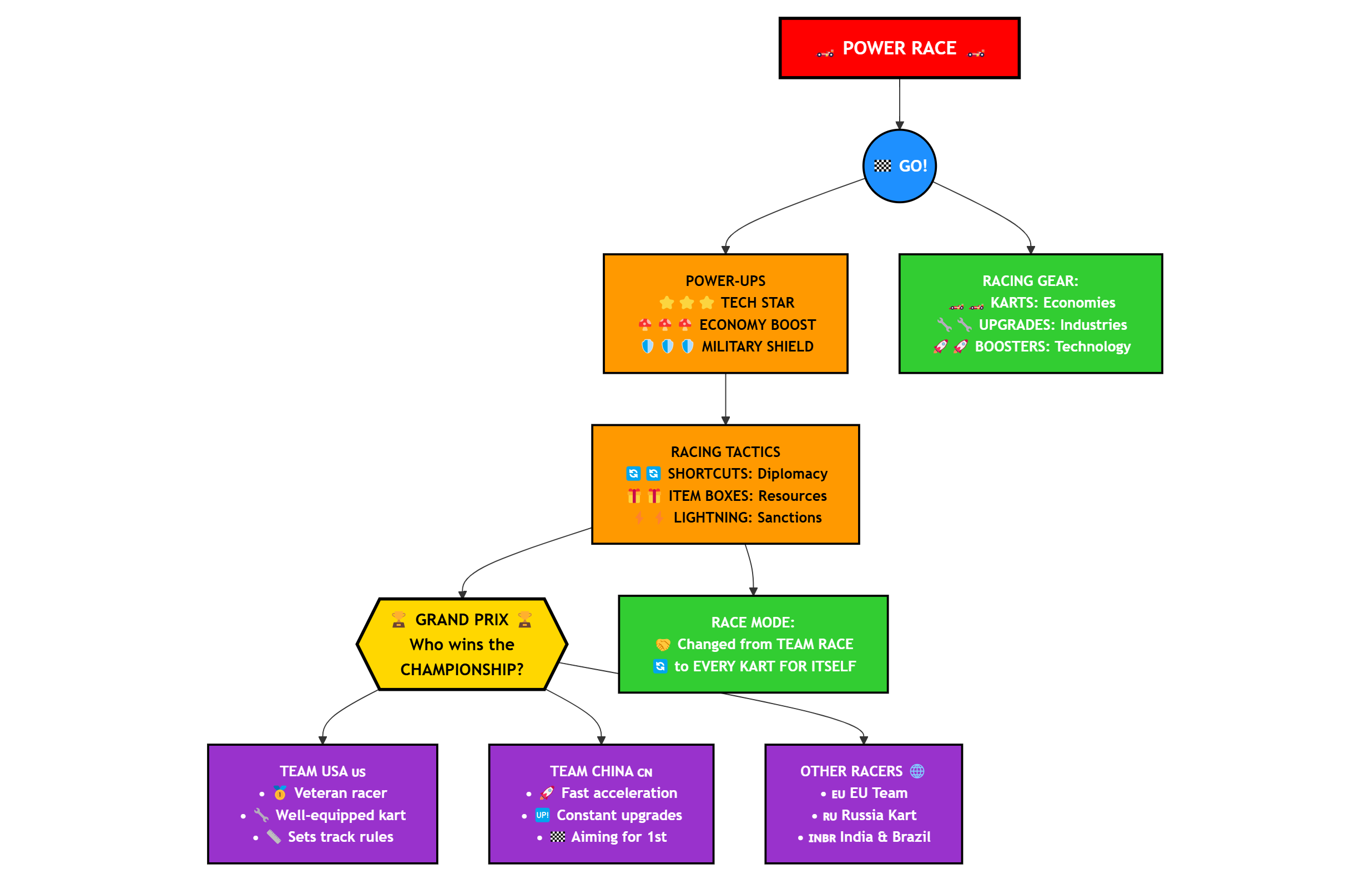
U.S.-China: Contest for Supremacy
America, still the incumbent superpower, approaches this challenge from a position of strength but also complacency to overcome. It possesses unmatched military capabilities (especially power projection – carriers, global airlift, hundreds of bases). It leads in many tech fields and has a culture of innovation driven by private enterprise and top universities, attracting talent worldwide (though that pipeline faces issues if politics curtail immigration or exchange). Critically, it also has a robust network of allies – NATO, Japan, Five Eyes intelligence, etc. – a force multiplier China largely lacks (China has partners but no comparably binding alliances). The dollar remains the global reserve currency, giving the U.S. enormous financial leverage and insulation.
Yet, American primacy is under strain. Politically, the U.S. has been polarized and inconsistent (e.g., oscillating between internationalist and nationalist administrations, which unsettles allies). Economically, its share of global GDP has declined relative to China’s meteoric rise (China is already larger in PPP terms, and could equal the U.S. in nominal GDP within a decade or two if trends hold). Militarily, the U.S. faces the challenge of stretching its forces to deter two major powers at once (Russia in Europe, China in Asia) – something it hasn’t had to do since the early Cold War before the Soviet-China split. The U.S. also grapples with overextended supply lines in a Pacific conflict scenario, whereas China would have home-field advantage.
China, the rising power, has strengths and weaknesses in this transition. Its strengths: a huge population and market, which it leverages for economic influence; a centralized state able to marshal resources for long-term goals (like mega infrastructure or industrial plans); rapid advances in education and R&D (China is producing vast numbers of STEM graduates and scientific papers, and closing the gap in fields like AI, quantum, aerospace). It has accumulated significant financial clout (largest FX reserves, major trade surpluses) and has become the top trading partner for over 100 nations – giving it diplomatic pull. It’s also building a military capable of challenging U.S. dominance regionally – including “the largest navy in the world” by ship count, potent missile forces, and space/cyber units.
However, China has vulnerabilities too. Its economic model faces headwinds: slowing growth, high debt, and an aging population (due to the one-child policy’s legacy) which could peak China’s power before it fully overtakes the U.S. Xi Jinping’s centralization of power and crackdowns on tech firms and dissent risk stifling the very dynamism and openness needed for innovation. Internationally, China’s assertiveness (in the South China Sea, border clashes with India, “wolf warrior” diplomacy) has sparked a backlash, pushing many countries closer to the U.S. orbit. Beijing often underestimates how its actions generate fear and balancing. It also lacks true allies – Russia is a tactical partner but wary; most neighbors hedge or quietly resist Chinese dominance (Japan rearming, India opposing BRI in its region, ASEAN states inviting U.S. presence as a counterweight). And China is still behind in key military areas: fewer nukes than U.S., no match to U.S. global reach (no network of bases like the U.S. has), and it relies on external sources for energy and food which could be choked in conflict.
The Taiwan question epitomizes the rivalry. Taiwan is a flashpoint where interests and ideologies clash: for China, eventual unification is a core nationalist goal; for the U.S. and its allies like Japan, Taiwan’s de facto independence is important for regional balance and as a democratic beacon. Taiwan also happens to produce 90% of the world’s most advanced chips (TSMC), making it a critical economic node – call it the “Silicon Shield,” as some analysts do, implying the world is so dependent on Taiwanese chips that it deters conflict. Yet, as China’s power grows, it may feel capable of taking Taiwan, while the U.S. faces a dilemma of how strongly to commit to Taiwan’s defense (the policy of “strategic ambiguity” leaves it open, to deter both Chinese aggression and a formal Taiwanese independence declaration). A war over Taiwan would be devastating and could escalate to U.S.-China direct confrontation – something leaders on both sides currently seem keen to avoid. The challenge is maintaining deterrence (so China doesn’t attempt force) without provocations that could trigger conflict (like an ill-timed independence push). This requires deft strategy – a hallmark realist balancing act.
For now, the U.S.-China competition manifests in shows of presence and proxy contests: freedom of navigation operations in disputed seas, jockeying for influence in third countries via aid/investment, tech and trade wars. Both engage in extensive espionage (physical and cyber) against each other. Both build up narratives: the U.S. frames it as democracy vs authoritarianism; China frames it as Western hegemony vs a fair multipolar order. But fundamentally, it’s about power hierarchy. Each wants to be number one (or at least not subservient to the other). The world has seen such power transitions before – some peaceful (UK to US), many violent (Sparta vs Athens, or France vs rising Prussia leading to the 1870 war). The saving grace is a degree of economic mutual need and the nuclear deterrent pushing caution. The risk is accidents or overconfidence – e.g., a skirmish in the South China Sea escalates, or one side misreads the other’s resolve.
Toward a Multipolar Concert?
While Washington and Beijing occupy the spotlight, the structure of the international system is broadening beyond a simple duel. Analysts increasingly describe a system where multiple centers of power assert their interests. Russia remains a nuclear superpower and a disruptive force, albeit weakened in conventional power by its Ukraine fiasco. India has demographic and economic heft that could make it the world’s third-largest economy and a military power of note, with its own great power aspirations. The European Union (or its leading states) have significant economic power and some diplomatic sway as a bloc, though both military and political fragmentation limit their independent role in great power competition. Japan is an economic titan and now flexing more strategic muscle as it departs from its post-war pacifism incrementally. Middle powers like Turkey, Brazil, Saudi Arabia, South Africa, Indonesia each have regional influence and occasionally global impact (e.g., Turkey mediating in Ukraine grain deal; Saudi dictating OPEC+ oil output affecting the global economy).
This multipolarity is being formalized in various ways: BRICS, originally a term for emerging markets, is evolving into a political grouping challenging Western dominance. In 2023, the BRICS (Brazil, Russia, India, China, South Africa) agreed to invite six new members (including oil states Saudi Arabia, UAE, and regional leaders like Egypt, Ethiopia, Iran). This expansion, as an Atlantic Council piece noted, “has the potential to fast-track the transition to a multipolar world” by uniting non-Western powers and even proposing new financial architectures. BRICS countries already account for a greater share of global PPP-GDP than the G7, and their intra-trade is soaring (fueled by commodities like Russian oil to China/India). While BRICS lack cohesion (China and India are rivals, etc.), the symbolism of a larger bloc is powerful – a counterpoint to G7. Similarly, the Shanghai Cooperation Organization (SCO) is a China-led security forum including Russia, Central Asians, India, Pakistan, and Iran – a kind of eastern parallel to NATO (though not a mutual defense pact). The mere existence of these forums signals a desire among many countries for a world not dominated by the Western clubs.
In the Middle East, the Abraham Accords brought some realignment (Arab-Israeli normalization) but new players like China stepping in shows a loosening of U.S. singular influence. In Africa and Latin America, countries are welcoming multiple partners (Chinese investment, U.S./European aid, Turkish or Gulf financing) and resisting being forced to pick sides. At the 2023 G20, Western leaders pressed others to condemn Russia’s invasion; while many did, a number of Global South states stayed neutral, more concerned with food/fuel security issues.
This trend echoes the 1950s-60s Non-Aligned Movement (NAM), where countries like Yugoslavia, India, Egypt didn’t want to be in either superpower camp. Today’s version might be described as a “multi-aligned movement” – countries trading and engaging with all, to maximize their benefits. As one Asia Society piece suggests, “countries such as India or Vietnam might be able to hinge more widely, hewing towards the US on some issues and to China on others”. We see this: Vietnam cooperates with the U.S. on security (against China’s maritime claims) but keeps China close economically; India works with Quad but buys Russian arms; the UAE hosts U.S. forces but also Huawei 5G and Russian money.
For a multipolar system to be stable, there typically needs to be a consensus on some rules of the game or at least a recognition of red lines not to cross. During the 19th century multipolar concert, for example, great powers had an implicit agreement to respect each other’s core interests (like not inciting revolutions in each other’s domains, maintaining the territorial status quo in Europe post-1815). In today’s emerging multipolarity, is there any such consensus? Possibly a shared interest in avoiding world war and nuclear conflict – that remains a universal red line. Also, perhaps a shared interest in global economic stability (all major powers suffer if world trade collapses or if climate change goes unabated, etc.). However, beyond those broad points, consensus is lacking: on human rights/norms, on internet governance, on intervention norms (West is more interventionist on humanitarian grounds, others are absolutist on sovereignty except when it suits them). The UN Security Council, supposed to manage great power consensus, is largely paralyzed when great powers disagree (vetoes ensure that).
It might be that smaller groupings of great powers will have to coordinate. Some analysts propose an informal G3 or G4 (US, China, EU, India perhaps) consultations on big issues. Others suggest revitalizing something like the P5 (the five permanent UNSC members) to hammer out deals – though with U.S.-Russia and U.S.-China relations so poor, that’s tough now. Perhaps necessity will drive creativity: climate change might force the U.S. and China to cooperate regardless of rivalry, forging some functional détente on that front. A scary scenario, conversely, is a series of regional conflicts (Ukraine, Taiwan, India-China border, MidEast flare-ups) that rage on without resolution because each sees external powers involved and thus stalemate persists.
In this fluid environment, leaders will look to history for guidance. Some will see parallels to the Cold War and seek containment or détente strategies. Others will cite the rise of Kaiser’s Germany and World War I as a cautionary tale – urging preventive measures to avoid miscalculations. Chinese commentators sometimes reference the “Century of Humiliation” to justify why China must be strong and never let foreigners dominate it again, which resonates domestically but alarms neighbors. Indian strategists often harken back to non-alignment principles of Nehru. Russian leaders channel Tsarist or Soviet-era spheres of influence logic (hence Putin’s obsession with Ukraine as historically part of Russia’s realm). These historical narratives inform current strategic culture and thus how each power approaches multipolar dynamics.
Box 4: Is the U.S. Era of Global Hegemony Over?
(A Snapshot of Indicators & Arguments in the Post-2016 Landscape, with Growing Flex of Power Politics)
1. Context & Question
Since the 1990s, the U.S. has broadly been seen as the single hegemonic power, shaping global norms through its military reach, dollar-based financial system, and leadership of key institutions (IMF, World Bank, WTO). However, several recent developments—China’s rapid expansion, the emergence of regional blocs like BRICS, and persistent U.S. domestic strains—spark debate: Are we witnessing the end of the U.S.-led unipolar moment?
Yet in this period of uncertainty about global leadership, the United States has begun flexing its muscles more overtly, sometimes even vexing traditional allies. Under the new Trump administration, a more transactional approach has replaced past soft-power overtures. Although the style has changed, the final objective remains: the U.S. will do whatever it deems necessary to preserve its dominance, up to and including harsh tactics that can hurt allied states. This stance underscores the raw logic of power politics—ultimately, those who have power wield it to remain on top, while the less powerful endure the consequences.
2. Signs of Potential Decline
- Economic Indicators
- BRICS Surpassing G7 in PPP GDP: By 2023, combined BRICS GDP (PPP) exceeded that of the G7, underlining a shift toward emerging-market growth.
- Dedollarization: While the U.S. dollar still dominates global reserves (~59% in mid-2023), its share has fallen from ~70% in 2000. Some countries (e.g., Russia, China) push alternatives (yuan swaps, gold purchases).
- Geopolitical Realignments
- Chinese Initiatives: The Belt and Road Initiative spans 140+ participating countries, offering an alternative to Western-led finance.
- Limited U.S. Leverage on Allies: Tensions arise when Washington presses for alignment on sanctions or export controls. Some allies quietly maintain or deepen economic ties with China, challenging U.S. hegemony by stealth.
- Military-Strategic Overstretch
- Concurrent Theaters: The U.S. supplies Ukraine against Russia, shores up Taiwan, and manages Middle East volatility—straining budgets and logistics.
- Technological Parity: China’s advanced missile programs, AI-driven military R&D, and naval expansion reduce the once-clear U.S. advantage.
3. Persistent U.S. Advantages
- Alliance Networks
- NATO, AUKUS, Chip 4: The U.S. orchestrates alliances with wealthier, tech-savvy partners (Europe, Japan, Korea, Australia), extending its influence and isolating rivals.
- Leverage Over Allies: Even if the U.S. approach becomes more coercive, allies often remain dependent on U.S. security guarantees and market access.
- Financial & Innovation Systems
- Dollar Supremacy: Over 85% of global forex transactions involve the USD. Commodity trades (oil, metals) remain dollar-denominated, tying global finance to Fed policy.
- Tech Leadership: The U.S. hosts over half the world’s top AI startups and leads in biotech patents, aided by unrivaled venture capital ecosystems (Silicon Valley, Boston).
- Global Public Goods & Soft Power
- Cultural Influence: U.S. media, tech platforms, and universities still attract top global talent.
- Rule-Setting Capacity: From internet governance to ISO standards, America remains influential. “Shared values” once underscored this leadership, though the new administration’s hard-power maneuvering often clashes with allied expectations.
4. Transactional Diplomacy & Power Politics
Under the second Trump administration, the United States demonstrates that realpolitik can override prior reliance on “soft” persuasion. In practice, this means:
- Allies as Pawns: Strong-arming partner nations into re-shoring advanced industries or restricting technology transfers to rivals, whether these allies benefit or not.
- Harsh Economic Moves: Imposing tariffs or investment screenings that ruffle even friendly states—asserting a “strong do what they can” stance.
- Grand Strategy for Rejuvenation: No matter the collateral damage to smaller allies, the U.S. pursues the reconsolidation of industrial and technological might on home soil, aiming to outpace both rivals and partners in critical value chains.
5. Conclusion: A Transitional Multipolar Phase with Coercive U.S. Dominance
Short Answer: The unipolar moment (1991–2016) has ended. Still, no single challenger (China or otherwise) has fully replaced the U.S. A contested multipolar environment takes shape, in which Washington remains powerful but must deploy tougher tactics—at times bruising allies—to sustain its lead.
Key Takeaway: The U.S. will continue to leverage both enduring structural advantages (alliances, currency supremacy) and increasingly transactional, coercive methods to uphold its primacy. Lofty ideals of a rules-based order often give way to raw power politics: “the strong do what they can, and the weak suffer what they must.” Whether America’s allies can accept this heightened assertiveness—and whether China or other powers find openings to erode U.S. primacy—will define the next chapter of global leadership.
The Near Future: Converging Trends
In the near term, a few key developments will indicate how the power transition is unfolding:
The trajectory of the Ukraine War
The Ukraine War now intersects with shifting U.S. policy under a second Trump term, intensifying uncertainties. If Russia falters, it may bind more tightly to Beijing, reinforcing a Sino-Russian bloc. If conflict freezes with Russian-held territory, Moscow remains a destabilizing spoiler. Meanwhile, a more transactional U.S. may deprioritize Ukraine to confront China or rebuild power at home, straining transatlantic cohesion. Some Europeans push for strategic autonomy, either rallying around rearmament or fracturing under war fatigue. Thus, the war’s outcome—plus Washington’s pivot—will determine to what extent Europe stays U.S.-led or seeks a more multipolar hedge.
Taiwan and East Asia flashpoints
Will tensions remain manageable or escalate? A stable status quo, possibly under tacit U.S.-China constraints, would keep competition below crisis levels. But a blockade, misfire, or local standoff could spiral fast, forcing nations to pick sides and accelerating bloc formation. North Korea’s unpredictable tests add another wild card, as major powers might align or oppose each other unexpectedly, testing the region’s delicate balance.
Technology races
Who dominates AI, quantum, biotech, or next-gen networks by 2030 could reorder alliances. If China’s state-driven approach outstrips others, many might see Beijing as the rising power worth courting. A U.S. lead, especially if shared with key allies (Japan, select EU states), could constrain China’s ambitions. However, Trump’s more transactional style complicates such tech coalitions, even as AUKUS (submarines, hypersonics) or U.S.-Japan quantum research aim to pool innovation. In the end, whoever masters these breakthroughs gains both economic leverage and geopolitical clout, making technology a prime battleground for great power rivalry.
Economic resilience or fracture
Whether global trade bifurcates or adapts hinges on how far decoupling goes. Intensified U.S.-China confrontation could split supply chains, standards, and financial architectures into rival blocs. Yet global business lobbies, Europe’s nuanced stance, and the U.S. quest to maximize gains—even at allies’ expense—could slow a full rupture. If partial decoupling settles into a new equilibrium, a competitive but interlinked system might persist, echoing 19th-century Europe’s interplay of rivalry and trade. Currency moves also loom large: efforts to expand yuan usage or alternative payment routes test dollar dominance, while confidence in U.S. stability may keep the greenback on top. Either way, economic dynamics remain woven into the broader power struggle.
Alliances and new security architectures
NATO’s evolution—expanded membership, deeper ties in Asia—could tilt balances, as might formalizing the Quad in the Indo-Pacific or forging fresh pacts if Washington retrenches. A Middle East security grouping might emerge if U.S. engagement wanes, or if regional players unite against threats. Meanwhile, any alliance breakdown (e.g., Turkey drifting from NATO, or the U.S. deprioritizing European defense) would reshape strategic lines. Even small shifts in alignment can alter the overall power configuration.
Domestic stability of great powers
Though realism spotlights external behavior, internal politics can undermine or bolster a state’s reach. U.S. polarization or debt struggles may erode its global leadership. China’s internal challenges—slower growth, social strains—could stall its rise or provoke more assertive policies. Russia’s future hinges on Putin’s longevity and whether a stable succession emerges. The EU’s cohesion depends on economic resilience and avoiding nationalist pulls from within. India’s path rests on sustaining growth while managing vast diversity democratically. A major internal shock in any key power would reverberate across the global balance.
In the background, transnational challenges
Climate change, pandemics, and mass migration loom as wild cards that might unite or deepen divides. A dire climate emergency could theoretically push China and the U.S. to cooperate, while failures to coordinate on resource depletion or disaster response could stoke more friction. As these cross-border crises intensify, they either become avenues for last-ditch collaboration or new catalysts for rivalry—further testing the resilience of an international system under strain from raw power competition.
Conclusion: A Hard-Line Realist Outlook
Bringing our analysis full circle, we see a world returning to fundamental principles of power and interest, albeit in new guises. Realism is vindicated as the underlying dynamic, even as it must account for modern wrinkles like technology and globalization. Hierarchy of theories: realism on top, guiding the core behavior; liberalism and others as footnotes or occasional mitigating factors when interests align or hegemons choose enlightened self-interest (for example, global trade rules or climate accords can emerge when powerful states see benefit, but they survive only while power realities support them).
We are in a period of transition – akin to other historical times when one epoch gave way to another (the interwar 1930s, or the turn of the 20th century, etc.). Such times are dangerous because the old order’s rules weaken before new ones solidify. Power competition intensifies as states test limits and jockey for advantage in the emerging order. The U.S.-China rivalry is the centerpiece, but set within a broader multipolar frame that includes rising and resurgent actors with their own agendas. The role of innovation and economic networks is central, making this a contest not just of armies and navies, but of engineers and supply chain managers, of sanctions strategists and central bankers. It is a multi-domain competition – military, economic, technological, even cultural to some extent (whose narrative wins hearts and minds).
Our tour has used historical parallels to shed light on present dynamics: Thucydides for power transition fear, the World Wars for arms race cautionary tales, the Cold War for alliance and ideological fervor, 19th century great power politics for multipolar balancing. History doesn’t repeat neatly, but it rhymes. Those parallels suggest both peril and possibility. Peril in that miscalculation or overreach could spark conflict worse than any we’ve seen since 1945 – especially with so many flashpoints and the temptation of new tech that leaders might underestimate. Possibility in that knowledge of these risks can guide statecraft to avoid pitfalls – for example, recognizing the security dilemma with China might push Washington and Beijing to better military-to-military dialogues to avert unintended clashes (like the U.S. and USSR eventually did in the Cold War); awareness of economic mutual destruction might encourage tacit rules (perhaps an agreement not to target certain crucial sectors, akin to how in WWII the US and Japan avoided using chemical weapons due to fear of retaliation – in our time, maybe a norm emerges against certain cyber-attacks on critical civilian infrastructure).
For now, however, the tone of global affairs is hard-line and competitive. Each major player is prioritizing its own strategic advantage, and cooperation is mostly transactional or within cliques. Prescriptions are few in this analysis, by design – we’ve taken a cold observer’s view. The realist perspective is often criticized as cynical or self-fulfilling, but its virtue is clarity about the true drivers of action. As we conclude, it’s worth remembering Bismarck’s quip: “Only a fool learns from his own mistakes. The wise man learns from the mistakes of others.” The world has plenty of historical mistakes to learn from as it navigates this fraught transition.
In the coming three region-specific articles, we will first focus on China, whose meteoric ascent has become the central catalyst challenging the U.S.-led order and reshaping global power relations. Next, we will examine the United States, tracking how it struggles to retain primacy in an era of domestic upheavals and “America First” imperatives. Finally, we will look at the European Union, caught between U.S. expectations and its own quest for strategic autonomy, all while contending with proximate threats. Each article will show how these major actors maneuver within the broader logic of power politics, leveraging techno-industrial ecosystems, alliances, and new economic spheres to advance their interests. Together, they will illustrate in concrete detail how the theoretical concepts here—from supply-chain realignments to strategic deterrence—play out across this contested multipolar landscape.
The conclusion of those regional analyses will aim to tie back to this overarching realist framework, evaluating whether the trends indeed consolidate a multipolar order or lead to a new dominant constellation. For now, the big picture is as we have painted: a world in flux, where power politics – enhanced and complicated by technology and interdependence – is king again. Nations large and small feel the imperative to look to their defenses, shore up their industries, and secure their interests in an environment where might, as Thucydides declared long ago, might often makes right. It is a sobering outlook, but one grounded in the strategic reality of our times.
As this hard-edged era unfolds, students of strategy would do well to keep the realist lens at the ready. It may not be optimistic, but it will likely prove accurate – and in statecraft, understanding what is must precede hopes of shaping what might be. In the end, a stable world order (if one re-emerges) will not be handed to us by providence; it will have to be negotiated and built atop the very power structures and competitions we have analyzed. Only by first seeing the world as it is – fierce, fluid, and driven by the logic of power – can wise leaders perhaps steer it toward a more secure peace.
Sources:
- Thucydides, History of the Peloponnesian War
- Mearsheimer, The Great Delusion: Liberal Dreams and International Realities
- Mearsheimer, The Tragedy of Great Power Politics (TOP 22 QUOTES BY JOHN MEARSHEIMER | A-Z Quotes)
- U.S. National Security Strategy 2017
- Gateway House analysis of Trump NSS (Trump’s NSS and Great Power competition – Gateway House)
- Asia Society on emerging multipolarity
- Georgetown Journal interview (Odd Arne Westad)
- Atlantic Council on BRICS and multipolar world
- Chatham House on geoeconomics
- CSIS on tech competition (Seth Center & Emma Bates)
- Atlantic Council on semiconductor decoupling
- Bloomberg/FinancialTimes via Atlantic Council on chip equipment restrictions (United States–China semiconductor standoff: A supply chain under stress – Atlantic Council)
- Reuters on China’s semiconductor fund
- LSE blog on techno-nationalism
- 360info on techno-nationalism quotes (Techno-nationalism – 360)
- Chatham House on China’s rare earth embargo (Geoeconomics explained | Chatham House – International Affairs Think Tank)
- Gateway House/Le Monde on Xi’s remarks about containment.
 The Carbon Compass