
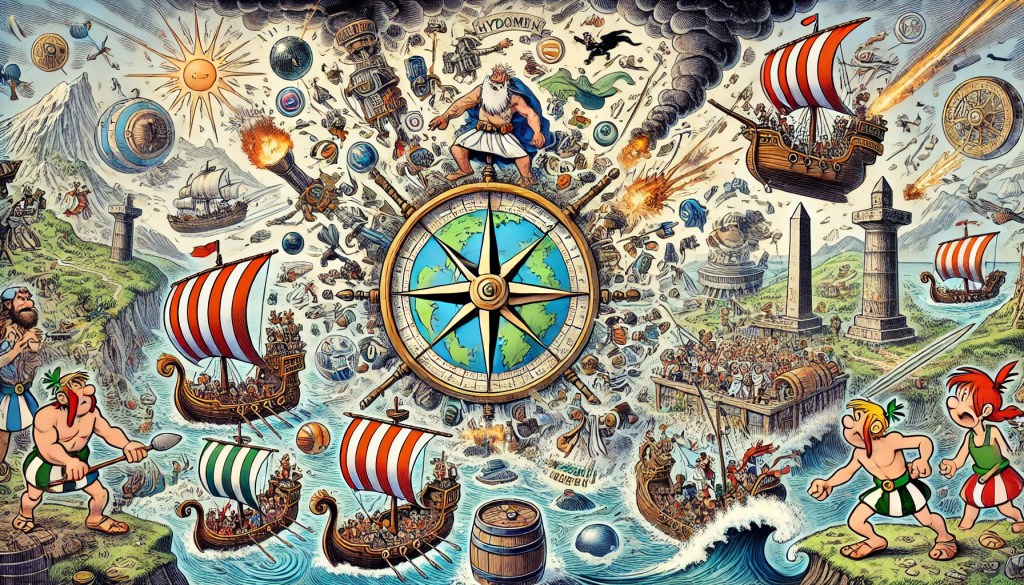
We are living through a profound era of global transformation, driven by two interconnected forces: the geopolitical race for power and the urgent need to address climate change. On one hand, nations and corporations compete for technological leadership in an increasingly fragmented world; on the other, they must cooperate to achieve net-zero goals. Technology value chains—from digital infrastructure to green solutions—sit at the crossroads of these forces, shaping national security, trade, and our collective capacity to tackle climate imperatives.
1. The Geopolitical Race for Power and Influence
The quest for power and influence has shaped history for centuries, but it is now accelerating as new powers like China challenge the long-standing dominance of the West. Traditional alliances are shifting, and terms such as “derisking,” “reshoring,” and “friendshoring” capture the desire to secure supply chains and reduce dependence on perceived rivals. Critical industrial and technological systems—once purely economic—have become strategic tools, leveraged for national security and economic resilience.
Meanwhile, Western powers continue to adapt their own strategies, navigating a landscape where cooperation and competition coexist. As a result, technology emerges as the main fault line, with AI, biotechnology, and low-carbon solutions all viewed as potential sources of geopolitical advantage.
2. Climate Change and the Need for Decarbonization
Running parallel to geopolitical competition is the existential challenge of climate change. The global community must drastically cut carbon emissions, requiring a sweeping overhaul of energy systems. Technologies like green hydrogen, CCUS, batteries, and renewable energies are essential to meet this challenge. Yet, these very solutions are often subject to great-power rivalries over who leads in critical raw materials, manufacturing, and intellectual property.
This dynamic creates a dual reality: decarbonization technologies are urgently needed worldwide, yet fragmented value chains and geopolitical tension threaten to slow progress. Balancing national interests with the shared imperative to reduce emissions becomes ever more complex in a world where technological leadership conveys both economic power and geopolitical influence.
3. The Intersection of Technology, Power, and Climate Action
At the heart of both competition and cooperation is technology—the key to addressing climate change yet also a central battleground for global dominance. Leading in critical value chains grants not only economic rewards but also strategic leverage. However, as nations scramble to reorganize and secure these supply lines, there is a risk of heightening fragmentation and delaying collective climate action.
4. The Purpose of The Carbon Compass
Against this backdrop, The Carbon Compass was created to decode and simplify the reconfiguration of global industrial and technological value chains, shaped by climate imperatives on one side and geopolitical competition on the other. By adopting a systemic framework centered on low-carbon technologies, competitiveness, and resilience, The Carbon Compass aims to:
- Track the Development of Low-Carbon Technologies
Monitor the innovation, scaling, and commercialization of solutions vital to the energy transition—assessing not just technical advances but also their economic feasibility and geopolitical significance. - Understand the Restructuring of Value Chains
Examine how trade policies, supply-chain realignments, and geopolitical shifts drive the reorganization of global manufacturing and resource flows—particularly for green and digital technologies. - Analyze Technology’s Role in Power Dynamics
Explore how technological leadership and control over critical materials have become key levers of influence, reshaping industrial strategies and affecting climate objectives.
The Carbon Compass strives to provide a balanced, fact-based perspective, bridging technical, economic, and geopolitical analyses to clarify the complex interplay between climate action and the geopolitical race for dominance. By breaking down the forces shaping today’s value chains into an accessible, systemic view, this platform seeks to spark practical insights and more informed decision-making.
5. My Commitment
The mission is straightforward yet ambitious:
- Decode the technological and geopolitical realities that define the race for decarbonization.
- Explain how global supply chains, particularly in green tech, are evolving amid growing competition.
- Contribute to a deeper understanding of how collective efforts can still thrive in a fragmented world and guide us toward a more resilient, low-carbon future.
By illuminating where and how climate priorities intersect with international power plays, The Carbon Compass empowers readers to engage with the energy transition from a systemic, forward-looking vantage point.
 The Carbon Compass